
DIY Vertical Wind Turbine for Home: Your Ultimate Guide to Harnessing Backyard Breeze
Imagine generating your own clean electricity, right from your backyard. The hum of a wind turbine spinning, not just powering a light, but empowering your independence. Sound appealing? You’re not alone. Many homeowners are eyeing renewable energy, and the idea of building a DIY Vertical Axis Wind Turbine (VAWT) for home use is incredibly tempting. It’s a hands-on project that connects you directly to sustainable living.
Table of Contents
- DIY Vertical Wind Turbine for Home: Your Ultimate Guide to Harnessing Backyard Breeze
- Why Build a DIY Vertical Axis Wind Turbine (VAWT)? The Home Advantage
- The Allure of DIY Renewable Energy
- VAWT vs. HAWT: Why Vertical Might Be Your Better Bet
- Realistic Expectations: What a Home VAWT Can (and Can’t) Do
- Choosing Your DIY VAWT Design: Types and Considerations
- Savonius VAWT: The Drag-Driven Workhorse
- Darrieus VAWT: The Lift-Driven Powerhouse
- Hybrid Designs and Emerging Concepts (e.g., Helix/Zoetrope)
- Essential Components for Your DIY Vertical Wind Turbine
- Blades: Shape, Material, and Aerodynamics
- The Rotor & Shaft: Stability is Key
- The Generator: AC vs. DC and Power Output
- Mounting Structure: Anchoring Your Powerhouse
- Electrical System: Beyond the Spin
- Step-by-Step Guide: Building a Basic Savonius VAWT (A Beginner-Friendly Approach)
- Tools and Materials Checklist
- Constructing the Blades
- Assembling the Rotor and Shaft
- Integrating the Generator
- Erecting the Mount and Wiring
- Initial Testing and Troubleshooting
- Safety First: Critical Precautions for Your DIY Build
- Optimizing Your VAWT’s Performance and Longevity
- Siting Your Turbine for Maximum Wind Exposure
- Maintenance Tips for DIY Longevity
- Integrating with Your Home Energy System
- The Cost of DIY vs. Commercial Small Wind Turbines
- Beyond the Build: Legality and Local Regulations
- Is a DIY VAWT Right for Your Home?
But let’s be real: is it truly feasible? What does it involve? And what can you realistically expect from a homemade wind turbine? This isn’t just a fantasy; it’s a practical guide to help you understand the ‘how-to,’ the ‘why,’ and the ‘what if’ of bringing a vertical wind turbine to life at your home. We’ll cut through the noise, give you the unvarnished truth, and equip you with the knowledge to decide if this exciting project is right for you.
Why Build a DIY Vertical Axis Wind Turbine (VAWT)? The Home Advantage
Before we dive into blueprints and wiring, let’s talk motivation. Why choose a VAWT, especially for a DIY project focused on home use?
The Allure of DIY Renewable Energy
The drive to build your own power source comes from a powerful place: energy independence. Imagine reducing your reliance on the grid, or at least supplementing your energy needs with power you’ve generated yourself. Beyond the practical savings, there’s immense satisfaction in learning, building, and contributing to a greener planet. It’s a tangible step towards sustainability, and a fantastic educational project for you and your family.
VAWT vs. HAWT: Why Vertical Might Be Your Better Bet
When most people think ‘wind turbine,’ they picture the giant, propeller-like Horizontal Axis Wind Turbines (HAWTs). But for home-scale DIY, VAWTs often offer distinct advantages:
- Omnidirectional: VAWTs don’t need to ‘turn into the wind.’ They capture wind from any direction, which is a huge plus in turbulent urban or suburban environments where wind patterns can shift rapidly.
- Lower Noise Profile: Generally, VAWTs tend to be quieter than HAWTs, making them more neighbor-friendly in residential areas.
- Easier Maintenance: Most of a VAWT’s moving parts (like the generator) are located at the base of the turbine, simplifying maintenance and repairs compared to climbing a tall HAWT tower.
- Aesthetics & Safety: Their often-unique designs can be more visually appealing, and with a lower center of gravity, they can sometimes be perceived as safer or less obtrusive. They’re also often considered more bird-friendly.
Here’s a quick comparison:
| Feature | Vertical Axis Wind Turbine (VAWT) | Horizontal Axis Wind Turbine (HAWT) |
|---|---|---|
| Wind Direction | Omnidirectional (no yaw mechanism needed) | Needs to face into the wind (requires yaw system) |
| Starting Wind Speed | Generally lower (especially Savonius types) | Generally higher, requires blades to ‘catch’ wind |
| Noise Output | Often quieter | Can be louder due to tip speed and gearbox |
| Efficiency | Typically lower than HAWTs for similar swept area | Generally higher, more common for large-scale power |
| Maintenance | Easier, components often at ground level | Requires tower climbing for many components |
| DIY Complexity | Can be simpler due to design flexibility | Often requires precision blade design and balancing |
Realistic Expectations: What a Home VAWT Can (and Can’t) Do
It’s crucial to manage expectations. A DIY home VAWT is unlikely to power your entire house, especially if you’re starting small. Think of it as a supplementary power source or a battery charger. It’s fantastic for:
- Charging a bank of deep-cycle batteries for off-grid lighting or small appliances.
- Providing power to remote sheds, gates, or security cameras.
- Reducing your grid consumption slightly, if integrated with a proper inverter and charge controller.
- An incredible learning experience about renewable energy systems.
Don’t expect to run your air conditioner or electric stove solely on a DIY VAWT. It’s about taking steps towards energy independence, one project at a time.
Choosing Your DIY VAWT Design: Types and Considerations
Not all VAWTs are created equal. The two most common types you’ll encounter in the DIY world are the Savonius and the Darrieus, each with its own quirks and advantages.

Savonius VAWT: The Drag-Driven Workhorse
The Savonius turbine is probably the most common and easiest VAWT for a beginner to build. It typically uses two or more ‘scoops’ or half-cylinders to catch the wind. Think of cutting a barrel in half vertically and offsetting the two halves.
- Pros: Very simple to construct, excellent self-starting capabilities even in low wind speeds, robust design.
- Cons: Generally less efficient for power generation compared to lift-based designs. It relies on drag, which isn’t as efficient as lift.
- DIY Suitability: High. Materials like PVC pipe, old barrels, or sheet metal are readily available. Perfect for learning the ropes.
Darrieus VAWT: The Lift-Driven Powerhouse
The Darrieus turbine is characterized by its slender, airfoil-shaped blades, often in an egg-beater (or ‘troposkien’) shape or straight vertical blades. It generates power through aerodynamic lift, much like an airplane wing.
- Pros: Much more efficient than Savonius designs, capable of higher power output in stronger winds.
- Cons: Requires higher wind speeds to self-start (often needs external help to begin spinning), blades are more complex to design and fabricate accurately.
- DIY Suitability: Medium to High. While more challenging, resourceful DIYers can construct blades from materials like PVC pipe cut into airfoils, or even custom-molded composites.
Hybrid Designs and Emerging Concepts (e.g., Helix/Zoetrope)
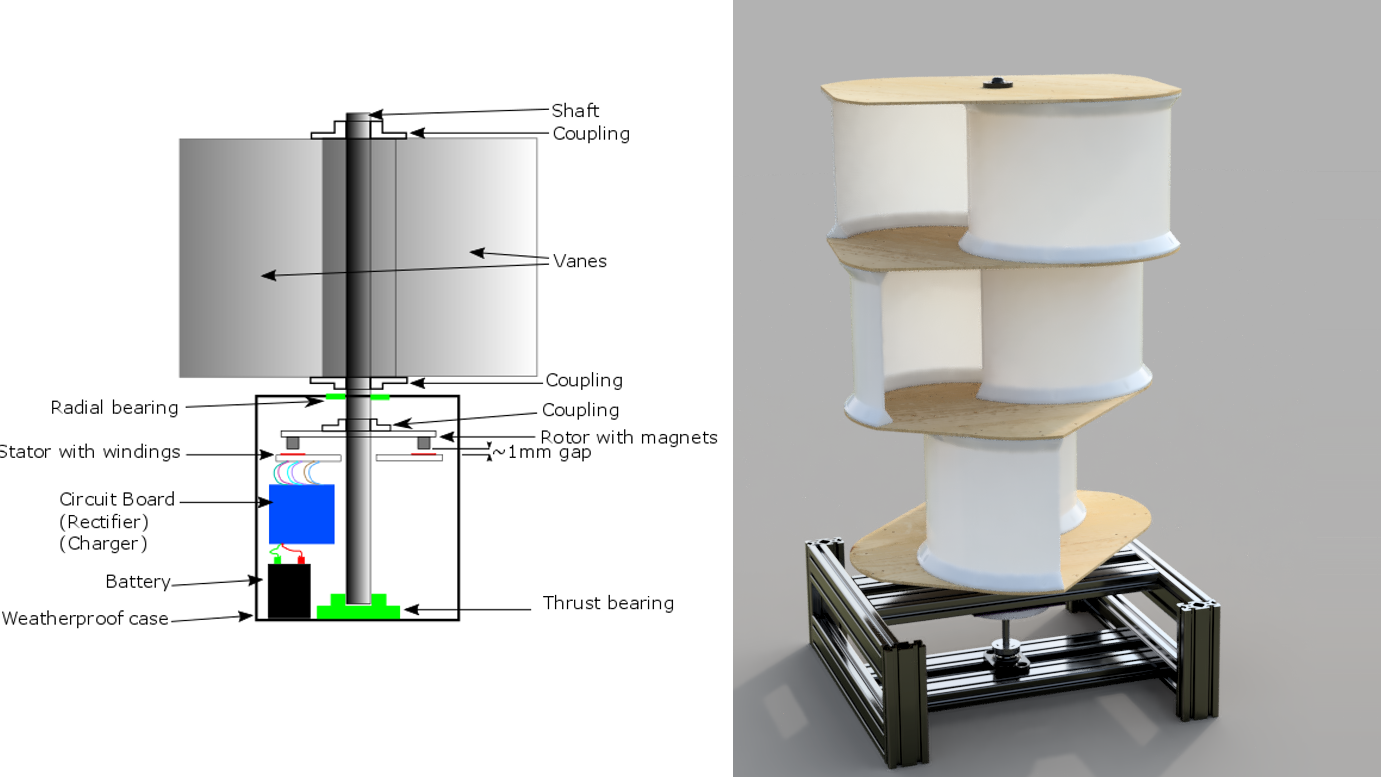
The world of VAWTs is constantly evolving. Hybrid designs combine features of Savonius and Darrieus turbines to overcome individual limitations. For example, a small Savonius rotor at the bottom might help a Darrieus rotor self-start. Concepts like the helical Savonius (where the scoops spiral up the central axis) offer smoother operation and potentially better efficiency by spreading the blade surface. The ‘Zoetrope’ design, mentioned in some resources, often refers to a type of Darrieus or modified Savonius VAWT that aims for simplicity and common materials.
| VAWT Type | Principle | DIY Complexity | Starting Speed | Efficiency Potential |
|---|---|---|---|---|
| Savonius | Drag-driven | Low | Very Low (self-starting) | Low to Moderate |
| Darrieus | Lift-driven | Medium to High | Moderate to High (often needs boost) | Moderate to High |
| Hybrid/Helical | Drag/Lift combination | Medium | Low (improved self-starting) | Moderate |
Essential Components for Your DIY Vertical Wind Turbine
Regardless of the design, a VAWT for home use needs several key components to function safely and effectively. Understanding these will help you gather materials and plan your build.
Blades: Shape, Material, and Aerodynamics
The blades are where the magic happens – they catch the wind! For DIY VAWT blades, common materials include:
- PVC Pipe: Affordable, easy to cut and shape, good for Savonius designs.
- Sheet Metal (Aluminum, Steel): Durable, but requires specific tools for cutting and bending. Great for robust Savonius or straight-bladed Darrieus.
- Wood: Can be used for custom airfoils, but requires sealing and protection from weather. Adds weight.
- Recycled Materials: Think old barrels, road cones, or even satellite dishes (with modification).
For any blade material, balance is critical. An unbalanced rotor will vibrate excessively, leading to premature wear and potential failure. You’ll need to ensure all blades are identical in size, shape, and weight, and are mounted symmetrically.
The Rotor & Shaft: Stability is Key
The rotor is the assembly of blades and end plates that spins. The shaft is the central pole or axle around which the rotor rotates. This needs to be incredibly sturdy and well-supported.
- Shaft Material: Strong metal pipe (e.g., galvanized steel) or solid rod is essential.
- Bearings: High-quality, sealed bearings (like pillow block bearings or flange bearings) are non-negotiable. They reduce friction, allow smooth rotation, and determine the lifespan of your turbine. Don’t skimp here!
- End Plates: These sturdy discs (made from wood, metal, or thick plastic) hold the blades in place at the top and bottom, connecting them to the central shaft.
The Generator: AC vs. DC and Power Output
This is where kinetic energy (wind) becomes electrical energy. For DIY projects, you’ll typically look at:
- Repurposed Motors: Many DC motors can act as generators when spun. Treadmills, washing machines, or car alternators can sometimes be modified, though efficiency can vary.
- Permanent Magnet Alternators (PMAs): These are often preferred for small wind turbines as they produce AC current directly and are designed for continuous operation. You can buy small PMAs specifically for DIY wind projects.
The voltage and amperage produced will depend on the generator’s design and the turbine’s rotational speed. You’ll likely be dealing with low-voltage DC (if rectified from AC) suitable for battery charging.
Mounting Structure: Anchoring Your Powerhouse
Your turbine needs a stable base. This could be:

- A Pole Mount: A robust pole (metal, often guyed with wires for stability) embedded in concrete. This is common for smaller turbines.
- A Roof Mount: More complex, as it requires careful consideration of roof integrity, vibration, and local regulations. Generally not recommended for beginners due to structural risks.
The height of your mount is crucial for catching unobstructed wind, but also affects stability. Always err on the side of over-engineering for stability.
Electrical System: Beyond the Spin
Getting power from your turbine to your devices involves a few more pieces:
- Rectifier (if AC generator): Converts the AC output from the generator into DC, which is necessary for charging batteries.
- Charge Controller: Essential! This device protects your batteries from overcharging and prevents power from flowing back to the turbine when the wind isn’t blowing.
- Batteries: Deep-cycle batteries (like those used in RVs or marine applications) are needed to store the energy generated.
- Inverter (optional): If you want to power standard AC household appliances, you’ll need an inverter to convert the DC power from your batteries back into usable AC.
Step-by-Step Guide: Building a Basic Savonius VAWT (A Beginner-Friendly Approach)
Let’s outline the process for building a simple, yet effective, Savonius VAWT. This is a foundational project that will teach you the core principles.
Tools and Materials Checklist
For a basic Savonius VAWT, you’ll need:
- Blades: One 10-foot section of 8-inch diameter PVC pipe.
- End Plates: Two 12-inch diameter circular pieces of 3/4-inch plywood or sturdy plastic.
- Shaft: One 4-foot section of 1-inch galvanized steel pipe or solid rod.
- Bearings: Two 1-inch pillow block or flange bearings.
- Generator: A small permanent magnet DC motor (e.g., from an old treadmill) or a dedicated small PMA (e.g., 12V, 50W).
- Mounting: A sturdy metal pole, concrete mix, guy wire kit.
- Electrical: Charge controller (12V), 12V deep-cycle battery, heavy-gauge wire, voltmeter, rectifier (if using AC PMA).
- Tools: Saw (jigsaw, circular saw), drill, sandpaper, tape measure, marking pen, wrenches, screwdriver, level, safety glasses, gloves.
Constructing the Blades
- Cut the PVC: Carefully cut the 10-foot PVC pipe into two 5-foot sections. Then, cut each 5-foot section exactly in half lengthwise. You’ll end up with four half-cylinders.
- Shape the Blades: Take two of these half-cylinders. You’ll mount them opposite each other around the central shaft, slightly offset to create the ‘scoop’ effect. Sand any rough edges.
- Prepare End Plates: Find the center of your plywood circles. Mark evenly spaced holes where your blades will attach.
Assembling the Rotor and Shaft
- Mount Blades to End Plates: Secure your two PVC half-cylinders to the end plates using bolts, ensuring they are perfectly parallel and diametrically opposed. Ensure an overlap or offset that creates the scoop effect (e.g., one edge of each half-cylinder overlaps the center shaft).
- Attach Shaft: Mount one pillow block bearing to the center of the bottom end plate and another to the top end plate (or a separate bracket). Insert your steel pipe shaft through the bearings and secure it. The rotor should spin freely on the shaft.
Integrating the Generator
- Mount Generator: Attach your chosen generator securely to the bottom of the mounting pole, directly beneath the turbine shaft.
- Connect Rotor to Generator: Use a pulley system, direct drive coupler, or bicycle chain and sprockets to connect the main turbine shaft to the generator’s input shaft. Ensure a smooth, secure connection without excessive friction or wobble.
Erecting the Mount and Wiring
- Dig Foundation: Dig a post hole deep enough for your mounting pole (typically 2-3 feet deep for a 10-foot pole, ensure it’s below the frost line).
- Set Pole: Place the pole in the hole, ensure it’s perfectly vertical with a level, and pour concrete around it. Use guy wires during setting to hold it stable. Let the concrete cure fully (several days) before mounting the turbine.
- Mount Turbine: Once the pole is secure, lift and mount your assembled turbine onto the pole, ensuring the generator connection is sound.
- Wire It Up: Connect the generator output to your rectifier (if needed), then to the charge controller, and finally to your deep-cycle battery. Always follow wiring diagrams for your specific charge controller and generator. Use appropriate gauge wire.
Initial Testing and Troubleshooting
Once everything is connected and the concrete is cured, it’s time to test:
- Check for Spin: In a gentle breeze, does the turbine spin freely? Is it balanced? Any strange noises or wobbles?
- Measure Output: Use a voltmeter to check the voltage at the charge controller’s battery terminals. It should show charging voltage when the turbine spins.
- Common Issues: No spin (too much friction, wind too low, unbalanced), no power output (loose wiring, faulty generator/controller, rectifier issue).
Safety First: Critical Precautions for Your DIY Build
Working with power tools, heights, and electricity carries inherent risks. Safety must be your absolute top priority.
- Personal Protective Equipment (PPE): Always wear safety glasses, gloves, and appropriate footwear.
- Power Tools: Understand how to use all your tools safely. Never work alone, especially with saws or drills.
- Electrical Safety: Always disconnect power before working on wiring. Double-check all connections. If you’re unsure about wiring, consult a qualified electrician. Water and electricity are a dangerous mix; ensure all outdoor electrical components are weatherproof.
- Working at Heights: Use stable ladders or scaffolding. Never overreach. Have someone spot you.
- Turbine Stability: Ensure your mounting pole is incredibly secure. Wind forces can be immense, especially during storms. Guy wires are highly recommended for any pole over 8-10 feet tall.
- Moving Parts: Never approach or touch a spinning turbine. Keep children and pets away from the operational area.
Optimizing Your VAWT’s Performance and Longevity
Building it is one thing; making it perform well and last is another. A few considerations can make a big difference.
Siting Your Turbine for Maximum Wind Exposure
This is arguably the most important factor for wind turbine performance. Wind is not a constant, and it’s affected by everything around it.
- Clear Airflow: Mount your turbine above and away from obstructions like trees, buildings, and fences. Aim for at least 20 feet higher than anything within 300 feet.
- Wind Assessment: Before you build, spend some time observing wind patterns in your yard. Use a simple anemometer if you can, or even just watch flags and tree movement.
- Local Regulations: Double-check local zoning laws, HOA rules, and potential permit requirements for tower height and turbine placement.
Maintenance Tips for DIY Longevity
A DIY turbine needs love to keep spinning efficiently.
- Regular Inspections: Periodically check for loose bolts, frayed wires, blade damage, or rust.
- Bearing Lubrication: If your bearings aren’t sealed, they’ll need regular lubrication as per manufacturer instructions. Even sealed bearings should be checked for smooth operation.
- Electrical Connections: Inspect all wiring for corrosion or loose connections. Tighten terminals as needed.
- Balance Check: Over time, material changes or debris accumulation can unbalance the rotor. If you notice increased vibration, recheck the balance.
Integrating with Your Home Energy System
For a basic setup, your VAWT will likely charge a dedicated battery bank that powers specific DC loads (like LED lights) or an inverter for a few AC appliances. If you’re looking for more sophisticated integration, such as a grid-tied system that feeds power back into your home’s main electrical panel, you’ll need professional assistance. Grid-tie systems involve complex safety features, certifications, and strict electrical codes, making them unsuitable for most DIY efforts.
The Cost of DIY vs. Commercial Small Wind Turbines
The appeal of DIY often includes the promise of cost savings. While a DIY VAWT can be cheaper upfront, it’s essential to consider the full picture.
| Factor | DIY Vertical Wind Turbine | Commercial Small Wind Turbine |
|---|---|---|
| Initial Material Cost | $100 – $500 (can vary wildly based on scrounged parts) | $500 – $5,000+ (for turbine head only) |
| Labor/Time Investment | Significant personal time for design, build, troubleshoot | Minimal personal assembly, professional installation often required |
| Power Output | Often 50W – 200W peak (depends on design, wind) | 500W – 5,000W+ peak (designed for consistent output) |
| Durability/Longevity | Highly variable, depends on build quality and materials | Designed for years of outdoor operation, warranties often included |
| Safety/Certifications | DIY standards, no official certifications | Tested to industry standards, often certified |
| Educational Value | Extremely High | Low |
While the monetary cost of materials for a DIY build might be lower, your time is a significant investment. Moreover, a commercial turbine is engineered for optimal performance, safety, and longevity, often offering a much higher power output for its size. The true ‘cost savings’ of DIY might come from the experience and the satisfaction, rather than purely the kilowatt-hours generated.
Beyond the Build: Legality and Local Regulations
Before you even buy your first piece of PVC, check your local laws! Wind turbines, even small ones, are subject to:
- Zoning Ordinances: Many municipalities have restrictions on height, setback from property lines, and noise.
- Permits: You’ll almost certainly need a building permit for any structure over a certain height, and potentially an electrical permit if you’re connecting to your home’s wiring.
- Homeowners Association (HOA) Rules: If you live in an HOA, they often have strict aesthetic guidelines that might prohibit a wind turbine.
- Utility Interconnection: If your goal is to feed power back into the grid, you’ll need to work with your utility company, which has specific requirements for grid-tied systems.
Ignorance of the law is not an excuse. A quick call to your local planning department or a check of your HOA bylaws can save you a lot of headache and potential fines down the road.
Is a DIY VAWT Right for Your Home?
Building a DIY vertical wind turbine for your home is an incredibly rewarding project. It’s a journey into renewable energy, a practical exercise in engineering, and a testament to your commitment to sustainability. You’ll learn invaluable skills, gain a deeper understanding of electricity, and contribute to your energy independence.
However, it’s also a project that demands patience, research, and a healthy respect for safety. It’s best approached as a passion project or a supplementary power source for charging batteries or specific off-grid loads, rather than a primary means to zero out your electric bill overnight. If you’re driven by the desire to learn, to build with your own hands, and to make a tangible, green impact, then absolutely, a DIY VAWT could be a fantastic endeavor for your home. Just go into it with open eyes, a willingness to learn, and a commitment to doing it safely and smartly.
Frequently Asked Questions
How much power can a DIY vertical wind turbine generate for a home?
A typical DIY vertical wind turbine for home use is best suited for supplementary power, often generating between 50W to 200W peak in good wind conditions. It’s usually enough to charge a 12V deep-cycle battery bank, power small DC loads like LED lights, or provide energy for remote applications like security cameras. It’s generally not sufficient to power an entire house or large appliances.
What are the easiest materials to use for a DIY VAWT?
For beginners, readily available and easy-to-work-with materials are key. PVC pipe (for blades), plywood or sturdy plastic (for end plates), and galvanized steel pipe or solid rod (for the shaft) are excellent choices. These are affordable, accessible at most hardware stores, and suitable for building robust Savonius-style VAWTs.
Is a DIY vertical wind turbine safe to install at home?
Safety is paramount. While a DIY VAWT can be safe, it involves working with power tools, heights, and electricity, which all carry inherent risks. Always use proper personal protective equipment, ensure your mounting structure is incredibly stable and properly anchored, and follow strict electrical safety guidelines. If you are unsure about any electrical connections, consult a qualified electrician. Never work on a spinning turbine.
Do I need permits or permission to build a DIY wind turbine?
Yes, it’s highly likely. Most municipalities have zoning ordinances that dictate structure height, setback from property lines, and sometimes even aesthetic requirements. You will almost certainly need a building permit for the tower structure, and an electrical permit if you’re integrating it with your home’s wiring. Homeowners Associations (HOAs) also often have strict rules. Always check with your local planning department and HOA before starting any construction.
How efficient are DIY vertical wind turbines compared to commercial ones?
DIY vertical wind turbines are generally less efficient than commercially engineered turbines. Commercial turbines are optimized for aerodynamics, material science, and generator design to maximize power output and durability. A DIY turbine’s efficiency is highly dependent on the builder’s skill, design choices, and available materials, often prioritizing simplicity and cost-effectiveness over peak efficiency. They excel in educational value and personal satisfaction more than raw power output.
Can a DIY VAWT be connected to the grid?
Connecting a DIY VAWT directly to your home’s main electrical grid (grid-tying) is highly complex, expensive, and generally not recommended for DIY projects. It requires specialized grid-tie inverters, strict adherence to electrical codes, utility company approval, and often professional installation to ensure safety and compliance. Most DIY VAWTs are best suited for off-grid applications or charging a dedicated battery bank that powers specific DC or inverter-fed AC loads.
