
Unpacking Wind Turbine Maximum Power Output: The Definitive Guide
Ever gazed at those towering wind turbines, silently slicing through the air, and wondered: “How much power can one of those things *really churn out?” You’re not alone. It’s a question at the heart of understanding renewable energy, and it’s more nuanced than a simple number. Let’s dive straight into the impressive capabilities of wind turbines, from the smallest residential units to the colossal offshore giants.
Table of Contents
- Unpacking Wind Turbine Maximum Power Output: The Definitive Guide
- What is “Maximum Power Output” for a Wind Turbine?
- Rated Capacity vs. Actual Generation: Understanding the Core Difference
- Average & Peak Power Output: The Numbers You Need to Know
- The Giants Among Us: Most Powerful Wind Turbines Today
- Engineering for Power: Factors Influencing Max Output
- Wind Speed: The Primary Driver
- Rotor Diameter: Sweeping More Air
- Hub Height: Tapping Into Stronger, More Consistent Winds
- Generator Efficiency: Turning Mechanical into Electrical Power
- Control Systems & Software: Optimizing Performance
- The Reality Check: Capacity Factor & Real-World Generation
- How Many Homes Can a Wind Turbine Power? (Updated Calculations)
- The Future of Wind Turbine Power: Bigger, Smarter, Stronger
In the U.S., the average capacity of newly installed onshore wind turbines in 2023 hovered around 3.4 megawatts (MW). But that’s just an average, and it represents their maximum rated capacity, not their constant output. The true potential for power generation is influenced by a symphony of engineering, physics, and, of course, the ever-unpredictable wind.
What is “Maximum Power Output” for a Wind Turbine?
When you hear about a wind turbine’s power, it’s typically referring to its rated capacity, also known as nameplate capacity. This is the maximum electrical power (in kilowatts or megawatts) that the generator is designed to produce under ideal wind conditions.
Rated Capacity vs. Actual Generation: Understanding the Core Difference
Think of it like the top speed of a sports car. It can* go 200 mph, but it rarely does on your daily commute. Similarly, a wind turbine’s rated capacity is its theoretical peak. In reality, a turbine rarely operates at this maximum for extended periods. Why?
- Wind Variability: Wind speeds are constantly changing. They fluctuate throughout the day, across seasons, and due to local topography.
- Operational Limits: Turbines have cut-in speeds (when they start generating power) and cut-out speeds (when they shut down to prevent damage in extreme winds).
- Maintenance: Like any complex machinery, turbines require downtime for maintenance.
This brings us to a crucial concept: capacity factor. It’s the ratio of a turbine’s actual energy output over a period (usually a year) to its maximum possible output if it operated at its rated capacity continuously. For example, a 5 MW turbine with a 40% capacity factor would produce, on average, 2 MW of power over the year.
Average & Peak Power Output: The Numbers You Need to Know

Wind turbine technology is advancing at a breathtaking pace, meaning what was considered “big” a decade ago is now standard, and what’s standard today will be dwarfed by tomorrow’s innovations.
- Average Onshore Turbine Output: As of 2023, new onshore turbines in the U.S. average around 3.4 MW. These are typically installed in wind farms across plains, hills, and agricultural areas.
- Average Offshore Turbine Output: Offshore turbines, benefiting from stronger and more consistent coastal winds, are significantly larger. New installations commonly range from 8 MW to 15 MW, with even larger models on the horizon.
- Small-Scale/Residential Turbine Output: For homes or small businesses, turbines range from a few hundred watts (W) to 100 kilowatts (kW). These are designed for distributed generation, often complementing solar panels.
To give you a clearer picture, here’s a comparative table:
| Turbine Category | Typical Rated Capacity | Rotor Diameter Range (Approx.) | Hub Height Range (Approx.) |
|---|---|---|---|
| Small-Scale/Residential | 500 W – 100 kW | 1.5 – 20 meters | 10 – 30 meters |
| Commercial Onshore | 2 MW – 6 MW | 90 – 150 meters | 80 – 160 meters |
| Commercial Offshore | 8 MW – 18 MW+ | 160 – 280 meters+ | 120 – 200 meters+ |
The Giants Among Us: Most Powerful Wind Turbines Today
The race for the largest and most powerful wind turbine is fierce, driven by the economics of scale. Bigger turbines can capture more wind, generate more electricity per installation, and ultimately lower the cost of energy. Here are some of the current record-holders and leading models:
- MingYang Smart Energy MySE 16.0-260: This offshore behemoth boasts a staggering 16 MW capacity and a rotor diameter of 260 meters – larger than five Boeing 747s parked nose-to-tail! It’s designed for extreme wind conditions and deep-sea deployments.
- Vestas V236-15.0 MW: With a 15 MW rating and a 236-meter rotor, this turbine is a key player in the next generation of ultra-large offshore wind farms. Its sheer size allows it to capture a vast amount of wind energy.
- GE Haliade-X: Originally launched as a 12 MW platform, the Haliade-X has seen upgrades to 13 MW, 14 MW, and even 15.5 MW variants. Its 220-meter rotor diameter (for the 12 MW version) set new industry standards and is deployed in significant offshore projects globally.
- Siemens Gamesa SG 14-222 DD & SG 14-236 DD: These direct-drive offshore turbines offer flexible power ratings, typically around 14-15 MW, with impressive rotor diameters. Siemens Gamesa is a dominant force in the offshore market.
These colossal machines are engineering marvels, designed to withstand immense forces while efficiently converting wind into clean electricity. Their development underscores the industry’s commitment to maximizing output and efficiency.
| Turbine Model | Rated Capacity (MW) | Rotor Diameter (m) | Hub Height (m, est.) | Type |
|---|---|---|---|---|
| MingYang MySE 16.0-260 | 16 | 260 | ~150-180 | Offshore |
| Vestas V236-15.0 MW | 15 | 236 | ~120-150 | Offshore |
| GE Haliade-X (15.5 MW variant) | 15.5 | 220 | ~120-140 | Offshore |
| Siemens Gamesa SG 14-236 DD | 14-15 | 236 | ~120-150 | Offshore |
| Nordex N175/6.X | 6.8 | 175 | ~100-164 | Onshore |
Note: Specifications can vary based on specific project configurations and ongoing development.
Engineering for Power: Factors Influencing Max Output
Achieving maximum power output isn’t just about making things bigger; it’s about sophisticated engineering that optimizes every component to harness as much wind energy as possible. Here’s a breakdown:
Wind Speed: The Primary Driver
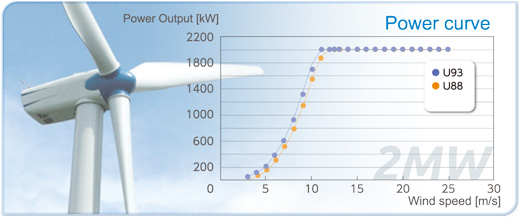
This is arguably the most critical factor. The power available in the wind is proportional to the cube of the wind speed. What does that mean? If the wind speed doubles, the power increases by a factor of eight (2x2x2=8)! This exponential relationship is why wind farm siting is so crucial.
- Cut-in Speed: The minimum wind speed (typically 3-4 m/s or 7-9 mph) at which the turbine begins to generate power.
- Rated Speed: The wind speed (typically 12-15 m/s or 27-34 mph) at which the turbine reaches its maximum rated power output. Beyond this, the turbine’s control systems start to regulate power to prevent overloading.
- Cut-out Speed: The maximum wind speed (typically 25 m/s or 56 mph) at which the turbine safely shuts down to avoid damage from extreme gusts.
Rotor Diameter: Sweeping More Air
The rotor, which includes the blades, is the “collector” of wind energy. The longer the blades, the larger the area they sweep, and the more energy they can capture. The power available from the wind is proportional to the square of the rotor diameter. So, a turbine with double the blade length can sweep four times the area (2×2=4), significantly increasing potential output.
Modern blades are not just long; they are incredibly sophisticated aerodynamic structures, designed with specialized airfoils (shapes) to maximize lift and minimize drag, much like an airplane wing.
Hub Height: Tapping Into Stronger, More Consistent Winds
Wind speeds generally increase with height above ground due to reduced friction from terrain and obstacles. This phenomenon is called wind shear. Taller towers allow turbines to reach higher altitudes where winds are stronger, steadier, and less turbulent, leading to higher energy capture and better capacity factors.
Generator Efficiency: Turning Mechanical into Electrical Power
Once the wind spins the rotor, a gearbox (though many modern offshore turbines are direct-drive, eliminating the gearbox) transmits that rotational energy to a generator. The generator’s job is to convert mechanical energy into electrical energy. Modern generators, especially those using permanent magnets, are highly efficient, minimizing energy loss during this conversion process.
Control Systems & Software: Optimizing Performance
It’s not enough to have a big turbine; it needs to be smart. Advanced control systems continuously monitor wind conditions and adjust the turbine’s orientation and blade angles (pitch) to maximize power output while ensuring structural integrity.
- Yaw Control: The system that rotates the entire nacelle (the housing for the generator, gearbox, etc.) to face the wind directly.
- Pitch Control: Adjusts the angle of the blades to optimize aerodynamic efficiency at varying wind speeds and to feather them (turn them out of the wind) during high winds or shutdown.
These sophisticated algorithms allow turbines to operate within their optimal performance curve, extracting the most energy possible across a wide range of wind conditions.
The Reality Check: Capacity Factor & Real-World Generation
I mentioned capacity factor earlier, but let’s look at its practical impact. It’s the bridge between a turbine’s theoretical maximum power and its actual contribution to the grid.

Capacity Factor Calculation:
Capacity Factor = (Actual Energy Output over Period) / (Rated Power x Total Hours in Period)
For example, if a 5 MW turbine operates for a year (8,760 hours) and produces 17,520 MWh of electricity, its capacity factor would be:
17,520 MWh / (5 MW * 8,760 hours) = 17,520 MWh / 43,800 MWh = 0.40 or 40%
Typical capacity factors vary significantly:
- Onshore Wind Farms: Generally range from 25% to 50%, depending on the site’s wind resource, turbine technology, and maintenance schedules.
- Offshore Wind Farms: Often achieve higher capacity factors, from 40% to over 60%, thanks to more consistent and stronger winds over the open ocean.
This means that while a 5 MW turbine *can* produce 5 MW, it typically operates at an average of 2 MW (if its capacity factor is 40%) over the course of a year. This average output is what truly matters for grid planning and energy supply.
How Many Homes Can a Wind Turbine Power? (Updated Calculations)
This is one of the most common questions, and it helps put the impressive numbers into perspective. The answer depends on the turbine’s size and, crucially, its capacity factor, as well as the average electricity consumption of a household.
In the U.S., the average household consumes roughly 10,632 kilowatt-hours (kWh) per year (or approximately 886 kWh per month, according to EIA data). One megawatt-hour (MWh) equals 1,000 kWh.
Here’s the formula for estimating homes powered:
(Turbine Rated Capacity in MW * 8760 hours/year * Capacity Factor) / (Average Home kWh/year / 1000)
Let’s apply this to different turbine sizes, assuming reasonable capacity factors:
| Turbine Type & Size | Rated Capacity | Est. Capacity Factor | Annual Energy (MWh) | Approx. Homes Powered |
|---|---|---|---|---|
| Small Residential | 10 kW (0.01 MW) | 20% | 17.5 | ~1-2 |
| Average Onshore | 3.4 MW | 35% | 10,417 | ~980 |
| Large Offshore | 15 MW | 55% | 72,270 | ~6,800 |
Note: These are approximations. Actual numbers depend heavily on local wind resources, turbine efficiency, and specific household consumption patterns.
As you can see, even a single large offshore turbine can power a small town! This highlights the immense potential of wind energy, especially as turbines continue to grow in size and efficiency.
The Future of Wind Turbine Power: Bigger, Smarter, Stronger
The journey to maximize wind turbine power output is far from over. Engineers and researchers are continuously pushing boundaries:
- Increased Size: The trend towards larger turbines, particularly offshore, will continue. Expect 20+ MW turbines to become a reality, with rotor diameters approaching 300 meters.
- Floating Offshore Wind: Unlocking deeper waters, floating platforms allow wind farms to be built further from shore, accessing even stronger, more consistent winds and opening vast new areas for development.
- AI and Data Analytics: Advanced software is optimizing turbine operation in real-time, predicting wind patterns, and fine-tuning individual turbine settings within a farm for maximum collective output.
- Hybrid Systems: Combining wind power with energy storage (batteries), solar, and even green hydrogen production for a more stable and dispatchable renewable energy supply.
- Advanced Materials: Lighter, stronger, and more flexible blade materials will enable even longer blades that can withstand greater stresses and capture more energy.
The relentless drive for efficiency and scale is not just about raw power; it’s about reducing the Levelized Cost of Energy (LCOE), making wind power increasingly competitive and a cornerstone of a sustainable energy future.
So, the next time you see a wind turbine, remember it’s not just a mechanical structure; it’s a sophisticated energy harvester, meticulously engineered to convert the invisible power of the wind into tangible electricity, with its maximum power output being a testament to human ingenuity and our commitment to a greener planet.
Frequently Asked Questions
What is the average maximum power output of a modern wind turbine?
The average maximum power output (rated capacity) of newly installed onshore wind turbines in the U.S. is around 3.4 megawatts (MW). For offshore turbines, this average is significantly higher, often ranging from 8 MW to 15 MW, with some commercial models reaching 16-18 MW or more.
What’s the difference between a wind turbine’s ‘rated capacity’ and its ‘actual output’?
Rated capacity (or nameplate capacity) is the maximum power a turbine can produce under ideal wind conditions, as designed by the manufacturer. Actual output, however, is the real amount of electricity generated over time, which is almost always lower than the rated capacity due to varying wind speeds, maintenance, and other operational factors. The ratio of actual output to rated capacity is called the capacity factor.
What is capacity factor and why is it important?
Capacity factor is a crucial metric that indicates how often a power plant, including a wind turbine, operates at its full potential. It’s the ratio of actual energy produced over a period to the maximum possible energy output if it ran continuously at rated capacity. For wind turbines, typical capacity factors range from 25-50% for onshore and 40-60%+ for offshore. A higher capacity factor means more efficient and consistent electricity generation from the same rated power.
How much electricity does the most powerful wind turbine produce?
The most powerful commercial wind turbines currently have a rated capacity of 16 MW or more. For example, the MingYang Smart Energy MySE 16.0-260 is rated at 16 MW. These colossal machines are designed to produce a vast amount of electricity; a single 15 MW turbine with a 55% capacity factor could generate over 72,000 MWh annually, enough to power approximately 6,800 average U.S. homes.
What factors determine a wind turbine’s maximum power output?
Several key factors influence a wind turbine’s maximum power output: wind speed (power is proportional to the cube of wind speed), rotor diameter (larger swept area captures more wind, proportional to the square of diameter), hub height (taller towers access stronger, more consistent winds), generator efficiency (how effectively mechanical energy is converted to electrical), and sophisticated control systems (like yaw and pitch control) that optimize performance.
How many homes can one wind turbine power?
This varies greatly depending on the turbine’s size and its capacity factor. A small residential 10 kW turbine might power 1-2 homes. An average new onshore turbine (3.4 MW with a 35% capacity factor) can power roughly 980 homes annually. A large offshore 15 MW turbine with a 55% capacity factor could power around 6,800 homes, based on average U.S. household electricity consumption.
