
Wind Power for Your House: The Complete, Realistic Guide to Home Wind Turbines
You’ve probably dreamt of cutting ties with your ever-increasing utility bill, maybe even imagined a sleek wind turbine quietly powering your home. The idea of generating your own clean electricity from the wind is incredibly appealing, and for good reason. But here’s the honest truth: home wind power isn’t a one-size-fits-all solution. Unlike solar panels which can grace almost any sunny rooftop, small wind turbines require a very specific set of circumstances to be truly effective and economically sensible for residential use.
Table of Contents
- Wind Power for Your House: The Complete, Realistic Guide to Home Wind Turbines
- Is Residential Wind Power Right for YOUR Home? A Realistic Look
- The Ideal Scenario: When Small Wind Turbines Shine
- Key Factors Determining Feasibility for Homeowners
- Wind Resource Assessment: Is Your Property Windy Enough?
- Space Requirements: How Much Land Do You Need?
- Local Zoning and Permitting: Navigating the Red Tape
- Energy Needs: How Much Power Do You Really Use?
- Budget Considerations: Upfront vs. Long-Term Savings
- How Do Home Wind Turbines Actually Work? (And What Are the Types?)
- The Basic Mechanics: From Wind to Wattage
- Horizontal-Axis vs. Vertical-Axis Turbines: Which is Best for Homes?
- Key Components of a Home Wind System (Beyond the Turbine)
- The Dollars and Cents: Cost, Savings, and Payback for Home Wind Power
- What Does a Home Wind Turbine System Cost? (Breaking Down the Expenses)
- Understanding Your Potential Energy Savings
- Incentives, Rebates, and Tax Credits: Lowering Your Investment
- The Payback Period: When Does It Make Financial Sense?
- Wind vs. Solar: Which Renewable is Right for You?
- Strengths of Wind Power (When it Outperforms Solar)
- Strengths of Solar Power (When it’s the Clear Winner)
- Hybrid Systems: The Best of Both Worlds?
- Planning and Installation: Your Step-by-Step Journey
- Step 1: Preliminary Site Assessment (Wind, Space, Obstacles)
- Step 2: Research Local Regulations & Permitting
- Step 3: Sizing Your System (Matching Output to Needs)
- Step 4: Choosing the Right Turbine & Installer
- Step 5: Installation & Grid Connection (or Off-Grid Setup)
- Living with Home Wind Power: Maintenance, Lifespan, and Realities
- Routine Maintenance: Keeping Your Turbine Spinning
- Expected Lifespan and Durability
- Addressing Common Concerns: Noise, Visual Impact, Wildlife
- Grid-Tied vs. Off-Grid Systems: What You Need to Know
So, when does it make sense to harness the wind for your home? And when is it just a pipe dream? This guide cuts through the marketing hype to give you a clear, realistic picture. We’ll explore exactly what it takes for residential wind power to be a smart investment, how these systems work, what they cost, and how they stack up against other renewable options like solar. By the end, you’ll know if a wind turbine belongs in your backyard – or if your renewable energy dreams are better served elsewhere.
Is Residential Wind Power Right for YOUR Home? A Realistic Look
Let’s be upfront: residential wind power isn’t for everyone. Before you get excited about spinning blades, you need to honestly assess if your property and lifestyle align with the requirements for a successful home wind system. Getting this wrong can lead to a costly, underperforming investment.
The Ideal Scenario: When Small Wind Turbines Shine
Small wind turbines truly shine in specific situations. If your property checks these boxes, you might be an ideal candidate:
- Consistently Windy Location: This is the absolute non-negotiable. Not just occasional gusts, but a steady, reliable average wind speed of at least 10-12 mph (4.5-5.4 m/s) is essential for economic viability.
- Rural or Semi-Rural Setting: Urban and suburban areas often lack sufficient wind resources due to obstructions (buildings, trees) and face stricter zoning laws and visual impact concerns.
- Ample Land: You need space for the turbine’s tower, adequate setbacks from property lines and buildings, and clear airspace without obstacles.
- High Electricity Consumption & Rates: The more electricity you use, and the higher your utility’s rates, the faster a wind system will pay for itself by offsetting your purchases.
- Desire for Energy Independence: For those looking to significantly reduce or eliminate their reliance on the grid, especially in off-grid scenarios, wind can be a powerful component.
Key Factors Determining Feasibility for Homeowners
Beyond the ideal, these are the concrete factors you must evaluate:
Wind Resource Assessment: Is Your Property Windy Enough?
This is the single most critical factor. Without consistent, strong wind, your turbine is just an expensive lawn ornament. Don’t rely on guesswork. You need to investigate average annual wind speeds at potential turbine height. Methods include:
- Online Wind Maps: Resources from the Department of Energy or local meteorological stations can give you a preliminary idea.
- Local Airport Data: Airports often have detailed historical wind data, though conditions at your specific property might differ.
- Anemometer Installation: For serious consideration, installing a temporary anemometer (wind speed measuring device) at the proposed tower height for a period of 6-12 months provides the most accurate data for your specific site.
Remember, a slight increase in average wind speed can lead to a disproportionate increase in power output, as power is proportional to the cube of wind speed.
Space Requirements: How Much Land Do You Need?
Small wind turbines need space – and lots of it. A typical residential turbine tower can range from 30 to over 100 feet tall. You’ll need:
- Tower Footprint: For the foundation itself.
- Setbacks: Local regulations often require turbines to be set back from property lines, homes, and other structures by a distance equal to 1.5 to 2 times the tower height, in case of collapse.
- Obstacle Clearance: The turbine’s rotor needs to be at least 30 feet above any obstacles (trees, buildings) within a 300-foot radius to avoid turbulence, which reduces efficiency and increases wear.
Local Zoning and Permitting: Navigating the Red Tape
This is where many residential wind projects stall. Unlike solar, which is often streamlined, wind turbines face significant regulatory hurdles due to their height, visual impact, and potential for noise. You’ll likely encounter:
- Height Restrictions: Many municipalities have strict limits on structure height.
- Zoning Overlays: Certain areas may prohibit or heavily restrict wind turbines.
- Noise Ordinances: While modern turbines are much quieter, noise can still be a concern for neighbors.
- Visual Impact Assessments: Especially in scenic or historic areas.
- HOA Regulations: If you live in a Homeowners Association, prepare for additional rules and approvals.
Your first step should always be a call to your local planning and zoning department.
Energy Needs: How Much Power Do You Really Use?
Understand your average monthly electricity consumption (in kilowatt-hours, kWh) from your utility bills. A typical U.S. home uses around 900 kWh per month. A 1.5 kW wind turbine might generate 300 kWh/month in a very windy location (14 mph average), so you may need a larger turbine or multiple turbines to meet your full demand, depending on your wind resource.
:max_bytes(150000):strip_icc()/wind-turbine-generator-on-house-roof-90967703-b9619befbf954726ae92dfb6154711f2.jpg "Is a Home Wind Turbine Right for You?")
Budget Considerations: Upfront vs. Long-Term Savings
Home wind systems are a significant investment. While they can provide substantial long-term savings on electricity bills, the initial cost can be a barrier. Factor in not just the turbine price, but also the tower, installation, permitting, and potential grid connection fees. We’ll dive deeper into costs shortly.
How Do Home Wind Turbines Actually Work? (And What Are the Types?)
Understanding the basics of how these systems convert wind into usable electricity is key to appreciating their potential and limitations.
The Basic Mechanics: From Wind to Wattage
At its core, a wind turbine is remarkably simple:
- Blades Catch the Wind: The wind pushes against the turbine blades, causing the rotor (the hub and blades) to spin.
- Rotor Turns a Shaft: This spinning motion is transferred to a main shaft connected to a generator.
- Generator Produces Electricity: Inside the generator, magnets spin around coils of wire, inducing an electric current.
- Controller Manages Power: A charge controller regulates the electricity, protecting batteries (if used) and ensuring stable power.
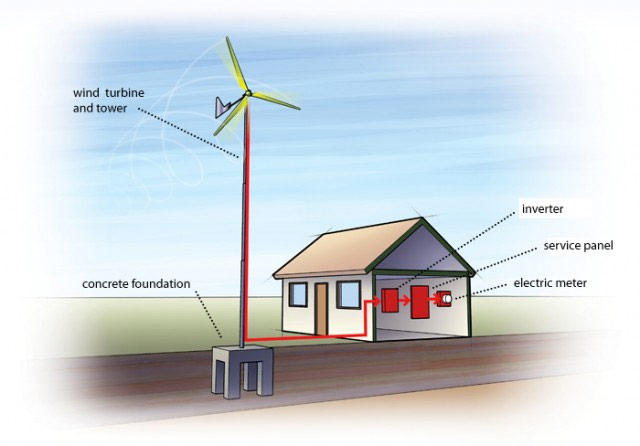
- Inverter Converts Power: For most homes, the direct current (DC) electricity from the generator needs to be converted into alternating current (AC) to power household appliances and connect to the utility grid. This is the job of an inverter.
Horizontal-Axis vs. Vertical-Axis Turbines: Which is Best for Homes?
Small wind turbines primarily come in two configurations:
1. Horizontal-Axis Wind Turbines (HAWT): These are what most people picture – the classic propeller-style turbines, with blades rotating around a horizontal axis. They are the most common and efficient design for large-scale wind farms and often for residential applications in very open, consistently windy areas.
2. Vertical-Axis Wind Turbines (VAWT): These turbines have blades that rotate around a vertical axis, resembling egg-beaters or Savonius rotors. They are generally less efficient than HAWTs but have some advantages, particularly in turbulent or urban wind conditions.
| Feature | Horizontal-Axis Wind Turbines (HAWT) | Vertical-Axis Wind Turbines (VAWT) |
|---|---|---|
| Efficiency | Generally higher (35-50% of Betz limit) | Generally lower (15-30% of Betz limit) |
| Startup Wind Speed | Requires higher wind speed to start generating | Can start generating at very low wind speeds |
| Wind Direction | Must yaw (turn) to face the wind; requires a tail fin or motor | Omni-directional; doesn’t need to turn into the wind |
| Noise | Can be noticeable, especially in lower wind speeds as blades cut air | Generally quieter due to different aerodynamic profile |
| Maintenance | Gearbox and generator are high up, requiring specialized equipment | Generator is typically at ground level, easier access |
| Aesthetics | Traditional “windmill” look, can be visually prominent | Often perceived as more modern or less intrusive |
| Best Use Case | Open, consistently windy rural sites with minimal turbulence | Turbulent wind conditions, urban/suburban rooftops, small-scale applications where space is limited |
Key Components of a Home Wind System (Beyond the Turbine)
The turbine itself is just one part of a complete system:
- Tower: Lifts the turbine to optimal wind height, away from ground-level turbulence. Towers can be guyed (supported by cables) or freestanding (monopole).
- Charge Controller: Manages the flow of electricity, especially important for systems with batteries, preventing overcharging.
- Inverter: Converts DC electricity from the turbine (and batteries, if present) into AC electricity suitable for your home and the grid.
- Batteries (Optional, for Off-Grid or Hybrid): Store excess energy for use when the wind isn’t blowing. Essential for off-grid homes, optional for grid-tied systems that use the grid for storage (net metering).
- Grid Interconnection Equipment: For grid-tied systems, this includes safety disconnects and metering devices required by your utility.
The Dollars and Cents: Cost, Savings, and Payback for Home Wind Power
Let’s talk money. The cost of a home wind power system is a critical factor, and it’s more than just the price tag of the turbine itself.
What Does a Home Wind Turbine System Cost? (Breaking Down the Expenses)
For a typical residential system (1-10 kW), you can expect the total installed cost to range significantly, often between $15,000 and $80,000+. Here’s a breakdown:
| Component | Estimated Cost Range (USD) |
|---|---|
| Small Turbine (1-5 kW) | $3,000 – $15,000 |
| Tower (30-100 ft) | $3,000 – $18,000 (guyed are cheaper than freestanding) |
| Foundation & Site Prep | $2,000 – $10,000 (can vary based on soil, terrain) |
| Inverter & Controller | $1,000 – $5,000 |
| Installation Labor | $5,000 – $20,000+ (highly variable by location and complexity) |
| Permitting & Interconnection Fees | $500 – $3,000+ |
| Batteries (Optional, for Off-Grid) | $5,000 – $20,000+ (depending on capacity) |
| Total System Cost Estimate (excluding batteries) | $15,000 – $80,000+ |
These are rough estimates and can fluctuate based on turbine size, tower type, site accessibility, local labor rates, and the complexity of your electrical setup.
Understanding Your Potential Energy Savings
Your savings are directly tied to how much electricity your turbine generates and your utility’s electricity rates. If your turbine produces 500 kWh per month and your rate is $0.15/kWh, you save $75 that month. Over a year, that’s $900. These savings are tax-free and will likely increase as utility rates rise over time.
Incentives, Rebates, and Tax Credits: Lowering Your Investment
Just like solar, small wind energy systems can qualify for various incentives:
 "Home Wind Turbines: When Do They Make Sense? | EnergySage")
- Federal Investment Tax Credit (ITC): Currently, residential wind systems can qualify for a significant federal tax credit (e.g., 30% of the installed cost for systems placed in service by 2032). This is a credit, not a deduction, meaning it directly reduces your tax liability.
- State and Local Incentives: Many states, counties, and even some utilities offer additional rebates, grants, or property tax exemptions for renewable energy installations. Websites like DSIRE (Database of State Incentives for Renewables & Efficiency) are excellent resources.
- Net Metering: Crucial for grid-tied systems, net metering allows you to send excess electricity generated by your turbine back to the grid, receiving credits on your bill for future use. This essentially uses the grid as a giant battery.
These incentives can dramatically reduce your net out-of-pocket cost and improve your payback period.
The Payback Period: When Does It Make Financial Sense?
The payback period is the time it takes for your energy savings (and incentives) to equal your initial investment. For home wind systems, this can vary wildly:
- Highly Favorable Conditions: In very windy locations with high electricity rates and strong incentives, payback could be 6-10 years.
- Average Conditions: More commonly, 10-20 years.
- Unfavorable Conditions: If wind resources are poor or costs are high, the payback period might exceed the system’s lifespan, making it a poor financial investment.
A detailed financial analysis, considering your specific costs, wind resource, electricity rates, and available incentives, is essential before committing.
Wind vs. Solar: Which Renewable is Right for You?
For most homeowners considering renewable energy, the choice often comes down to wind or solar. Both offer clean power, but their suitability varies greatly depending on your circumstances.
Strengths of Wind Power (When it Outperforms Solar)
- Nighttime Generation: Unlike solar, wind turbines can generate electricity 24/7 as long as there’s wind, making them excellent for continuous power.
- Winter Performance: Wind resources are often stronger in winter months, precisely when solar output is lower due to shorter days and lower sun angles.
- Space Efficiency for High Output: In extremely windy locations, a single turbine can generate substantial power without covering a large roof area like solar panels would.
- Complementary to Solar: When combined with solar (a hybrid system), wind can balance out solar’s intermittency, providing power when the sun isn’t shining.
Strengths of Solar Power (When it’s the Clear Winner)
- Ubiquitous Resource: Most locations in the U.S. have sufficient sunshine for solar power, making it widely applicable.
- Simpler Installation: Solar panels are typically installed on rooftops, avoiding the complex tower construction and extensive site preparation of wind turbines.
- Lower Upfront Cost: Generally, a comparable solar system is less expensive to install than a wind system, leading to quicker payback periods for many homes.
- Less Visual/Noise Impact: Panels are often less visually intrusive and are completely silent.
- Established Market: The solar industry is more mature, with a broader range of installers, financing options, and standardized processes.
Hybrid Systems: The Best of Both Worlds?
For true energy independence, especially in off-grid scenarios, a hybrid wind-solar system is often the most robust solution. Solar excels during the day, particularly in summer, while wind often performs better at night and during winter. By combining them, you get a more consistent and reliable power supply, minimizing the need for large battery banks or reliance on a generator.
| Feature | Home Wind Power | Home Solar Power |
|---|---|---|
| Primary Resource | Wind (requires consistent speeds) | Sunlight (requires direct exposure) |
| Output Consistency | Intermittent, but can generate 24/7; often stronger in winter | Intermittent (daylight only); strongest in summer |
| Space Requirement | Requires significant land for tower and setbacks | Mostly rooftop space; less ground footprint generally |
| Ideal Location | Rural, open, consistently high average wind speeds | Anywhere with good sun exposure, less affected by nearby obstructions |
| Installation Complexity | Higher; requires tower construction, specialized equipment, often cranes | Lower; mostly rooftop work, less heavy machinery |
| Maintenance | More regular checks, moving parts | Minimal; occasional cleaning, fewer moving parts |
| Noise/Visual Impact | Can be a concern; tall structures, potential for low-level hum | Generally quiet; less visually intrusive (flush-mounted panels) |
| Average Cost (10kW system) | $30,000 – $80,000+ (installed) | $20,000 – $30,000 (installed) |
| Established Market | Smaller, niche market for residential systems | Mature, highly competitive, widespread market |
Planning and Installation: Your Step-by-Step Journey
If you’ve determined that residential wind power might be a good fit for your home, congratulations! Now, let’s look at the practical steps to bring your vision to life.
Step 1: Preliminary Site Assessment (Wind, Space, Obstacles)
Before investing any serious money, do your homework on your specific property. Use online tools, check local wind data, and walk your property to identify potential turbine locations. Look for clear, unobstructed areas, keeping in mind the need for your turbine to be above surrounding obstacles.
Step 2: Research Local Regulations & Permitting
As emphasized earlier, this is a make-or-break step. Contact your local planning and zoning department to understand all requirements for small wind turbine installation. Ask about:
- Permit applications and fees.
- Height restrictions and setback requirements.
- Noise ordinances.
- Visual impact guidelines.
- Any specific wind energy ordinances.
Also, check with your Homeowners Association (HOA) if applicable.
Step 3: Sizing Your System (Matching Output to Needs)
Review your electricity bills to determine your average monthly and annual kWh usage. Then, with your assessed wind resource data, work with a professional to size a turbine that can realistically meet a significant portion of your energy demand. Don’t oversize or undersize – find the sweet spot for efficiency and cost-effectiveness.
Step 4: Choosing the Right Turbine & Installer
- Turbine Selection: Research reputable manufacturers. Look for turbines that are certified by organizations like the Small Wind Certification Council (SWCC) or meet international standards (e.g., IEC 61400). Read reviews and compare performance data.
- Installer Selection: Find an experienced installer specializing in small wind. Ask for references, proof of licensing and insurance, and a detailed proposal including all costs and expected energy production. A good installer will also help navigate permits and grid interconnection.
Step 5: Installation & Grid Connection (or Off-Grid Setup)
Once permits are secured and equipment is ordered, the installation process begins. This typically involves:
- Foundation pouring for the tower.
- Erection of the tower and turbine.
- Electrical wiring and connection to your home’s main panel.
- Installation of inverters and controllers.
- For grid-tied systems: Inspection by local authorities and your utility company, followed by commissioning and activation of net metering.
- For off-grid systems: Integration with a battery bank and potentially a backup generator.
Always use qualified professionals for installation to ensure safety and compliance.
Living with Home Wind Power: Maintenance, Lifespan, and Realities
Once your turbine is up and spinning, it’s not entirely set-it-and-forget-it. Understanding the ongoing realities is part of being a prepared owner.
Routine Maintenance: Keeping Your Turbine Spinning
While small wind turbines are designed for durability, they have moving parts exposed to the elements. Regular maintenance is crucial for optimal performance and longevity:
- Annual Visual Inspection: Check blades for damage (cracks, chips), tower for corrosion or loose guy wires, and wiring for wear.
- Lubrication: Some turbines require periodic lubrication of moving parts (e.g., yaw bearings if it’s a HAWT).
- Bolt Tightness: Ensure all bolts and connections are secure.
- Brake System Check: Turbines have braking systems for high winds or maintenance; ensure these are functional.
- Professional Servicing: Consider a professional check-up every few years or if you notice any unusual noises or performance drops.
The good news is that most small turbines are designed to be low-maintenance, but neglecting these checks can lead to costly repairs down the line.
Expected Lifespan and Durability
A well-maintained, high-quality small wind turbine system can last 20-25 years or more. The turbine itself typically has a longer lifespan than components like inverters or batteries (if used), which may need replacement after 10-15 years. Towers are designed to last even longer, often 50+ years.
Addressing Common Concerns: Noise, Visual Impact, Wildlife
These are legitimate concerns often raised by homeowners and neighbors:
- Noise: Modern small wind turbines are significantly quieter than older models. However, at higher wind speeds, there can be a noticeable whooshing sound from the blades or a hum from the generator. Proper siting (away from habitable structures) and choosing a low-noise model are key. VAWTs tend to be quieter than HAWTs.
- Visual Impact: A tall tower and spinning blades are prominent. What one person sees as a symbol of clean energy, another might see as an eyesore. This is where local zoning and community acceptance play a huge role.
- Wildlife Impact: While large utility-scale wind farms have had issues with bird and bat mortality, the impact from single, properly-sited small residential turbines is generally considered minimal, especially compared to other common structures (e.g., communication towers, windows). Siting away from known migratory paths and using modern, slower-moving blades can further reduce risk.
Grid-Tied vs. Off-Grid Systems: What You Need to Know
- Grid-Tied Systems: The most common setup for homeowners. Your turbine supplements grid power. When you generate more than you use, excess power is sent to the grid, earning you credits (via net metering). When your turbine isn’t producing enough, you draw from the grid. These systems typically don’t require batteries for daily use but will go down during a grid outage unless equipped with specific battery backup and grid-isolation features.
- Off-Grid Systems: You are entirely independent from the utility grid. This requires a robust battery bank to store energy for periods of low wind, and often a backup generator for extended calm periods. Off-grid systems are complex and more expensive upfront but offer complete energy independence. They are ideal for remote locations where grid extension is prohibitively expensive.
Embarking on a journey with home wind power is a significant decision. It’s not just about installing a turbine; it’s about understanding your environment, your energy needs, and the technology itself. With realistic expectations and thorough planning, harnessing the power of the wind for your home can be a rewarding and sustainable venture.
Frequently Asked Questions
Is a home wind turbine worth it financially?
A home wind turbine can be a sound financial investment, but only under specific conditions. You need consistently high average wind speeds (at least 10-12 mph), high electricity consumption, and favorable local incentives. The upfront cost is significant ($15,000 – $80,000+), and payback periods can range from 6 to over 20 years, depending on these factors.
How much wind speed do I need for a home turbine to be effective?
For a home wind turbine to be economically effective, your property should have an annual average wind speed of at least 10-12 mph (4.5-5.4 m/s) at the proposed turbine height. Wind power output increases exponentially with wind speed, so consistent, strong winds are critical for good energy production.
Can a small wind turbine power an entire house?
Yes, a properly sized small wind turbine system can power an entire house, especially if your home is energy-efficient and located in a very windy area. However, most residential systems are designed to supplement grid power or work in hybrid systems with solar, providing a significant portion of a home’s energy needs rather than 100% of it continuously.
What’s the difference between Horizontal-Axis (HAWT) and Vertical-Axis (VAWT) wind turbines?
HAWTs (like traditional windmills) are generally more efficient, requiring higher startup winds and needing to turn into the wind. VAWTs (like egg-beaters) are less efficient but can start generating at lower, more turbulent wind speeds and are omni-directional, making them potentially more suitable for urban or complex wind environments. VAWTs are also often quieter and have ground-level components for easier maintenance.
Are home wind turbines noisy?
Modern home wind turbines are much quieter than older designs, but they are not silent. You might hear a low hum from the generator or a whooshing sound from the blades, especially at higher wind speeds. Proper siting (away from living spaces) and choosing a quieter model can minimize noise impact, with VAWTs often being a quieter option compared to HAWTs.
How do I find a reputable installer and ensure compliance?
Look for installers with specific experience in small wind energy systems, not just solar. Ask for references, proof of licensing and insurance, and check if they’re certified or recognized by industry bodies. A good installer will also guide you through local permitting, zoning regulations, and utility interconnection requirements, which are crucial for compliance.
