
Table of Contents
- Can a Wind Turbine Really Power Your Entire Home? The Honest Truth for Homeowners
- Is Residential Wind Power Right for YOU? Understanding the Key Factors
- Wind Resource Assessment: The Factor
- Energy Consumption: How Much Power Do You Actually Need?
- Space & Zoning: The Practicalities of Placement
- Budget & ROI: Initial Costs vs. Long-Term Savings
- Grid Connection vs. Off-Grid: Implications of Each
- How Much Wind Power Do You Actually Need? Sizing Your Turbine
- Calculating Your Home’s Energy Load
- Understanding Turbine Ratings (kW)
- The “Average Home” Myth: Why a Single Number Doesn’t Work
- Table: Typical Home Energy Consumption & Corresponding Turbine Size Estimate (USA)
- Types of Residential Wind Turbines: Horizontal vs. Vertical
- Horizontal Axis Wind Turbines (HAWTs)
- Vertical Axis Wind Turbines (VAWTs)
- Table: Horizontal Axis vs. Vertical Axis Wind Turbines for Home Use
- The Real Costs of Home Wind Power: Installation & Beyond
- Turbine Unit Cost
- Installation & Tower Costs
- Balance of System (BOS) Costs
- Permitting, Site Assessment & Maintenance
- Table: Estimated Cost Breakdown for a Residential Wind System (5 kW Turbine)
- Wind vs. Solar: Which is Better for Your Home? (Or Both?)
- Strengths and Weaknesses of Each
- The Power of Hybrid Systems (Wind-Solar Synergy)
- The Installation Journey: What to Expect
- Step 1: Site Assessment & Wind Resource Analysis
- Step 2: Energy Audit & Efficiency Upgrades
- Step 3: System Design & Component Selection
- Step 4: Permitting & Regulatory Hurdles
- Step 5: Professional Installation
- Step 6: Grid Interconnection (if applicable) or Off-Grid Setup
- Pros and Cons of Residential Wind Turbines
- Table: Advantages & Disadvantages of Residential Wind Turbines
- Making the Smart Decision: Is a Home Wind Turbine for You?
Can a Wind Turbine Really Power Your Entire Home? The Honest Truth for Homeowners
You’re dreaming of energy independence, lower utility bills, and a smaller carbon footprint. The idea of a sleek wind turbine gracefully turning in your backyard, silently powering your entire home, is incredibly appealing. But is it realistic?
The short answer is: yes, a wind turbine *can power a home, but it’s rarely as simple as a single turbine handling everything, especially if you want to go completely off-grid. For most homeowners, it’s a piece of a larger puzzle, often working in tandem with other renewable sources like solar, or supplementing grid power to significantly reduce your energy costs.
Is Residential Wind Power Right for YOU? Understanding the Key Factors
Before you even think about turbine models or costs, you need to honestly assess if your property and lifestyle are a good fit for residential wind energy. This isn’t just about wanting one; it’s about whether one will actually work effectively for you.
Wind Resource Assessment: The Factor
This is non-negotiable. A wind turbine needs consistent, strong wind to generate significant power. Think about it: no wind, no power. Your property might look breezy, but is it windy enough, consistently enough, at the height needed for a turbine? Hills, trees, and neighboring buildings can create turbulence and block wind, severely reducing a turbine’s efficiency.
You’ll need a professional site assessment. They’ll look at wind maps, local meteorological data, and may even install an anemometer (wind speed measuring device) on your property for a period to get accurate readings. Ideally, you want an average annual wind speed of at least 10-12 mph (4.5-5.4 m/s) at the turbine’s proposed height. Locations with less than 9 mph are generally not economically viable.
Energy Consumption: How Much Power Do You Actually Need?
Most people overestimate how much a small turbine can produce and underestimate their home’s energy appetite. Before investing in any renewable system, conduct a thorough energy audit to understand your typical monthly kWh usage and identify areas for efficiency improvements. Every kilowatt-hour you don’t* use is a kilowatt-hour you don’t have to generate.
Look at your electricity bills from the past 12-24 months to get an average. A typical American home uses around 893 kWh per month (according to EIA data). Your consumption will directly dictate the size and cost of the wind system you’ll need.
Space & Zoning: The Practicalities of Placement
Wind turbines, even residential ones, require space. We’re talking about a tower anywhere from 30 to 120 feet tall (or more!), plus rotor blades that need clearance. You’ll need:
- Sufficient Land:
- Zoning & Permitting:early in the process.
- Clear Airflow:
Budget & ROI: Initial Costs vs. Long-Term Savings
Residential wind turbines are a significant investment. Costs can range from $15,000 to $80,000+, depending on size, installation complexity, and whether you include battery storage. You’ll need to calculate the return on investment (ROI), considering:
- Your current electricity rates.
- How much energy the turbine will realistically generate.
- Available incentives (federal tax credits, state rebates, local programs).
- Maintenance costs over the system’s lifespan (typically 20-25 years).
Grid Connection vs. Off-Grid: Implications of Each
- Grid-Tied Systems:
- Off-Grid Systems:
How Much Wind Power Do You Actually Need? Sizing Your Turbine
This is where the rubber meets the road. Sizing a wind turbine isn’t a simple equation, but we can break down the key components.
Calculating Your Home’s Energy Load
As mentioned, knowing your average monthly kWh usage is critical. But also consider your peak demand – how many watts do you use when everything is running at once? This helps size your inverter and, if off-grid, your battery bank.
For simplicity, let’s use the average U.S. home’s consumption of ~893 kWh/month, which translates to roughly 30 kWh per day. To generate 30 kWh per day, you need a system that can produce that amount, factoring in your local wind speed and the turbine’s efficiency.
Understanding Turbine Ratings (kW)
Turbines are rated in kilowatts (kW) – this is their rated power output at a specific, optimal wind speed (e.g., a 5 kW turbine might produce 5 kW at 28 mph). But wind isn’t always optimal. The swept area (the area covered by the rotor blades) is a better indicator of actual potential, as power scales with the cube of wind speed and the square of blade radius.
The “Average Home” Myth: Why a Single Number Doesn’t Work
You’ll see headlines like “A 1.5 kW turbine can power a home!” While technically true in ideal conditions, it’s misleading. A 1.5 kW turbine generating its full capacity 24/7 would produce (1.5 kW * 24 hours) = 36 kWh per day. However, turbines rarely operate at full capacity due to fluctuating wind. Realistically, a 1.5 kW turbine might produce 10-15 kWh/day in a good wind location. A more practical size for significant home power is often in the 5 kW to 15 kW range.
Table: Typical Home Energy Consumption & Corresponding Turbine Size Estimate (USA)
| Home Size/Energy Use | Avg. Monthly Consumption (kWh) | Estimated Turbine Size Needed (kW) | Approximate Rotor Diameter (feet) |
|---|---|---|---|
| Small Home / High Efficiency | 300 – 600 kWh | 1 – 3 kW | 8 – 15 feet |
| Average U.S. Home | 600 – 1,000 kWh | 5 – 10 kW | 15 – 25 feet |
| Large Home / Heavy Use | 1,000 – 2,000+ kWh | 10 – 20 kW+ | 25 – 40+ feet |
Estimates assume good average wind speeds (12-14 mph) at turbine height. Actual performance will vary significantly based on specific site conditions and turbine model.
Types of Residential Wind Turbines: Horizontal vs. Vertical
Residential turbines generally fall into two main categories based on their axis of rotation:
Horizontal Axis Wind Turbines (HAWTs)
These are what most people picture: the classic propeller-style turbines, often with 2 or 3 blades. They are highly efficient at converting wind into electricity and are the dominant design for both utility-scale and most residential applications.
Vertical Axis Wind Turbines (VAWTs)
VAWTs have blades that rotate around a vertical axis. Common designs include Darrieus (egg-beater shape) and Savonius (S-shape). They are often marketed as quieter, better in turbulent wind, and more aesthetically pleasing. However, they are generally less efficient than HAWTs for the same swept area and can be less common in the residential market.
Table: Horizontal Axis vs. Vertical Axis Wind Turbines for Home Use
| Feature | Horizontal Axis (HAWT) | Vertical Axis (VAWT) |
|---|---|---|
| Efficiency | Generally higher (40-50% Betz limit) | Generally lower (10-30%) |
| Wind Direction | Must orient into the wind (often with a tail vane) | Omni-directional; no reorientation needed |
| Turbulence | Less tolerant, better in steady winds | Better performance in turbulent, gusty winds |
| Noise | Can be louder at high speeds due to blade tip speed | Generally quieter |
| Maintenance | Drive train components at height | Generator often at ground level, easier access |
| Aesthetics | Traditional “wind turbine” look | Often perceived as more modern/less intrusive |
The Real Costs of Home Wind Power: Installation & Beyond
Don’t be swayed by low turbine prices alone. The turbine itself is only one part of the total system cost.
Turbine Unit Cost
The turbine generator and blades typically range from $3,000 for a small 1kW unit to $25,000+ for a 10-15 kW system. Brand, quality, and features all play a role.
Installation & Tower Costs
This is often the largest component of the cost. You need a robust tower to get the turbine into optimal airflow. Towers can be guyed (less expensive, requires more land) or freestanding (more expensive, smaller footprint). Prices vary wildly:
- Tower: $2,000 – $15,000+ depending on height and type.
- Foundation: Requires significant concrete work, potentially $2,000 – $10,000+.
- Labor: Professional installation by certified technicians, crane rental, etc., can add $5,000 – $20,000+.
Balance of System (BOS) Costs
These are all the other components needed for the system to function:
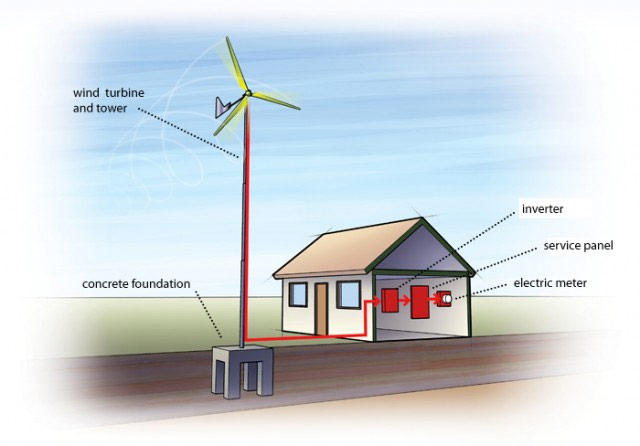
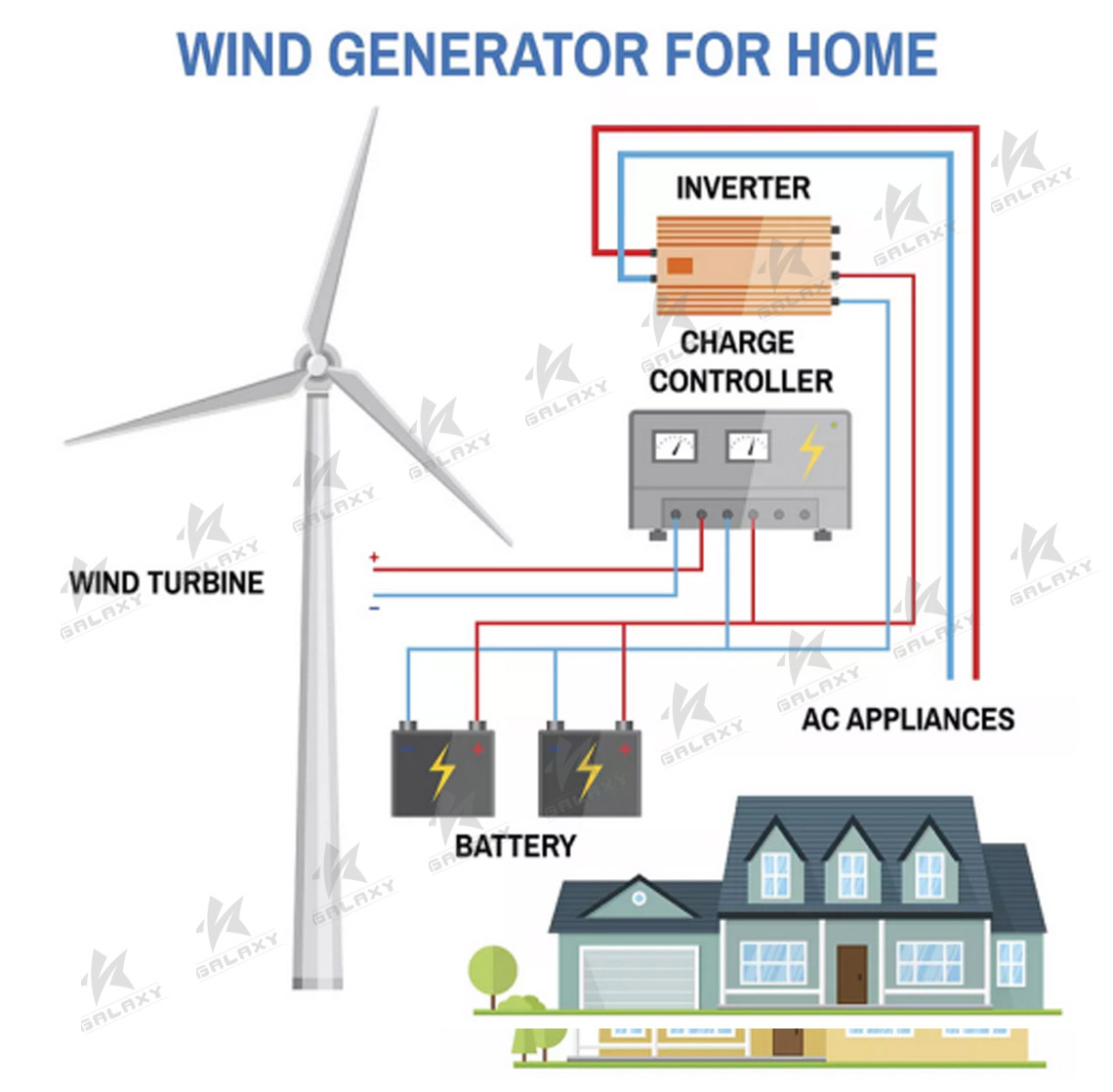
- Inverter: Converts the turbine’s raw DC power into usable AC power for your home or the grid. $1,000 – $5,000.
- Charge Controller: Manages power flow from the turbine, especially if batteries are involved. $300 – $1,500.
- Batteries (for off-grid or hybrid storage): The most expensive component if you go off-grid. A residential battery bank can cost anywhere from $10,000 to $30,000+ and needs replacement every 5-15 years.
- Wiring & Electrical Components: $500 – $3,000.
Permitting, Site Assessment & Maintenance
- Site Assessment: Professional wind resource and structural engineering assessments can cost $500 – $2,500.
- Permits & Fees: Varies by municipality, but expect $100s to $1,000s.
- Maintenance: Turbines require regular inspection (every 1-3 years), lubrication, and occasional component replacement. Budget $100 – $500 annually.
Table: Estimated Cost Breakdown for a Residential Wind System (5 kW Turbine)
| Cost Component | Estimated Range | Notes |
|---|---|---|
| Turbine Unit (5 kW) | $8,000 – $18,000 | Excludes very small or very large systems |
| Tower (60-80 ft) | $4,000 – $12,000 | Guyed is cheaper, freestanding more expensive |
| Foundation | $3,000 – $8,000 | Site-specific engineering required |
| Inverter & Charge Controller | $2,000 – $6,000 | Depends on grid-tied vs. off-grid |
| Battery Storage (Optional) | $10,000 – $30,000+ | Adds significant cost for off-grid reliability |
| Installation Labor & Crane | $6,000 – $15,000 | Highly variable by location and complexity |
| Permitting & Site Assessment | $1,000 – $3,000 | Includes engineering reports, fees |
| Total Estimated Cost (Grid-Tied) | $24,000 – $62,000 | Before incentives, without battery storage |
| Total Estimated Cost (Off-Grid) | $34,000 – $92,000+ | Includes significant battery storage |
These are broad estimates. Actual costs will depend on your specific site, chosen equipment, and local labor rates. Federal tax credits (like the Investment Tax Credit) can significantly reduce these costs.
Wind vs. Solar: Which is Better for Your Home? (Or Both?)
Often, the discussion boils down to wind or solar. The truth is, they’re not necessarily competitors but often complementary.
Strengths and Weaknesses of Each
- Solar (Photovoltaic):
- Pros: Ubiquitous sunlight (most places), modular, relatively easy to install on rooftops, silent, proven technology, significant cost reductions, fewer zoning hurdles than wind.
- Cons: Only produces during daylight, requires clear roof space or ground space, output drops on cloudy days or with snow, lower output in winter months.
- Wind:
- Pros: Can produce power 24/7 if wind is consistent, often stronger and more consistent in winter (when solar is weaker), excellent for specific windy, rural locations.
- Cons: Highly site-specific, needs strong average wind speeds, visual impact, potential noise concerns, significant installation complexity (tower, foundation), more stringent zoning.
The Power of Hybrid Systems (Wind-Solar Synergy)
For true energy independence and consistent power generation, a wind-solar hybrid system is often the superior choice. Here’s why:
- Complementary Production: Wind often blows stronger at night and during winter, precisely when solar production is at its lowest. Solar performs best during sunny days and summer months. This creates a more stable, year-round energy supply.
- Reduced Storage Needs: By having two sources that offset each other’s down times, you might need a smaller battery bank compared to relying solely on one intermittent source for off-grid living.
- Enhanced Reliability: If one system is temporarily down for maintenance or experiences poor conditions, the other can still contribute.
Many experts agree that unless you’re in an exceptionally windy location with poor solar access (e.g., northern Alaska), a hybrid system offers the best balance of cost, efficiency, and reliability for homeowners seeking significant energy independence.
The Installation Journey: What to Expect
Installing a residential wind turbine is a complex project best left to certified professionals. Here’s a general roadmap:
Step 1: Site Assessment & Wind Resource Analysis
A crucial first step. Professionals will evaluate your property’s wind potential, topography, nearby obstructions, and assess the optimal turbine location and tower height. This might involve installing temporary wind measurement equipment.
Step 2: Energy Audit & Efficiency Upgrades
Before designing your system, it’s wise to reduce your energy demand. An energy audit helps identify areas for improvement (insulation, windows, efficient appliances) that can lower your overall power needs, allowing for a smaller, less expensive wind system.
Step 3: System Design & Component Selection
Based on your energy needs and wind resource, a professional will design the complete system, specifying the turbine model, tower type, inverter, charge controller, and (if applicable) battery bank. This phase also includes structural engineering for the tower and foundation.
Step 4: Permitting & Regulatory Hurdles
Your installer will guide you through local zoning laws, building codes, and permitting processes. This can be the longest and most challenging part of the project. Be prepared for potential public hearings, especially if neighbors have concerns.
Step 5: Professional Installation
This involves preparing the site, pouring the foundation, erecting the tower, assembling the turbine, and connecting all electrical components. It requires specialized equipment (cranes) and skilled labor to ensure safety and proper functioning.
Step 6: Grid Interconnection (if applicable) or Off-Grid Setup
For grid-tied systems, the utility company will inspect the installation and connect your system to the grid, enabling net metering. For off-grid systems, the battery bank and backup generator (if any) are integrated and tested.
Pros and Cons of Residential Wind Turbines
Like any major investment, home wind power comes with its own set of advantages and disadvantages.
Table: Advantages & Disadvantages of Residential Wind Turbines
| Advantages (+) | Disadvantages (-) |
|---|---|
| Clean, Renewable Energy: Zero emissions during operation. | High Upfront Cost: Significant initial investment. |
| Energy Independence: Reduced reliance on utility companies. | Site Specificity: Only viable in areas with consistent, strong wind. |
| Lower Electricity Bills: Significant savings over the system’s lifespan. | Intermittency: Only produces when the wind blows. |
| Potential for Net Metering: Sell excess power back to the grid. | Noise & Visual Impact: Can be concerns for neighbors and local aesthetics. |
| 24/7 Production Potential: Unlike solar, can generate power at night. | Zoning & Permitting: Often complex and restrictive. |
| Federal & State Incentives: Tax credits and rebates can reduce costs. | Maintenance: Requires periodic professional inspection and upkeep. |
| Long Lifespan: 20-25 years or more with proper maintenance. | Potential for Bird/Bat Collisions: Though small residential turbines pose less risk than large utility ones. |
Making the Smart Decision: Is a Home Wind Turbine for You?
So, can a wind turbine power your house? Yes, it can make a substantial contribution, and for some, it can even achieve near or total energy independence. However, it’s not a plug-and-play solution.
Residential wind power is best suited for homeowners who:
- Live in consistently windy, open, rural areas.
- Have sufficient land for a tall tower and proper setbacks.
- Are prepared for a significant upfront investment and a long-term return.
- Are willing to navigate local zoning and permitting complexities.
- Are open to combining it with solar power and battery storage for optimal reliability.
Before taking the plunge, prioritize energy efficiency, get a professional wind resource assessment, and consult with experienced renewable energy installers. They can provide tailored advice and help you determine if the dream of powering your home with wind is a practical reality for your specific situation. The future of your home’s energy might just be blowing in the wind.
Frequently Asked Questions
How much does a wind turbine cost to run a house?
The total cost for a residential wind turbine system, including the turbine, tower, installation, inverter, and permitting, can range from $24,000 to over $60,000 for a grid-tied system. If you opt for an off-grid system with battery storage, costs can exceed $90,000. These figures are before any federal or state incentives.
What size wind turbine do I need for my home?
The size needed depends heavily on your home’s energy consumption and local wind conditions. An average U.S. home (600-1,000 kWh/month) typically requires a 5 kW to 10 kW turbine for significant power contribution. Smaller homes with high efficiency might get by with 1-3 kW, while larger homes could need 10-20 kW or more. A professional site assessment is crucial to determine the accurate size.
Are home wind turbines noisy?
Modern residential wind turbines are generally much quieter than older models, but they do produce some sound. Horizontal axis turbines (HAWTs) can have a ‘whooshing’ sound from the blades, especially at higher wind speeds. Vertical axis turbines (VAWTs) are typically quieter. Proper placement and professional installation away from living areas and property lines can help mitigate noise concerns.
:max_bytes(150000):strip_icc()/wind-turbine-generator-on-house-roof-90967703-b9619befbf954726ae92dfb6154711f2.jpg "Is a Home Wind Turbine Right for You?")
Can a wind turbine power a house completely off-grid?
Yes, a wind turbine can power a house completely off-grid, but it’s more complex and expensive. An off-grid system requires a robust battery bank to store energy for when the wind isn’t blowing, and often a backup generator for extended calm periods. For maximum reliability off-grid, a hybrid wind-solar system is often recommended.
Do home wind turbines require a lot of maintenance?
Residential wind turbines require periodic maintenance to ensure optimal performance and longevity. This typically includes annual or bi-annual inspections, lubrication of moving parts, checking electrical connections, and occasionally replacing components. Budgeting for professional maintenance, roughly $100-$500 annually, is advisable.
Is wind power more efficient than solar for a home?
Neither is inherently ‘more efficient’ for all homes; they excel in different conditions. Solar is more widely applicable due to prevalent sunlight, while wind requires specific, consistently windy sites. Wind can produce 24/7, including winter and night, when solar is weakest. For many, a hybrid wind-solar system offers the most efficient and reliable year-round energy production by leveraging the strengths of both.
What are the best locations for a residential wind turbine?
The best locations are open, rural areas with an average annual wind speed of at least 10-12 mph (4.5-5.4 m/s) at the turbine’s proposed height. The site should be free from significant obstructions like tall trees, hills, or buildings that could create turbulence or block airflow. A higher tower generally leads to better wind resources and thus more power generation.
