
Wind Power for Your Home: Is a Residential Wind Turbine Right for You?
Dreaming of cutting ties with your utility company? Picture this: your own miniature wind turbine, gracefully spinning, generating clean electricity right in your backyard. It’s a powerful vision of energy independence, but is it a realistic one for your home?
Table of Contents
- Wind Power for Your Home: Is a Residential Wind Turbine Right for You?
- The Core Question: When Does Residential Wind Power Make Sense?
- Key Factors for Viability
- Dispelling Common Myths About Home Wind Power
- How Residential Wind Turbines Actually Work
- From Wind to Watt: The Basic Mechanics
- Key Components of a Home Wind System
- Types of Home Wind Turbines: Horizontal vs. Vertical Axis
- Horizontal-Axis Wind Turbines (HAWTs)
- Vertical-Axis Wind Turbines (VAWTs)
- Micro-Turbines and Hybrid Systems
- Sizing Your Home Wind System: How Much Power Do You Need?
- Understanding Your Energy Consumption (kWh)
- Calculating Turbine Output: Factors to Consider
- The Cost of Going Wind: Investment, Savings, and ROI
- Upfront Costs: Equipment, Installation, Permitting
- Operating Costs and Maintenance
- Incentives and Rebates: Federal, State, Local Programs
- Return on Investment (ROI): When Does it Pay Off?
- Wind vs. Solar: A Head-to-Head Comparison for Homeowners
- When Wind Shines (and the Sun Doesn’t)
- The Hybrid Advantage: Combining Wind and Solar
- The Installation Journey: What to Expect
- Step 1: Site Assessment & Wind Resource Evaluation
- Step 2: Permitting, Zoning, and HOA Approval
- Step 3: Choosing a Qualified Installer
- Step 4: Installation Process
- Step 5: Interconnection and Operation
- Living with Home Wind Power: Maintenance and Performance
- Routine Checks and Lifespan
- Troubleshooting Common Issues
- The Future of Residential Wind Power
- Advancements in Technology
- Growing Accessibility and Affordability
- Conclusion: Making Your Decision
Many homeowners eye the wind as a potential source of clean energy, perhaps even as an alternative to the ubiquitous solar panel. But unlike solar, which has become a common sight on rooftops, residential wind power remains a less understood and often more complex endeavor. The truth is, while incredibly appealing, a home wind turbine isn’t a plug-and-play solution for everyone. It demands specific conditions and a clear understanding of its benefits and limitations.
This guide will cut through the hype and give you the straightforward facts you need. We’ll explore when residential wind power makes sense, how these systems work, what they cost, and how they stack up against other renewable options like solar. By the end, you’ll have a clear roadmap to decide if harnessing the wind is your next smart move.
The Core Question: When Does Residential Wind Power Make Sense?
Let’s be blunt: home wind turbines aren’t for every property. The viability hinges on several critical factors, often more stringent than those for solar power. Ignoring these can lead to a costly, underperforming system and a lot of frustration.
Key Factors for Viability
- Wind Resource: Consistent Wind is King. This is arguably the most crucial factor. A wind turbine needs a reliable, consistent wind speed to generate meaningful electricity. Sporadic gusts won’t cut it. You’re looking for an average annual wind speed of at least 10-12 mph (4.5-5.5 m/s), ideally higher. Urban areas or locations sheltered by trees, hills, or buildings typically don’t have this.
- Space Requirements: Land, Not Just Roof. Unlike solar panels that often fit snugly on your roof, wind turbines require significant clear space. This includes not just the footprint of the tower itself, but also a “clear air zone” free from obstructions. You’ll need enough land for a tall tower (often 30-100 feet or more) and ensure it’s positioned far from your home, neighbors, and tall trees to avoid turbulence.
- Energy Needs: Are You a High User? Small wind systems are designed to offset a portion or all of a home’s electricity bill. If your household consumes a large amount of electricity, a larger, more efficient turbine might be economically justified. For homes with very low energy consumption, the payback period might be extended.
- Grid Connection vs. Off-Grid: What’s Your Goal?
- Grid-Tied: Most residential systems are connected to the existing utility grid. When your turbine produces more power than you need, the excess can often be sent back to the grid (and you get credit through net metering). When it’s not windy, you draw power from the grid. This is usually the most cost-effective approach.
- Off-Grid: For remote homes without grid access, wind power combined with battery storage is a viable option. However, off-grid systems are typically more expensive due to the cost of batteries and require careful sizing to ensure consistent power supply.
- Local Regulations: Zoning, Permitting, and HOAs. This is a major hurdle for many. Municipalities often have strict zoning laws regarding tower height, setbacks from property lines, noise levels, and aesthetic considerations. Homeowners’ Associations (HOAs) can also have restrictive covenants. Obtaining permits can be a lengthy and complex process.
Dispelling Common Myths About Home Wind Power
Before we dive deeper, let’s clear up some common misconceptions that can lead to disappointment:
- Myth: Small turbines are silent. While modern turbines are quieter than older models, they do produce some noise, especially in higher winds. This is a critical factor for neighbor relations and local zoning.
- Myth: You can install a small turbine anywhere. As discussed, wind resource and space are paramount. A turbine won’t perform well on a suburban rooftop or surrounded by tall trees.
- Myth: Home wind power is always cheaper than grid electricity. The upfront cost can be substantial, and the payback period depends heavily on your wind resource, electricity rates, and available incentives.
- Myth: All wind turbines kill birds. While larger utility-scale turbines have historically faced concerns, well-sited residential turbines, especially those with slower blade tip speeds, pose a much lower risk.
How Residential Wind Turbines Actually Work
At its heart, a wind turbine is remarkably simple: it converts the kinetic energy of moving air into usable electricity. Think of it like a reverse fan.
From Wind to Watt: The Basic Mechanics
When wind blows, it pushes against the blades of the turbine, causing them to rotate. These spinning blades are connected to a shaft, which in turn drives a generator. The generator, through electromagnetic induction, converts that mechanical rotation into electrical energy (alternating current, or AC). This AC electricity is then either used directly in your home, stored in batteries, or sent to the grid.
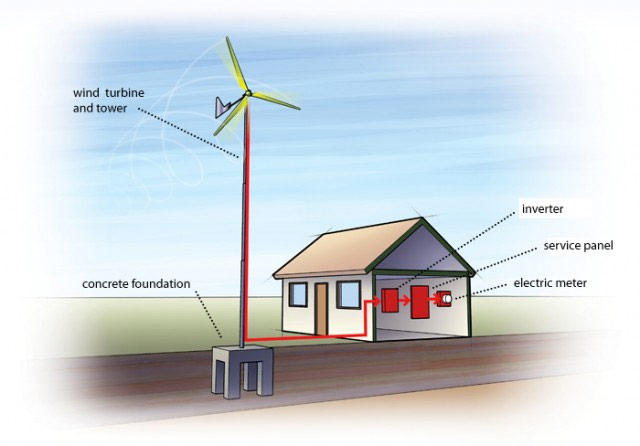
Key Components of a Home Wind System
A complete residential wind power system is more than just the turbine itself. Here are the essential parts:
- Turbine: The visible part with blades, a rotor, and a nacelle (housing the generator, gearbox, and braking system). Its design dictates efficiency and output.
- Tower: Lifts the turbine high enough to access stronger, less turbulent wind. Towers can be self-supporting (freestanding) or guyed (supported by cables). Height is crucial – the higher, the better the wind resource.
- Inverter: Converts the raw AC power from the turbine into the specific voltage and frequency (typically 120/240V AC, 60Hz in the US) suitable for your home’s electrical system or the utility grid.
- Charge Controller (for battery systems): Regulates the flow of electricity from the turbine to the batteries, preventing overcharging and optimizing battery life.
- Batteries (for off-grid/hybrid): Store excess electricity for use when the wind isn’t blowing or demand is high. Essential for off-grid systems, optional but beneficial for grid-tied systems wanting backup power.
- Grid-Tie Equipment: Includes disconnect switches, metering, and safety devices required for connecting to the utility grid.
Types of Home Wind Turbines: Horizontal vs. Vertical Axis
When you picture a wind turbine, you’re likely thinking of a Horizontal-Axis Wind Turbine (HAWT). But there’s another player in the residential market: the Vertical-Axis Wind Turbine (VAWT). Each has its pros and cons.
| Feature | Horizontal-Axis Wind Turbines (HAWTs) | Vertical-Axis Wind Turbines (VAWTs) |
|---|---|---|
| Typical Appearance | Propeller-like blades on a horizontal shaft, usually elevated on a tall tower. | Eggbeater (Darrieus) or S-shaped (Savonius) blades rotating around a vertical shaft, often closer to the ground. |
| Efficiency | Generally more efficient at converting wind energy into electricity, especially in consistent, high winds. | Less efficient than HAWTs for the same swept area, but can capture wind from any direction without reorientation. |
| Wind Direction | Must “yaw” or orient itself into the wind using a tail vane or electronic control. | Omni-directional; can capture wind from any direction, making them potentially better in turbulent urban environments (though less efficient overall). |
| Noise Level | Can produce some aerodynamic noise from blades, especially larger models. | Generally considered quieter than HAWTs of comparable size. |
| Aesthetics | Traditional turbine look; often requires a tall, prominent tower. | Can be perceived as less intrusive or more modern in design; lower profile. |
| Bird/Bat Impact | Low risk for residential-sized turbines when properly sited; blade tips are faster. | Potentially lower risk due to slower blade tip speeds and more visible rotation. |
| Installation | Typically requires significant tower construction and a crane for larger models. | Can be easier to install due to lower height and components closer to the ground. |
| Maintenance | Requires lowering the turbine or climbing the tower for major work. | Often easier to access generator and other components at the base of the turbine. |
Horizontal-Axis Wind Turbines (HAWTs)
These are the iconic, propeller-style turbines you see in large wind farms, scaled down for residential use. They consist of two or three blades attached to a horizontal shaft, which is mounted on top of a tall tower. A tail vane often keeps the turbine facing into the wind for optimal performance.
Pros: Typically more efficient, better power output in strong, consistent winds, well-understood technology.
Cons: Require tall towers, must orient into the wind, can be noisier than VAWTs, potentially higher visual impact.
Vertical-Axis Wind Turbines (VAWTs)
VAWTs have blades that rotate around a vertical axis. Common designs include the ‘eggbeater’ (Darrieus) or ‘S-shaped’ (Savonius) types. Because they spin vertically, they don’t need to reorient with changing wind directions.
 "Home Wind Turbines: When Do They Make Sense? | EnergySage")
Pros: Omni-directional (no yaw mechanism needed), generally quieter, potentially better in turbulent wind conditions (though overall efficiency is lower), components at ground level for easier maintenance, less imposing appearance.
Cons: Lower efficiency compared to HAWTs of similar swept area, often require a starter mechanism, can experience vibration issues.
Micro-Turbines and Hybrid Systems
Beyond standard HAWTs and VAWTs, you’ll find micro-turbines designed for very small energy needs or supplemental power, often mounted on shorter poles. Many homeowners also opt for hybrid systems, combining wind and solar power. This approach leverages the strengths of both: wind often blows more strongly at night or during cloudy, winter days when solar production is low, providing a more consistent year-round energy supply.
Sizing Your Home Wind System: How Much Power Do You Need?
Choosing the right size turbine is crucial for cost-effectiveness and meeting your energy goals. Too small, and you won’t generate enough power; too large, and you’ll pay for excess capacity you don’t use, increasing your payback period.
Understanding Your Energy Consumption (kWh)
The first step is to know your average monthly and annual electricity consumption. Look at your past utility bills; they typically show usage in kilowatt-hours (kWh). A typical US home uses around 900 kWh per month, or 10,800 kWh per year, but this can vary wildly based on location, home size, and habits.
Example: If you use 800 kWh/month, you’ll need a system capable of generating approximately 9,600 kWh annually (800 kWh/month * 12 months).
Calculating Turbine Output: Factors to Consider
Turbine manufacturers provide a “rated power” (e.g., 1 kW, 5 kW, 10 kW), which is the maximum power output under specific optimal wind conditions (often 25-30 mph). However, your turbine won’t always operate at this peak. Key factors influencing actual output include:
- Average Annual Wind Speed: This is paramount. A small increase in average wind speed results in a disproportionately large increase in power output (due to the cubic relationship of power to wind speed).
- Rotor Diameter: Larger blades capture more wind.
- Tower Height: Taller towers access stronger, less turbulent wind.
- Turbine Efficiency: How well the turbine converts wind energy into electricity.
- Capacity Factor: This is the ratio of actual energy produced by a turbine over a period to its maximum possible output over the same period. For residential wind turbines, capacity factors typically range from 15% to 30%, depending heavily on the wind resource.
Rough Sizing Estimate:
- A 1 kW turbine might produce 1,000-2,000 kWh per year in a good wind resource (average 10-12 mph).
- A 5 kW turbine could produce 8,000-12,000 kWh per year in very good wind (average 12-14+ mph).
- A 10 kW turbine might generate 15,000-25,000 kWh per year in excellent wind conditions.
To get an accurate estimate, a professional wind resource assessment is essential. Don’t rely solely on manufacturer claims, which are often based on ideal conditions.
The Cost of Going Wind: Investment, Savings, and ROI
Let’s talk money. Residential wind power is a significant investment, but it can also lead to substantial savings over its lifespan. Understanding the financial picture is key to making an informed decision.
Upfront Costs: Equipment, Installation, Permitting
The total cost for a residential wind system can vary widely, typically ranging from $10,000 to $70,000+. This depends on turbine size, tower height, system complexity (grid-tied vs. off-grid with batteries), site preparation, and labor costs in your region.
| Component/Service | Estimated Cost Range (USD) | Notes |
|---|---|---|
| Turbine (2-10 kW) | $4,000 – $25,000 | Price varies significantly by size, brand, and type (HAWT vs. VAWT). |
| Tower (30-100 ft) | $2,000 – $15,000 | Cost depends on height, material, and type (guyed vs. self-supporting). |
| Balance of System (BOS) | $3,000 – $10,000 | Includes inverter, charge controller, wiring, safety disconnects, grounding, etc. |
| Batteries (for off-grid/hybrid) | $5,000 – $20,000+ | Significant additional cost for energy storage; varies by capacity and battery chemistry. |
| Installation Labor | $3,000 – $15,000 | Site preparation, foundation work, crane rental, wiring, setup, testing. |
| Permitting & Site Assessment | $500 – $3,000 | Wind resource assessment, engineering studies, permits, grid interconnection fees. |
| Total Estimated Cost | $10,000 – $70,000+ | This is a rough estimate; always get multiple quotes. |
Operating Costs and Maintenance
Once installed, a wind turbine has relatively low operating costs. Annual maintenance typically involves checking bolts, guy wires, and electrical connections, and potentially replacing parts like bearings or brake pads after many years. This could be a few hundred dollars annually, depending on whether you do some maintenance yourself or hire a professional. The lifespan of a well-maintained residential wind turbine can be 20-25 years or more.
Incentives and Rebates: Federal, State, Local Programs
This is where things get interesting and can significantly reduce your upfront cost. Look into:
- Federal Investment Tax Credit (ITC): Similar to solar, residential wind systems in the US may qualify for a significant federal tax credit (e.g., 30% for systems installed through 2032 under current law). This is a dollar-for-dollar reduction in your income tax liability.
- State and Local Incentives: Many states, counties, and even utility companies offer additional rebates, grants, or property tax exemptions for renewable energy installations. Check the Database of State Incentives for Renewables & Efficiency (DSIRE) for your specific area.
- Net Metering: If you’re grid-tied, net metering policies allow you to send excess electricity back to the grid and receive credits on your bill, further offsetting your costs.
Return on Investment (ROI): When Does it Pay Off?
The payback period for a residential wind turbine can range from 5 to 20 years, varying wildly based on your initial cost, wind resource, local electricity rates, and available incentives. In areas with high electricity prices and excellent wind, the ROI can be very attractive. In contrast, areas with low wind and cheap power will see a much longer payback.
:max_bytes(150000):strip_icc()/wind-turbine-generator-on-house-roof-90967703-b9619befbf954726ae92dfb6154711f2.jpg "Is a Home Wind Turbine Right for You?")
It’s crucial to perform a detailed financial analysis based on your specific circumstances. A good installer will help you with this, factoring in all potential costs and savings.
Wind vs. Solar: A Head-to-Head Comparison for Homeowners
Often, homeowners considering renewable energy pit wind against solar. While both harness clean energy, they have distinct characteristics that make one more suitable than the other for different situations. Or, perhaps, both working together is the answer.
| Feature | Wind Power | Solar Power |
|---|---|---|
| Primary Resource Needed | Consistent, strong wind (average 10-12+ mph). | Abundant sunlight (high solar irradiance). |
| Space Requirements | Large land area for tower and clear air zone; tall towers. | Typically rooftop or ground-mount array, less land required per kW. |
| Intermittency | Variable; produces power when wind blows (day or night); often higher in winter. | Variable; produces power when the sun shines (daytime only); often higher in summer. |
| Maintenance | Annual checks, potential component replacement over time. | Relatively low; occasional cleaning, inverter checks. |
| Aesthetics/Noise | Tall tower, visible blades, potential noise (can be a concern). | Flat panels on roof/ground; virtually silent (generally no aesthetic issues once accustomed). |
| Permitting Difficulty | Often more complex due to height, noise, and visual impact regulations. | Generally simpler, though still requires local permits. |
| Upfront Cost (per kW) | Often higher per kW than solar for smaller residential systems. | Generally lower per kW, especially for systems with simple installations. |
| Market Maturity | Niche market for residential; fewer certified installers. | Mainstream; competitive market, many experienced installers. |
When Wind Shines (and the Sun Doesn’t)
Wind power truly distinguishes itself in regions with: a) consistently high wind speeds; and b) poor solar resources (e.g., very cloudy climates). Wind often blows strongest in the winter months and at night, precisely when solar output is at its lowest. This makes wind an excellent complement to solar, rather than a direct competitor, for year-round energy production.
The Hybrid Advantage: Combining Wind and Solar
For the ultimate in energy independence and reliability, a hybrid wind and solar system is often the best solution. By combining the two, you mitigate the intermittency of each individual source. When it’s sunny but calm, solar takes over. When it’s cloudy and windy, the turbine picks up the slack. This synergistic approach can lead to a more stable and robust energy supply, especially for off-grid applications or those seeking maximum grid independence.
The Installation Journey: What to Expect
Installing a home wind turbine is a multi-step process that requires careful planning, professional expertise, and often, significant patience. It’s not a weekend DIY project.
Step 1: Site Assessment & Wind Resource Evaluation
Before anything else, you need a professional wind resource assessment. This involves:
Anemometer Placement: An expert might install an anemometer (wind measuring device) on a temporary mast on your property for several months to gather accurate wind speed data at various heights.
Obstruction Analysis: Assessing nearby trees, buildings, and terrain that could create turbulence and reduce turbine performance.
Energy Audit: Understanding your current electricity usage to size the system appropriately.
Step 2: Permitting, Zoning, and HOA Approval
This is often the most challenging and time-consuming phase. You’ll need to navigate:
Local Zoning Ordinances: These dictate where on your property you can place a turbine, maximum height, and setback requirements.
Building Permits: For the tower foundation and electrical work.
Environmental Reviews: To assess potential impacts on wildlife (e.g., birds and bats) or noise pollution.
Homeowners’ Association (HOA) Rules: Many HOAs have strict rules against visible structures like wind turbines. It’s crucial to understand these early.
Your installer should have experience with local regulations and can assist with the application process.
Step 3: Choosing a Qualified Installer
Select an installer with proven experience in residential wind systems. Look for:
Certifications: NABCEP (North American Board of Certified Energy Practitioners) certification for small wind installers is a strong indicator of expertise.
References: Ask for local references and inspect previous installations.
Insurance and Licensing: Ensure they are properly insured and licensed.
Warranty: Understand what warranties are offered on equipment and labor.
Step 4: Installation Process
Once permits are secured, installation involves:
Foundation Work: Pouring a concrete foundation for the tower.
Tower Erection: Raising the tower, often with a crane.
Turbine Mounting: Attaching the turbine to the top of the tower.
Electrical Wiring: Connecting the turbine to the charge controller, inverter, and your home’s electrical panel or battery bank.
Step 5: Interconnection and Operation
If you’re grid-tied, your utility company will need to inspect the system and approve its interconnection to the grid. This typically involves installing a net meter. Once approved, you’re ready to start generating your own clean power!
Living with Home Wind Power: Maintenance and Performance
A well-installed and properly maintained residential wind turbine can provide decades of clean energy. Like any mechanical system, it requires some attention.
Routine Checks and Lifespan
Expect an annual check-up, either by yourself or a professional. This typically includes:
Visual Inspection: Checking blades for damage, tower for corrosion or loose guy wires.
Bolt Tightening: Ensuring all connections are secure.
Electrical Connections: Checking for wear or corrosion.
Lubrication: Greasing specific components as per manufacturer guidelines.
The turbine’s main components (blades, generator, gearbox) are designed for a long life, often 20-25 years or more. Inverters and batteries (if applicable) may have shorter lifespans and might need replacement after 10-15 years.
Troubleshooting Common Issues
Most issues are minor and easily resolved. Common problems can include:
Low Power Output: Often due to insufficient wind, obstructions, or minor mechanical issues.
Unusual Noise: Could indicate a loose component or bearing wear.
System Shutdown: Safety features might engage during extreme winds or electrical faults. Your system monitor should provide diagnostic codes.
Always consult your installer or the manufacturer’s manual for specific troubleshooting steps. Do not attempt repairs on a live electrical system without proper training and safety equipment.
The Future of Residential Wind Power
While solar has seen a faster residential adoption rate, small wind technology continues to evolve. Advancements are making these systems more efficient, quieter, and potentially more accessible.
Advancements in Technology
Researchers are developing:
Improved Aerodynamics: Blade designs that capture wind energy more efficiently at lower wind speeds.
Quieter Operation: Materials and designs that reduce noise pollution.
Smarter Controls: Advanced electronics for better performance optimization and grid integration.
New Turbine Designs: Innovations like bladeless turbines or smaller, more aesthetic VAWTs are continuously being explored, though many are still in early stages for practical home use.
Growing Accessibility and Affordability
As manufacturing scales and technology matures, the cost of residential wind power is expected to decrease, similar to the trajectory of solar PV. Increased awareness and streamlined permitting processes in some regions could also contribute to wider adoption. The integration with smart home energy management systems is also a promising trend, allowing homeowners to optimize energy usage based on real-time generation from both wind and solar sources.
Conclusion: Making Your Decision
Investing in a residential wind turbine is a significant decision, driven by a desire for energy independence, environmental stewardship, and long-term savings. It’s clear that while the dream of harnessing the wind is powerful, its practical application for the home requires careful consideration of your specific circumstances.
If you live in a rural area with abundant, consistent wind, ample space, and favorable local regulations, a home wind turbine can be an incredibly rewarding investment, providing clean, reliable power for decades. However, if your property is in a sheltered or urban environment, or if your primary goal is simply to reduce a small electricity bill with minimal fuss, solar power might be a more straightforward and cost-effective solution.
The key takeaway? Do your homework. Conduct a professional site assessment, understand your energy needs, explore all available incentives, and get multiple quotes from qualified installers. Armed with solid data and a clear understanding of the commitment, you can confidently decide if wind power will be the next step in your journey toward a sustainable, self-sufficient home.
Frequently Asked Questions
Is residential wind power right for every home?
No, residential wind power is not suitable for every home. It primarily makes sense for properties with consistent, strong average wind speeds (at least 10-12 mph annually), sufficient clear land for a tall tower, and favorable local zoning regulations. Urban or heavily obstructed areas are generally not ideal.
How much does a home wind turbine system cost?
The total cost for a residential wind system can range from $10,000 to $70,000 or more, depending on the turbine size, tower height, system complexity (e.g., whether batteries are included), installation labor, and permitting fees. Federal, state, and local incentives can significantly reduce this upfront cost.
How do I know if my property has enough wind for a turbine?
To accurately assess your property’s wind resource, you should hire a professional to conduct a site assessment. This often involves installing an anemometer to measure wind speed and direction over several months, as well as analyzing terrain and obstructions. Relying on general weather data is usually insufficient.
What’s the main difference between horizontal-axis (HAWT) and vertical-axis (VAWT) wind turbines?
HAWTs (the traditional propeller-style turbines) are generally more efficient at converting wind energy into electricity and require reorienting into the wind. VAWTs (like ‘eggbeater’ designs) are omni-directional, often quieter, and may be easier to maintain as components are closer to the ground, but typically have lower efficiency for the same swept area.
Can I combine wind power with solar panels for my home?
Yes, combining wind and solar power in a hybrid system is an excellent strategy for many homeowners, especially for off-grid applications. Wind often produces electricity when solar output is low (e.g., at night, during cloudy days, or in winter), and vice-versa, creating a more consistent and reliable year-round energy supply.
How long does it take for a residential wind turbine to pay for itself?
The payback period for a residential wind turbine can vary widely, typically ranging from 5 to 20 years. This depends on factors such as the initial system cost, your average wind speed, local electricity rates, and the availability of incentives like tax credits or rebates.
