
Floating Offshore Wind Projects in the USA: The Definitive List & Future Outlook
Picture this: a future where America’s vast, deep ocean waters, once deemed unreachable for large-scale wind energy, are humming with clean power. That’s the promise of floating offshore wind – a technology rapidly transitioning from cutting-edge concept to a cornerstone of our nation’s energy independence. If you’re looking for a clear, comprehensive breakdown of where the United States stands on this exciting frontier, you’ve come to the right place. We’re talking about real projects, real potential, and the strategic importance of harnessing wind power far from shore.
Table of Contents
- Floating Offshore Wind Projects in the USA: The Definitive List & Future Outlook
- Why Floating Offshore Wind is a Game-Changer for the United States
- Unlocking Deepwater Potential
- Geographic Advantages
- Economic and Job Creation Impact
- Operational & Pilot Floating Offshore Wind Projects in the US
- Spotlight on Key Pilots
- Floating Offshore Wind Projects Under Development & Proposed in the US
- West Coast Pioneers
- East Coast Expansion
- Gulf of Mexico Considerations
- The Technology Behind Floating Wind: What You Need to Know
- Platform Types Explained
- Mooring Systems & Dynamic Cables
- Manufacturing & Installation Innovations
- Navigating the Waters: Challenges and Opportunities for US Floating Wind
- Permitting and Regulatory Hurdles
- Supply Chain & Port Infrastructure Development
- Cost Reduction & Scalability
- Environmental Considerations & Stakeholder Engagement
- The Future is Afloat: US Floating Wind Outlook
- Policy Support & Incentives
- Research & Development
- Collaboration & International Partnerships
Unlike traditional fixed-bottom offshore wind turbines that are anchored directly to the seabed in shallower waters, floating turbines are mounted on innovative platforms that allow them to be deployed in depths greater than 60 meters (approximately 200 feet). This capability unlocks an enormous resource potential, especially along the US West Coast, Gulf of Mexico, and parts of the East Coast, where the continental shelf drops off rapidly.
Why Floating Offshore Wind is a Game-Changer for the United States
The US has a unique geography and energy demand profile that makes floating offshore wind not just an option, but a necessity for truly robust renewable energy growth. It’s more than just a list of projects; it’s about strategic advantage.
Unlocking Deepwater Potential
Imagine the Pacific Coast of California or Oregon. The seabed plunges dramatically just a few miles offshore. Fixed-bottom turbines simply aren’t feasible here. Floating technology changes everything, allowing us to tap into some of the strongest, most consistent wind resources in the world. This is about accessing gigawatts of clean energy that were previously out of reach, dramatically expanding the potential for offshore wind in the US.
Geographic Advantages
Beyond the West Coast, floating wind offers advantages for states with narrow or protected shallow-water areas, or those with significant shipping lanes. It provides flexibility, allowing projects to be sited further offshore, potentially reducing visual impacts and opening up new development zones that would otherwise be off-limits. This is crucial for states looking to meet ambitious clean energy targets without compromising coastal aesthetics or other ocean uses.
Economic and Job Creation Impact
Developing a new industrial sector from the ground up creates immense economic opportunities. We’re talking about new jobs in manufacturing advanced platforms, specialized shipbuilding, marine operations, port upgrades, and project management. This isn’t just about constructing turbines; it’s about building an entirely new supply chain, fostering innovation, and creating high-wage, skilled jobs across the nation, driving local economies in coastal communities.
Operational & Pilot Floating Offshore Wind Projects in the US
While the utility-scale floating offshore wind industry is still in its nascent stages globally, the United States is making significant strides with foundational pilot projects. These pioneers are crucial for proving the technology, understanding local conditions, and building the necessary expertise and supply chains. Here’s a look at the leading edge:

| Project Name | Location | State | Developer(s) | Target Capacity (MW) | Status | Platform Technology | Notes |
|---|---|---|---|---|---|---|---|
| Redwood Coast Offshore Wind Project (RCOWP) | Humboldt Bay | California | California North Floating (Copenhagen Infrastructure Partners) | 100-150 (Pilot) | Lease Acquired, Development Planning | Semi-submersible | One of the first commercial-scale floating projects in US waters. |
| Aqua Ventus I | Monhegan Island | Maine | New England Aqua Ventus (University of Maine, RWE, Mitsubishi) | 12 (2 Turbines) | Permitting, Expected late 2020s | VolturnUS (Semi-submersible concrete hull) | Leverages patented University of Maine technology. |
| CalWEA (Multiple projects under consideration) | Various | California | Multiple Developers (e.g., Equinor, Invenergy) | ~4,600 (Total Target) | Lease Auctions Held, Early Planning | Various (Semi-submersible, Spar) | Includes Morro Bay and Humboldt lease areas. |
Spotlight on Key Pilots
The Redwood Coast Offshore Wind Project (RCOWP) in California is often cited as a crucial first step for the US. Located off Humboldt Bay, this project aims to demonstrate commercial-scale floating technology, paving the way for larger developments. It represents a significant commitment to bringing the technology to fruition in a high-demand market. Similarly, Maine’s Aqua Ventus I project, developed by the University of Maine with industry partners, is pioneering with its unique VolturnUS concrete hull technology. This project is a testament to academic innovation driving real-world energy solutions and promises a pathway for domestic manufacturing.
Floating Offshore Wind Projects Under Development & Proposed in the US
The pipeline for floating offshore wind in the US is robust and rapidly expanding. Federal and state governments have set ambitious targets, spurring significant interest from major energy developers. This section highlights the future of US floating wind, showcasing the potential for massive capacity deployment.
| Project Name / Lease Area | Location | State(s) | Developer(s) | Target Capacity (MW) | Estimated Commercial Operation | Status | Notes |
|---|---|---|---|---|---|---|---|
| Morro Bay Wind Energy Area Lease OCS-P 0561 | Central Coast | California | Equinor Wind US | ~2000 | Early 2030s | Lease Awarded, Site Assessment | Part of CA’s ambitious offshore wind goals. |
| Morro Bay Wind Energy Area Lease OCS-P 0562 | Central Coast | California | Central California Offshore Wind (Copenhagen Infrastructure Partners) | ~1500 | Early 2030s | Lease Awarded, Site Assessment | Significant capacity to power millions of homes. |
| Humboldt Wind Energy Area Lease OCS-P 0564 | North Coast | California | Invenergy California Offshore LLC | ~1000 | Mid 2030s | Lease Awarded, Site Assessment | Critical for California’s renewable energy mix. |
| Coos Bay WEA | South Coast | Oregon | (Multiple Bidders) | ~2000-3000 | Late 2030s | Lease Sale Expected | Oregon’s first major floating wind auction area. |
| Portions of Gulf of Maine WEA | Gulf of Maine | Maine, Massachusetts, New Hampshire | (Multiple Bidders) | ~3000-4000 | Late 2030s – 2040 | Call for Information, Future Lease Sale | Exploring deeper waters of the Gulf of Maine. |
West Coast Pioneers
California is truly leading the charge in the US for utility-scale floating wind. With aggressive renewable energy targets and deep coastal waters, the state has actively pursued and held lease auctions for massive wind energy areas off Morro Bay and Humboldt. These areas, once fully developed, could collectively deliver gigawatts of clean power, significantly bolstering California’s grid stability and clean energy goals. Oregon is also hot on its heels, with plans for its own lease auctions in the Coos Bay and Brookings areas, eyeing similar substantial capacity.
East Coast Expansion
While the East Coast has traditionally focused on fixed-bottom offshore wind, deeper waters further offshore in areas like the Gulf of Maine present prime opportunities for floating technology. States like Maine, Massachusetts, and New Hampshire are exploring these areas, understanding that floating wind can complement existing fixed-bottom developments and expand their renewable energy portfolios, accessing higher wind speeds and avoiding conflicts in shallower, more congested zones.
Gulf of Mexico Considerations
Don’t count out the Gulf of Mexico. While currently dominated by oil and gas infrastructure, the region has significant wind resources in deeper waters suitable for floating platforms. There’s a growing recognition that floating offshore wind could provide a crucial economic transition for the Gulf’s skilled workforce and robust marine infrastructure, offering a new pathway for energy production in a region historically defined by fossil fuels.
The Technology Behind Floating Wind: What You Need to Know
Understanding floating offshore wind goes beyond just knowing where the projects are. It’s about appreciating the incredible engineering that makes it all possible. This isn’t just a bigger version of a land-based turbine; it’s an entirely different beast.
Platform Types Explained
The ingenuity of floating wind lies in its foundation. There are three primary types of floating platforms, each with unique characteristics:
- Spar-buoy: Imagine a tall, slender cylinder that floats vertically, with most of its structure submerged deep underwater. This provides inherent stability, much like a bobber in water. Think of Equinor’s Hywind Scotland project, a global pioneer using this type.
- Semi-submersible: These platforms look a bit like oil rigs, with multiple columns connected by pontoons, partially submerged. They achieve stability through buoyancy and ballast, offering a wider footprint. They are often easier to assemble in port and tow out. Many US projects are exploring semi-submersible designs.
- Tension-leg Platform (TLP): This design uses vertical tendons anchored to the seabed, keeping the platform under tension and providing exceptional stability with minimal motion. TLPs are generally lighter but require more complex mooring installation.
Mooring Systems & Dynamic Cables
It’s not enough for the platform to float; it needs to stay put and transfer power. Mooring systems – a combination of anchors, chains, and synthetic ropes – keep these massive structures precisely positioned against powerful ocean currents and waves. Then there are the dynamic cables. Unlike static seabed cables for fixed-bottom turbines, floating wind requires cables that can flex and move with the platform’s motion, carrying the electricity to a fixed substation or directly to shore. This is a complex engineering challenge, requiring robust, flexible, and durable designs.

Manufacturing & Installation Innovations
Building these colossal structures and deploying them is a monumental task. The industry is constantly innovating to optimize manufacturing processes, allowing for assembly in port and wet-towing to site. This minimizes expensive offshore construction time and leverages existing port infrastructure, which is a significant focus for the US supply chain. New heavy-lift vessels and specialized installation techniques are also under development to handle the scale of future projects.
Navigating the Waters: Challenges and Opportunities for US Floating Wind
While the potential is undeniable, developing floating offshore wind in the US comes with its own set of hurdles. Addressing these challenges effectively will determine the pace and scale of its deployment.
Permitting and Regulatory Hurdles
The federal permitting process, primarily managed by the Bureau of Ocean Energy Management (BOEM), is complex and time-consuming. It involves extensive environmental reviews, stakeholder consultations, and interagency coordination. Streamlining this process while ensuring robust environmental protection is critical. State-level permitting also adds layers of complexity, requiring careful navigation and collaboration.
Supply Chain & Port Infrastructure Development
The US needs to significantly invest in its domestic supply chain and port infrastructure to support a thriving floating wind industry. We need facilities capable of manufacturing and assembling large floating platforms, deepwater ports for heavy-lift operations, and a skilled workforce to execute these projects. This represents both a challenge and a massive opportunity for economic development and job creation across coastal states.
Cost Reduction & Scalability
Currently, floating offshore wind is more expensive per megawatt than fixed-bottom installations. Driving down costs through technological advancements, economies of scale, and efficient project development is paramount. The industry is focused on standardization, industrialization of manufacturing, and innovative installation methods to achieve grid parity over time, making it a competitive energy source.
Environmental Considerations & Stakeholder Engagement
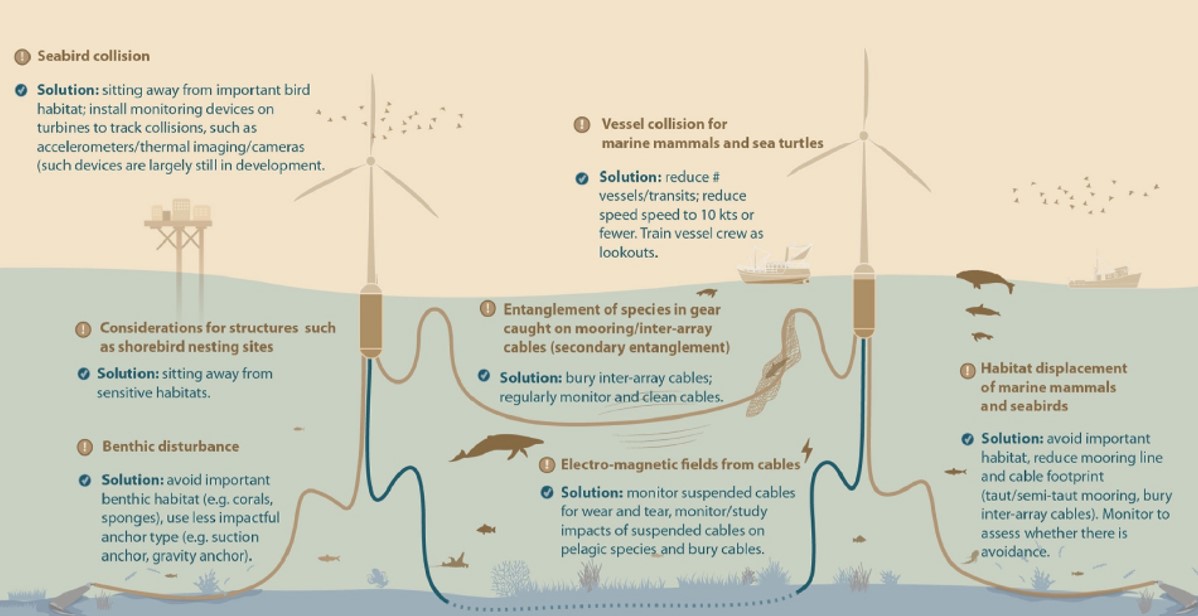
Protecting marine ecosystems, migratory birds, and marine mammals is a top priority. Developers must conduct thorough environmental impact assessments and implement mitigation strategies. Moreover, meaningful engagement with local communities, fisheries, Indigenous peoples, and other ocean users is essential to ensure projects are developed responsibly and inclusively, addressing concerns and fostering local support.
The Future is Afloat: US Floating Wind Outlook
The trajectory for floating offshore wind in the US is undeniably upward. With ambitious federal goals and strong state-level commitments, the next decade promises significant growth and maturation for this transformative technology.
Policy Support & Incentives
The Biden-Harris administration has set a bold target of deploying 15 GW of floating offshore wind by 2035, underscoring a strong federal commitment. This is backed by funding for research and development, tax credits, and strategic lease area designations. States like California are also setting aggressive procurement targets, creating a clear market signal for developers and investors. This policy backbone is essential for de-risking investments and accelerating deployment.
Research & Development
The US Department of Energy and academic institutions are heavily invested in R&D to drive innovation in platform design, mooring systems, dynamic cables, and O&M (operations and maintenance) strategies. The goal is to enhance efficiency, reduce costs, and improve reliability. Collaboration between government, academia, and industry is fostering breakthroughs that will solidify the US as a leader in floating wind technology.
Collaboration & International Partnerships
The US is actively learning from and collaborating with global leaders in floating wind, such as Norway, the UK, and Portugal, who have operational projects and decades of offshore experience. This knowledge transfer is invaluable, helping the US to rapidly advance its own capabilities, adapt best practices, and accelerate the commercialization of floating technology in its unique ocean environments.
The journey to harness floating offshore wind in the United States is an ambitious one, but it’s a journey fueled by innovation, necessity, and a clear vision for a cleaner, more sustainable energy future. The projects listed here are not just dots on a map; they represent the leading edge of a technological revolution that promises to redefine America’s energy landscape and unlock a vast, untapped clean energy resource for generations to come.
Frequently Asked Questions
What is floating offshore wind and how is it different from traditional offshore wind?
Floating offshore wind involves turbines mounted on buoyant platforms tethered to the seabed, allowing deployment in deep waters (over 60 meters). Traditional, fixed-bottom offshore wind turbines are installed directly into the seabed in shallower waters, typically less than 60 meters deep. Floating technology unlocks vast new areas for wind energy where fixed-bottom solutions are not feasible.
Why is floating offshore wind particularly important for the United States?
Floating offshore wind is crucial for the US because it unlocks access to strong, consistent wind resources in deep waters, particularly along the West Coast (California, Oregon) and parts of the East Coast (Gulf of Maine), where the continental shelf drops off rapidly. This significantly expands the nation’s potential for offshore wind, which is critical for meeting ambitious clean energy targets and enhancing energy independence.
What are the main types of floating platforms used for offshore wind turbines?
The three primary types of floating platforms are: Spar-buoy (a tall, slender, submerged cylinder providing stability), Semi-submersible (multi-column platforms partially submerged, offering stability through buoyancy and ballast), and Tension-leg Platform (TLP) (platforms held in place by vertical tendons anchored to the seabed, providing high stability).
What are the biggest challenges for deploying floating offshore wind in the US?
Key challenges include complex and lengthy permitting and regulatory processes, the need for significant investment in port infrastructure and domestic supply chain development, the higher upfront costs compared to fixed-bottom projects (though rapidly decreasing), and ensuring responsible environmental stewardship and stakeholder engagement with marine users and communities.
Which US states are leading the development of floating offshore wind projects?
California is currently leading the charge with significant lease areas off its central and northern coasts (Morro Bay, Humboldt) targeted for multi-gigawatt floating wind farms. Oregon is also actively pursuing floating wind development, and states in the Gulf of Maine (Maine, Massachusetts, New Hampshire) are exploring future opportunities in deeper waters.
What is the US government’s target for floating offshore wind capacity?
The Biden-Harris administration has set an ambitious target of deploying 15 gigawatts (GW) of floating offshore wind capacity by 2035. This goal is supported by federal funding, tax credits, and strategic lease area designations to accelerate development.
How will floating offshore wind benefit the US economy?
Floating offshore wind development is expected to create thousands of high-wage, skilled jobs across the nation in manufacturing, specialized shipbuilding, marine operations, and project management. It will also drive investment in port upgrades, foster technological innovation, and build a robust domestic supply chain, contributing significantly to local and national economies.


