
TwinHub Floating Offshore Wind Project: Unlocking the Celtic Sea’s Deep-Water Potential
Picture this: vast, untapped energy reserves lying in deep ocean waters, previously inaccessible to traditional offshore wind technology. Now, imagine a solution that can unlock them, propelling us into a cleaner, more sustainable future. That’s precisely what the TwinHub Floating Offshore Wind Project in the UK’s Celtic Sea represents. It’s not just another wind farm; it’s a critical demonstration project, pioneering a technology that could redefine the global energy landscape, including for regions like the US West Coast, Gulf of Maine, and the Great Lakes, where deep waters are the norm.
Table of Contents
- TwinHub Floating Offshore Wind Project: Unlocking the Celtic Sea’s Deep-Water Potential
- What is the TwinHub Project? A Pioneering Endeavor in Floating Wind
- Location, Location, Location: Why the Celtic Sea?
- The Core Mission: A 32 MW Demonstration of Next-Gen Technology
- Hexicon’s TwinWind Technology: A Game-Changer Explained
- The Dual-Turbine Advantage: How TwinWind Works
- Why TwinWind? Benefits Over Traditional Floating Designs
- The Journey So Far: Key Milestones and Development Timeline
- From Concept to Consent: A Regulatory Breakthrough
- The Consortium Behind the Innovation: Key Players and Partnerships
- Project Timeline Snapshot
- Why TwinHub Matters: Broader Implications for Offshore Wind
- Unlocking Deep-Water Potential: A Global Blueprint
- Driving Cost Reductions and Industrialization
- Environmental Impact and Sustainability Focus
- The Road Ahead: Challenges and Future Outlook
- Overcoming Hurdles: Supply Chain, Infrastructure, and Grid Connection
- What’s Next? Expanding Floating Wind Beyond TwinHub
If you’re looking for the definitive guide to TwinHub, its groundbreaking technology, and its far-reaching implications, you’ve landed in the right place. We’re going to dive deep into why this project is such a big deal, who’s behind it, and what it means for the future of renewable energy, globally and right here in the United States.
What is the TwinHub Project? A Pioneering Endeavor in Floating Wind
At its heart, the TwinHub project is a 32 MW floating offshore wind farm developed by TwinHub Ltd (a joint venture between Hexicon and Bechtel). It’s designed to be a crucial demonstrator, showcasing the commercial viability and technological prowess of Hexicon’s innovative TwinWind platform. Think of it as a crucial stepping stone, proving that floating wind can deliver reliable, clean power on a significant scale.
Location, Location, Location: Why the Celtic Sea?
The TwinHub project is strategically located approximately 16 kilometers off the coast of Hayle in Cornwall, England, within the well-established Wave Hub test site. Why here? The Celtic Sea is a prime example of a region with excellent wind resources but significant water depth – often exceeding 60 meters – making traditional fixed-bottom offshore wind turbines impractical or prohibitively expensive.
This deep-water characteristic is exactly why floating wind technology is essential. Fixed-bottom foundations, bolted directly to the seabed, become economically unfeasible in such depths. Floating platforms, on the other hand, can be moored to the seabed, allowing them to operate in much deeper waters and access stronger, more consistent winds further offshore. This makes the Celtic Sea a perfect natural laboratory for proving the TwinHub concept, mirroring challenges and opportunities found in US waters like those off California or the deeper parts of the Atlantic seaboard.

The Core Mission: A 32 MW Demonstration of Next-Gen Technology
The primary goal of TwinHub is to demonstrate that Hexicon’s TwinWind technology can be deployed effectively, operate reliably, and generate clean electricity on a pre-commercial scale. With a capacity of 32 MW, it’s not just a small pilot; it’s a substantial project designed to validate the technology and pave the way for much larger commercial floating wind farms. The project is expected to be commissioned and export clean power between 2025 and 2027, a timeline eagerly watched by renewable energy developers worldwide.
This demonstration isn’t just about proving the technology works; it’s also about optimizing installation methods, understanding operational challenges in real-world conditions, and gathering vital data to inform future large-scale developments. For the US, where floating wind is a nascent but critical sector, the lessons learned from TwinHub will be invaluable.
Hexicon’s TwinWind Technology: A Game-Changer Explained
The true innovation behind TwinHub lies in its core technology: Hexicon’s patented TwinWind floating platform. This isn’t your average floating wind turbine; it’s a revolutionary design that pushes the boundaries of offshore wind engineering. Understanding how it works is key to appreciating TwinHub’s significance.
The Dual-Turbine Advantage: How TwinWind Works
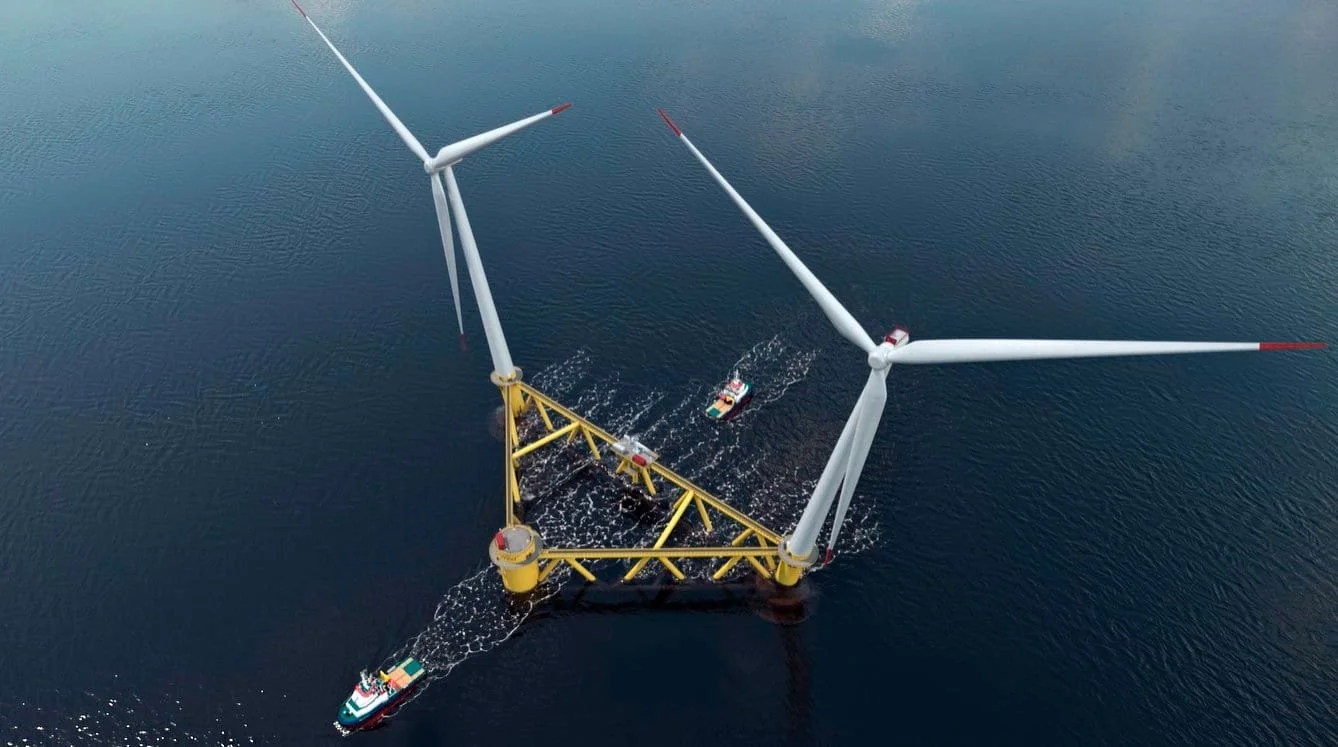
Unlike most floating wind concepts that host a single turbine, the TwinWind platform is designed to accommodate two wind turbines on a single floating foundation. Here’s a closer look at its unique features:
- Dual Turbines: By hosting two turbines on one platform, TwinWind significantly increases the power density of a given sea area. This means more energy generated from a smaller marine footprint.
- Single Mooring Point: The platform utilizes a single, central mooring point, around which the entire structure is designed to weathervane. This ingenious design allows the platform to passively align with the prevailing wind direction, maximizing energy capture and reducing stress on the mooring system.
- Passive Weathervaning: The ability to weathervane naturally minimizes the need for active control systems, simplifying operations and potentially reducing maintenance costs. As the wind shifts, the platform gracefully rotates to face it, ensuring optimal turbine performance.
- Semi-Submersible Design: The TwinWind platform is a semi-submersible structure, providing inherent stability in challenging marine environments. This design choice balances buoyancy and ballast to ensure the platform remains upright and stable even in strong waves and currents.
This integrated approach allows for greater energy production efficiency per platform, which is a critical factor in driving down the Levelized Cost of Energy (LCOE) for floating wind.
Why TwinWind? Benefits Over Traditional Floating Designs
The TwinWind technology offers several compelling advantages over single-turbine floating platforms and even traditional fixed-bottom installations:
| Feature | TwinWind Advantage | Impact |
|---|---|---|
| Power Density | Two turbines per platform | Maximizes energy generation from a smaller sea area; more power output for equivalent footprint. |
| Mooring System | Single mooring point, passive weathervaning | Reduced mooring infrastructure complexity and costs; lower maintenance, self-optimizing wind capture. |
| Cost-Effectiveness | Shared platform, reduced foundation costs per MW | Potential for lower capital expenditure (CAPEX) per megawatt installed; improves project economics. |
| Adaptability | Independent of water depth (within practical limits) | Unlocks vast deep-water areas globally, including those with significant US potential; not limited by seabed conditions. |
| Environmental Footprint | Consolidated infrastructure, fewer foundations | Minimized seabed disturbance; less material usage for foundations. |
By effectively doubling the generation capacity on a single floating unit, TwinWind offers a compelling economic argument. Fewer foundations, fewer mooring lines, and less subsea cabling per megawatt can translate into significant capital and operational expenditure savings over the lifespan of a wind farm. This is crucial for making floating offshore wind competitive with other forms of energy.
The Journey So Far: Key Milestones and Development Timeline
The TwinHub project hasn’t materialized overnight; it’s the result of years of development, engineering, and strategic partnerships. Let’s trace its journey.
From Concept to Consent: A Regulatory Breakthrough
The path to a groundbreaking energy project is paved with rigorous planning and regulatory hurdles. TwinHub reached a critical juncture when it secured its consent authorization, effectively gaining approval to proceed with its development. This was a significant achievement, signaling confidence from regulatory bodies in the project’s design and environmental considerations.
Perhaps even more significantly, TwinHub was awarded the UK’s first-ever dedicated Contract for Difference (CfD) for floating offshore wind. A CfD is a government-backed subsidy mechanism that provides a guaranteed strike price for electricity generated by renewable projects, offering financial certainty to developers and investors. Securing this dedicated CfD underscored the UK government’s commitment to supporting pioneering floating wind technology and cemented TwinHub’s status as a pathfinder project.
The Consortium Behind the Innovation: Key Players and Partnerships
Innovation rarely happens in a vacuum. TwinHub is the product of a powerful collaboration involving leading companies in renewable energy and engineering:
- Hexicon AB: The Swedish pioneer in floating wind technology, Hexicon is the visionary behind the TwinWind platform. They bring deep expertise in design, development, and intellectual property.
- TwinHub Ltd: The joint venture entity responsible for the project’s development and eventual operation.
- Bechtel: A global leader in engineering, procurement, and construction (EPC), Bechtel brings extensive experience in delivering complex infrastructure projects worldwide. Their involvement lends significant project management and construction prowess.
- Mingyang Smart Energy: A major Chinese wind turbine manufacturer, Mingyang is collaborating with Hexicon on the UK demonstrator project, providing valuable engineering experience and potentially supplying the turbines. This international partnership highlights the global nature of innovation in renewable energy.
This combination of technological innovation, engineering expertise, and project delivery capabilities creates a robust foundation for TwinHub’s success.

Project Timeline Snapshot
While specific dates can be fluid in large infrastructure projects, here’s a general overview of TwinHub’s development milestones:
| Phase/Milestone | Approximate Period/Status | Significance |
|---|---|---|
| Initial Development & Concept | Early 2020s | Feasibility studies, Hexicon’s TwinWind technology refinement. |
| Consent Authorization | Early 2020s | Regulatory approval to proceed with the project, environmental and technical reviews. |
| CfD Award (AR4) | 2022 | Secured UK’s first dedicated Contract for Difference for floating offshore wind, ensuring financial viability. |
| Pre-construction & Supply Chain Engagement | Ongoing | Detailed engineering design, securing components, port upgrades, local supply chain development. |
| Expected Commissioning & Operation | 2025-2027 | Full operation, exporting clean power to the grid, critical data collection for future projects. |
Why TwinHub Matters: Broader Implications for Offshore Wind
The TwinHub project is more than a regional energy development; it’s a global statement. Its success will have profound implications for how countries approach their renewable energy goals, especially those with extensive deep-water coastlines, like the United States.
Unlocking Deep-Water Potential: A Global Blueprint
The most significant impact of TwinHub is its role in proving the scalability and reliability of floating offshore wind in deep waters. This is a game-changer for:
- The US West Coast: States like California, Oregon, and Washington have immense offshore wind potential, but their continental shelf drops off rapidly into deep waters. Fixed-bottom technology is largely unsuitable. TwinHub’s success provides a crucial blueprint for developing projects in these vital areas.
- Gulf of Maine: Similarly, parts of the Gulf of Maine present deep-water challenges where floating technology is the only viable path to harnessing significant wind resources.
- Great Lakes: While technically freshwater, the deep sections of the Great Lakes could also potentially benefit from floating solutions, though unique ice-related challenges would need to be addressed.
- Other Global Regions: Many other nations, from Japan and South Korea to Portugal and Norway, have deep coastal waters with excellent wind resources. TwinHub contributes to a global body of knowledge that accelerates their own floating wind ambitions.
By effectively opening up vast new ocean territories for wind energy development, TwinHub demonstrates a pathway to significantly increasing global renewable energy capacity and accelerating the transition away from fossil fuels.
Driving Cost Reductions and Industrialization
Demonstration projects like TwinHub are vital for driving down the costs of emerging technologies. As the project moves through its construction and operational phases, valuable data will be collected on:
- Installation Efficiencies: Optimizing processes for manufacturing, assembly, towing, and connecting floating platforms.
- Supply Chain Development: Fostering local and regional supply chains capable of supporting the floating wind industry, creating jobs and economic growth.
- Operational Learnings: Understanding real-world performance, maintenance needs, and reliability of dual-turbine floating platforms.
Every lesson learned from TwinHub helps streamline future projects, making them faster to deploy and cheaper to operate. This industrialization is essential for floating wind to become a mainstream, competitive energy source.
Environmental Impact and Sustainability Focus
At its core, TwinHub is about clean energy. By harnessing the power of offshore wind, it will contribute significantly to reducing carbon emissions and combating climate change. Furthermore, floating wind projects, when properly designed and sited, can have a lower environmental impact on marine ecosystems compared to fixed-bottom foundations, particularly in areas with sensitive seabed habitats. The careful selection of the Wave Hub test site, an existing marine energy test facility, also minimizes new disruption.
The project’s focus on high power density from a single platform also means a more efficient use of marine space, potentially reducing the overall footprint required for future large-scale floating wind farms.
The Road Ahead: Challenges and Future Outlook
While TwinHub holds immense promise, the journey of any pioneering energy project is not without its challenges. Understanding these hurdles and the path forward is crucial for a realistic outlook on floating offshore wind.
Overcoming Hurdles: Supply Chain, Infrastructure, and Grid Connection
Developing any major offshore wind project, particularly a floating one, involves complex challenges:
- Supply Chain Maturity: While growing, the floating offshore wind supply chain is still evolving. Ensuring timely delivery of specialized components, vessels, and expertise requires careful planning and significant investment.
- Port Infrastructure: Floating platforms require specific port infrastructure for assembly and launch, which may necessitate upgrades or new development in coastal regions.
- Grid Connection: Integrating significant amounts of offshore wind power into existing national grids requires robust transmission infrastructure and smart grid management.
- Financing: As a nascent technology, floating wind projects can still carry higher perceived risks for investors, making securing financing a nuanced process, though CfDs like TwinHub’s help mitigate this.
TwinHub, as a demonstration project, is instrumental in addressing these challenges head-on, providing real-world data and solutions that will benefit future deployments globally.
What’s Next? Expanding Floating Wind Beyond TwinHub
The success of TwinHub is expected to be a catalyst for further floating wind development, both for Hexicon and for the industry at large. The Celtic Sea itself is earmarked for significant floating wind expansion, with targets to deploy 4 GW by 2035. TwinHub will be a critical precursor to these larger commercial arrays.

For Hexicon, TwinHub represents a validation of their core technology, paving the way for licensing agreements and partnerships in other markets, including the US. As the world increasingly looks to offshore wind to meet ambitious decarbonization targets, floating solutions like TwinWind will become indispensable, particularly for countries with deep coastlines and high energy demand.
The TwinHub project isn’t just about generating 32 MW of clean power; it’s about igniting a floating wind revolution. By demonstrating an innovative, cost-effective, and adaptable technology, it’s providing a vital blueprint for countries like the United States to harness their vast deep-water wind resources, driving energy independence, creating jobs, and accelerating our collective journey towards a sustainable energy future. Keep an eye on the Celtic Sea – the ripples of innovation from TwinHub are set to spread far and wide.
Frequently Asked Questions
What is the TwinHub Floating Offshore Wind Project?
The TwinHub project is a 32 MW demonstration floating offshore wind farm located in the UK’s Celtic Sea, off the coast of Cornwall. It’s designed to showcase Hexicon’s innovative TwinWind technology, which utilizes a dual-turbine floating platform, and is considered a pioneering effort in deep-water offshore wind development.
Where is the TwinHub project located?
The TwinHub project is situated approximately 16 kilometers (10 miles) off the coast of Hayle in Cornwall, England, within the designated Wave Hub test site in the Celtic Sea. This location was chosen due to its deep waters and excellent wind resources, which are ideal for demonstrating floating wind technology.
What technology does TwinHub use?
TwinHub utilizes Hexicon’s patented TwinWind technology. This unique floating platform is designed to host two wind turbines on a single semi-submersible foundation. It features a passive weathervaning system, allowing the platform to naturally align with the wind direction around a single mooring point, maximizing energy capture and reducing complexity.
Who are the main partners involved in the TwinHub project?
The TwinHub project is a collaborative effort involving several key players. The project is developed by TwinHub Ltd, a joint venture between Hexicon AB (the technology provider for the TwinWind platform) and Bechtel (a global leader in engineering and construction). China’s Mingyang Smart Energy is also collaborating on the project, providing engineering experience for the demonstrator.
What is the significance of the TwinHub project for the offshore wind industry?
TwinHub is highly significant because it’s a critical demonstration of commercial-scale floating offshore wind in deep waters. It’s the UK’s first floating wind project to secure a dedicated Contract for Difference (CfD). Its success will provide invaluable data and lessons for unlocking vast deep-water wind resources globally, particularly relevant for regions like the US West Coast, Gulf of Maine, and other deep-water areas where fixed-bottom wind is not feasible. It aims to drive down costs and industrialize floating wind technology.
When is the TwinHub project expected to be operational?
The TwinHub project is currently in the pre-construction phase and is expected to be commissioned and begin exporting clean power between 2025 and 2027. This timeline is subject to various factors inherent in large-scale infrastructure projects.
How does floating offshore wind differ from fixed-bottom offshore wind?
Fixed-bottom offshore wind turbines are permanently installed on foundations drilled or piled into the seabed, typically in waters up to about 60 meters deep. Floating offshore wind turbines, however, are mounted on buoyant platforms that are moored to the seabed, allowing them to operate in much deeper waters (often 60 meters or more). This unlocks access to stronger, more consistent winds further offshore and opens up new coastal regions globally for wind energy development.


