Vertical Axis Wind Turbines Offshore: The Future of Deep-Water Wind Power?
When you picture an offshore wind farm, what comes to mind? Towering structures with massive, three-bladed propellers majestically spinning against the horizon, right? Those are Horizontal Axis Wind Turbines (HAWTs), and they’ve been the undisputed champions of wind energy for decades. But for the toughest, deepest offshore environments, where traditional HAWTs struggle with stability, cost, and maintenance, a formidable challenger is emerging: the Vertical Axis Wind Turbine (VAWT).
Table of Contents
- Vertical Axis Wind Turbines Offshore: The Future of Deep-Water Wind Power?
- What Exactly is a Vertical Axis Wind Turbine (VAWT)?
- A Different Spin on Wind Energy
- Key Types of VAWTs for Offshore Consideration
- Why VAWTs are Turning Heads for Offshore Applications
- Stability in the Swell: Lower Center of Gravity
- Wind from Any Direction: Omnidirectional Operation
- Maintenance Made Easier: Ground-Level Components
- Design Simplicity & Manufacturing Potential
- Reduced Acoustic and Visual Impact?
- The Rough Seas Ahead: Challenges for Offshore VAWTs
- Structural Fatigue: The Achilles’ Heel
- Scaling Up: The Power Output Puzzle
- Starting Torque & Self-Starting Issues
- Market Maturity & Investment
- The Innovation Wave: Current Research & Development
- Floating Platforms: The Perfect Match?
- Advanced Aerodynamics & Blade Design
- Hybrid Designs & Control Systems
- Grid Integration & Energy Storage
- The Future Outlook: Will Offshore VAWTs Dominate the Horizon?
- Unlocking Deep Water Potential
- Environmental Considerations & Social Acceptance
- Investment & Policy Landscape
- Conclusion: A Promising Horizon
For years, VAWTs have been seen as niche players, often relegated to smaller, land-based applications. Yet, their unique design – with blades that spin around a vertical axis – offers compelling advantages for the harsh, dynamic conditions of the open ocean, especially when paired with innovative floating platforms. We’re talking about unlocking vast energy potential in waters previously deemed too deep or too challenging for wind power.
So, could VAWTs be the game-changer for next-generation offshore wind, particularly in deep waters? Let’s dive in.
What Exactly is a Vertical Axis Wind Turbine (VAWT)?
A Different Spin on Wind Energy
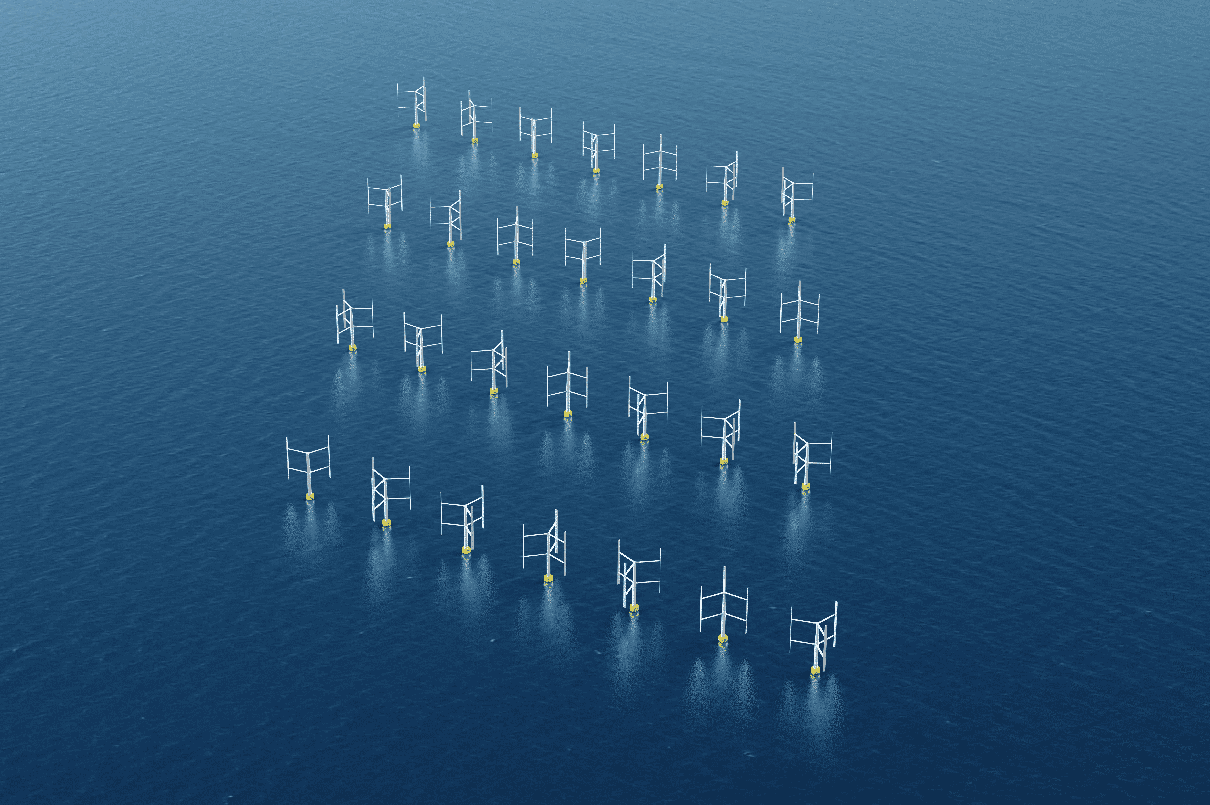
Imagine a giant egg beater or a rotating H-shaped structure, and you’re close to visualizing a VAWT. Unlike their HAWT cousins, where the main rotor shaft and electrical generator are at the top of a tower (like an airplane propeller), VAWTs have their primary rotating shaft positioned vertically, perpendicular to the ground. This fundamental difference unlocks a host of distinct characteristics and potential benefits, especially for the demanding offshore environment.
The blades of a VAWT capture wind from any direction, meaning the turbine doesn’t need to ‘yaw’ or turn to face the wind. This simplifies the design and reduces the number of moving parts exposed to the elements. For offshore operations, where consistent wind direction can be unpredictable and maintenance is costly, this omnidirectional capability is a significant advantage.
Key Types of VAWTs for Offshore Consideration
While various VAWT designs exist, two main types are most often discussed in the context of large-scale offshore applications, sometimes combined into hybrid systems:
- Darrieus VAWTs: These are the most common high-efficiency VAWTs. They are characterized by their aerofoil-shaped blades (like airplane wings) which generate lift as the wind passes over them, creating torque.
- H-rotor (or Giromill): Features straight, vertical blades attached to horizontal spokes, giving it an ‘H’ shape.
- Troposkien (or Egg-beater): Recognizable by its curved blades that minimize bending stress, resembling a whisk.
- Savonius VAWTs: These are drag-type devices, typically consisting of two or more ‘S’-shaped scoops or cups. They are robust and self-starting but generally less aerodynamically efficient than Darrieus types. They’re often used in hybrid designs to help Darrieus turbines start spinning.
For offshore, the structural simplicity and potential for modularity in Darrieus designs, coupled with the self-starting reliability of Savonius, present exciting avenues for development.
| VAWT Type | Key Characteristic | Offshore Suitability Highlight | Current Status/Examples |
|---|---|---|---|
| Darrieus (Troposkien) | Curved, aerofoil blades; high aerodynamic efficiency; ‘egg-beater’ shape. | Reduced blade bending stress; good for structural integrity in marine environments. | Focus of many advanced floating VAWT designs; undergoing R&D and pilot projects. |
| Darrieus (H-Rotor/Giromill) | Straight, vertical aerofoil blades; often multi-bladed ‘H’ shape. | Simpler manufacturing; potentially easier to scale; good lift generation. | Common in academic studies and some conceptual offshore designs. |
| Savonius | S-shaped scoops/cups; drag-based; high starting torque. | Excellent self-starting capability; robust in turbulent conditions. | Often integrated into hybrid VAWT systems to assist Darrieus types with startup. |
| Hybrid Designs | Combines elements of Darrieus (efficiency) and Savonius (starting torque). | Aims to leverage best features for offshore robustness and performance. | Active area of research to overcome limitations of individual types. |
Why VAWTs are Turning Heads for Offshore Applications
The allure of VAWTs for offshore wind isn’t just theoretical; it’s rooted in fundamental engineering advantages that directly address the pain points of deploying wind energy in deep, turbulent waters. Let’s compare them to traditional HAWTs in this challenging environment:
| Feature | Vertical Axis Wind Turbines (VAWT) Offshore | Horizontal Axis Wind Turbines (HAWT) Offshore |
|---|---|---|
| Rotor Orientation | Vertical axis, perpendicular to the ground. | Horizontal axis, parallel to the ground (like a propeller). |
| Center of Gravity | Significantly lower, often near or below the water line. | High, at the top of the tower (nacelle with generator, gearbox). |
| Yaw Mechanism | None required; omnidirectional wind capture. | Complex, heavy mechanism to orient the rotor into the wind. |
| Maintenance Access | Major components (generator, gearbox) can be placed at the base, near water level. | Major components are high up in the nacelle, requiring specialized access and vessels. |
| Wind Direction Sensitivity | Unaffected by changes in wind direction (omnidirectional). | Requires active yawing to track wind, leading to wear and tear. |
| Structural Loading | More uniform loading on support structure; reduced overturning moments. | Significant dynamic and overturning loads due to high center of gravity. |
| Platform Type Suitability | Highly suitable for floating platforms (semi-submersible, spar, TLP) due to stability. | Can be adapted for floating, but high CoG poses significant stability challenges and larger platform requirements. |
| Power Density | Historically lower; new designs showing significant improvements and potential for closer spacing. | High individual power output; but significant wake effects require wider spacing. |
| Market Maturity | Emerging, with several promising prototypes and research projects. | Mature, dominant technology with established supply chains. |
| Noise/Visual Impact | Potentially lower tip speeds; less visual clutter (no nacelle). | Higher tip speeds; prominent nacelle and blades. |
Stability in the Swell: Lower Center of Gravity
This is arguably the most compelling advantage for offshore VAWTs, especially in the context of floating wind farms. With the majority of their mass (generator, gearbox, and heavier components) located at or near the base, VAWTs boast a significantly lower center of gravity (CoG) compared to HAWTs. Why does this matter in the ocean?
A lower CoG drastically improves the stability of a floating platform. It means:
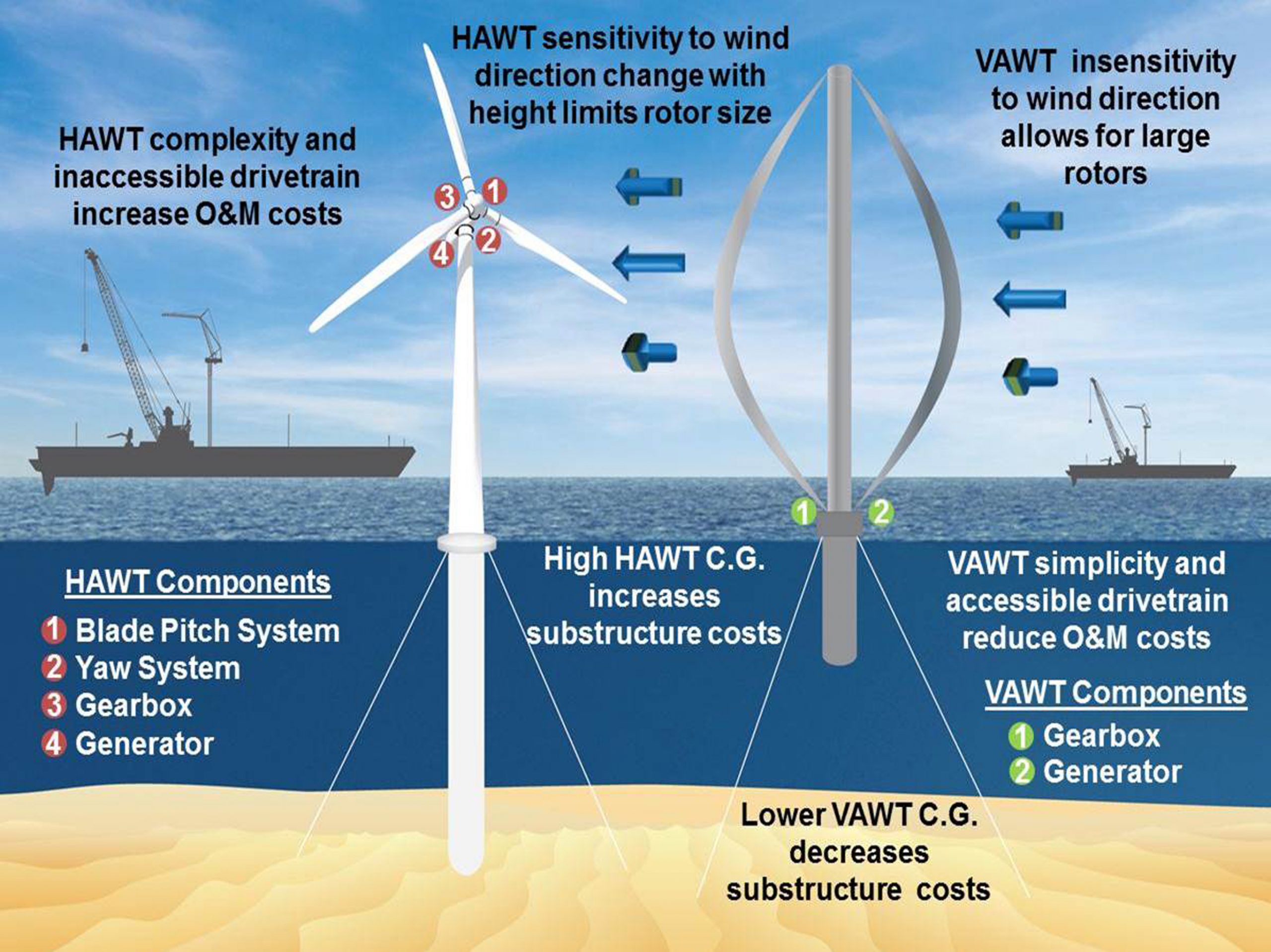
- Reduced Overturning Moments: Less leverage for waves and strong winds to tip the entire structure.
- Smaller, Simpler Platforms: Floating foundations can be designed to be less massive and complex, reducing material costs and fabrication time.
- Enhanced Dynamics: The system responds more favorably to wave motion, leading to less stress on mooring lines and connections.
Companies like SeaTwirl are pioneering designs that integrate the turbine and generator directly into a stable, submersible structure, further exemplifying this benefit.
Wind from Any Direction: Omnidirectional Operation
Offshore wind isn’t always perfectly consistent. Turbulences, shifts in wind direction, and unpredictable gusts are common. HAWTs require a complex and energy-consuming ‘yaw’ system to constantly turn the nacelle and blades into the wind. VAWTs, however, are inherently omnidirectional. They capture wind equally effectively from any direction. This eliminates the need for a yaw mechanism, leading to:
- Reduced Mechanical Complexity: Fewer moving parts means less to break down.
- Lower Maintenance Costs: No yaw system to maintain or repair.
- Improved Efficiency in Turbulent Winds: Instantaneous power capture regardless of rapid wind shifts.
Maintenance Made Easier: Ground-Level Components
Imagine needing to repair a gearbox in the middle of the ocean, 300 feet up a tower, in rough seas. That’s the reality for HAWT maintenance. For VAWTs, the major power-generating components (generator, gearbox) can be positioned at the base of the turbine, near or even below the water line. This offers immense operational advantages:
- Safer and Easier Access: Technicians can perform maintenance from a vessel or even from within the floating platform itself.
- Reduced Downtime: Repairs can be conducted more quickly and in a wider range of weather conditions.
- Lower Operational & Maintenance (O&M) Costs: Less need for specialized, expensive heavy-lift vessels and highly skilled climbing teams.
Design Simplicity & Manufacturing Potential
While the overall system is still complex, many VAWT designs exhibit a fundamental simplicity in their rotating elements compared to HAWTs. Their modular nature could lend itself to more streamlined manufacturing processes and potentially local fabrication, reducing reliance on highly specialized global supply chains. This translates to:
- Potentially Lower Capital Expenditure (CAPEX): Simpler components can be cheaper to produce.
- Faster Deployment: Easier assembly and installation offshore.
- Local Economic Benefits: Opportunities for regional manufacturing and job creation.
Reduced Acoustic and Visual Impact?
While often less critical for deep offshore locations, VAWTs generally operate at lower tip speeds than HAWTs. This can result in reduced acoustic noise, which might be a consideration for marine life. Visually, some VAWT designs, without a prominent nacelle, can appear less imposing, potentially easing concerns in areas with higher visibility.
The Rough Seas Ahead: Challenges for Offshore VAWTs
Despite their compelling advantages, VAWTs face significant hurdles before they can widely challenge HAWTs in the offshore arena. It’s not just smooth sailing; there are engineering and economic challenges that require innovative solutions.
Structural Fatigue: The Achilles’ Heel
One of the most persistent challenges for VAWTs is their susceptibility to fatigue loading. The blades experience complex and highly dynamic forces as they rotate into and out of the wind stream. This cyclic loading can lead to material fatigue over time, particularly at the blade roots and support structures. Offshore, with the added forces from waves and currents, this problem is exacerbated.
Current research focuses on:
- Advanced Materials: Utilizing stronger, lighter, and more fatigue-resistant composites.
- Improved Blade Design: Aerodynamic and structural optimization to distribute loads more evenly.
- Damping Systems: Incorporating mechanisms to absorb and dissipate vibrations.
Scaling Up: The Power Output Puzzle
Historically, VAWTs have struggled to achieve the same power coefficient (the efficiency with which they convert wind energy into mechanical energy) as large HAWTs. This means for the same rotor swept area, they might generate less power. Scaling VAWTs to the multi-megawatt sizes required for economically viable offshore farms presents engineering challenges related to:
- Aerodynamic Optimization: Designing blades and rotor configurations that maximize power capture across varying wind speeds.
- Wake Effects: Understanding and mitigating how the turbulence created by one VAWT affects those downwind in a large array.
Sandia National Laboratories, for instance, is actively researching innovative rotor designs to overcome these scaling limitations for large offshore VAWTs.
Starting Torque & Self-Starting Issues
Many pure Darrieus VAWT designs are not inherently self-starting; they require an external push or motor to begin rotation. While this isn’t a deal-breaker (a small motor can do the job), it adds complexity and energy consumption. For offshore environments, reliable self-starting is critical to maximize energy capture.
Solutions include:
- Hybrid Designs: Incorporating Savonius elements (which are self-starting) into Darrieus turbines.
- Smart Control Systems: Using sophisticated electronics to precisely control startup and optimize performance.
Market Maturity & Investment
The offshore wind industry is dominated by HAWTs, which benefit from decades of development, established supply chains, and proven track records. VAWTs, especially for large-scale offshore, are still largely in the prototype and demonstration phase. This creates a ‘chicken and egg’ problem:
- High Development Costs: Significant investment is needed for R&D, testing, and scaling.
- Perceived Risk: Investors are cautious about backing unproven technologies over established ones.
- Regulatory Hurdles: Navigating permitting and grid connection for novel designs can be more complex.
Overcoming this requires strong government support, private investment in pilot projects, and clear policy pathways.
The Innovation Wave: Current Research & Development
Despite the challenges, the potential benefits of offshore VAWTs are so compelling that research and development efforts are intensifying globally. Here’s where the cutting edge is heading:
Floating Platforms: The Perfect Match?
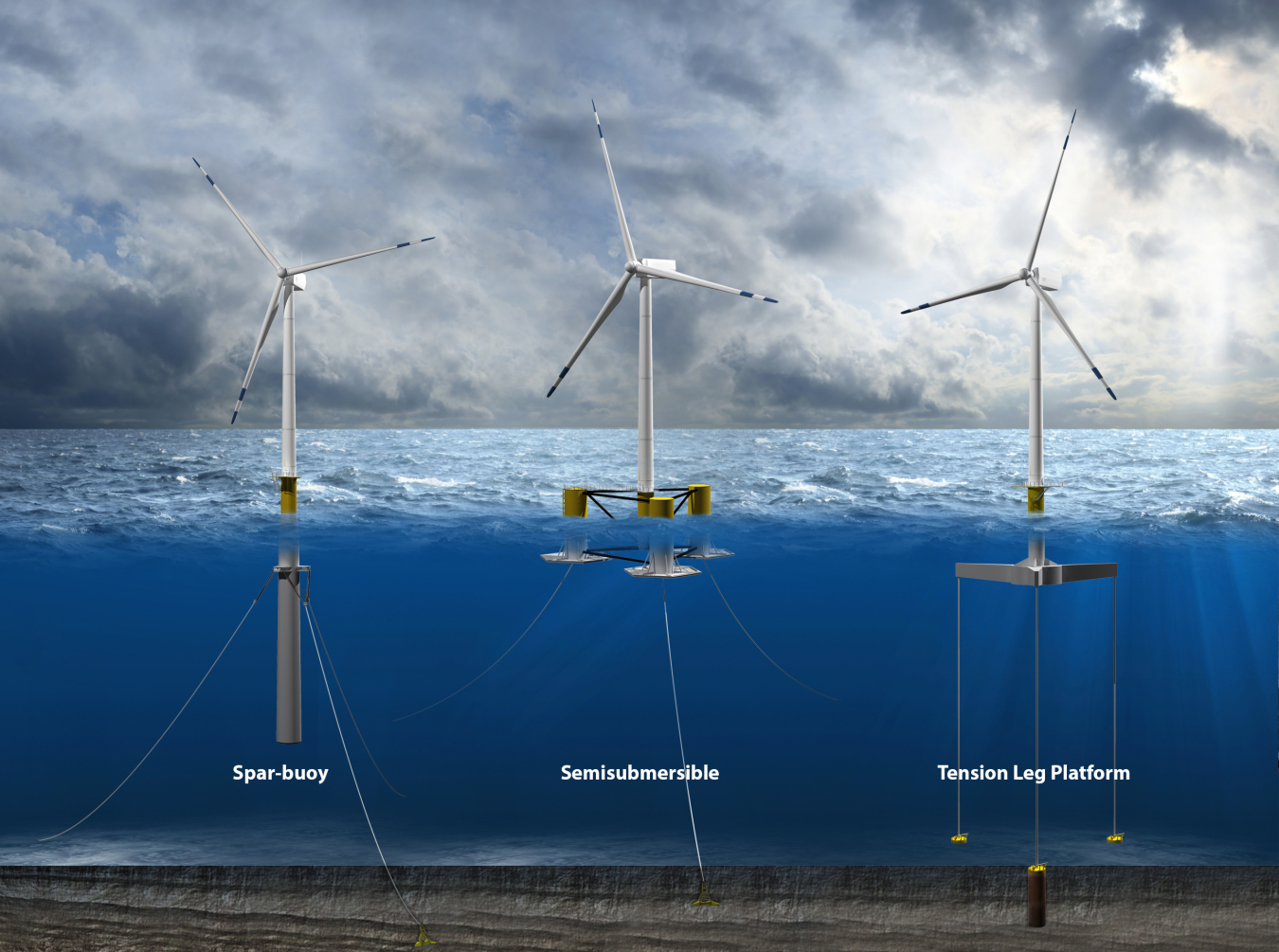
The inherent stability and low center of gravity of VAWTs make them ideal candidates for floating offshore wind platforms, which are essential for exploiting deep-water sites. Researchers are exploring how VAWTs can be optimally integrated with various floating substructures:
- Semi-submersibles: Stable platforms with multiple columns partially submerged.
- Spar Buoys: Long, slender, cylindrical structures that float mostly submerged, offering deep draft stability.
- Tension-Leg Platforms (TLPs): Buoyant platforms moored by taut tethers to the seabed, providing excellent stability.
The synergy between VAWTs and these platforms promises to reduce platform size, cost, and complexity, making deep-water deployment more economically feasible. The ARPA-E ALPHA program, for example, has focused on developing low-cost floating offshore VAWT systems.
Advanced Aerodynamics & Blade Design
Computational Fluid Dynamics (CFD) is playing a crucial role in simulating and optimizing VAWT blade designs. Researchers are exploring:
- Variable Pitch Blades: Blades that can change their angle of attack to optimize performance across different wind speeds and reduce fatigue loads.
- Morphing Airfoils: Blades that can actively change their shape to improve aerodynamic efficiency.
- Multi-Rotor Systems: Combining multiple smaller VAWT rotors on a single platform to increase overall power density.
These innovations aim to boost power output and enhance structural longevity, directly addressing the historic limitations of VAWTs.
Hybrid Designs & Control Systems
As mentioned, hybrid VAWT designs (e.g., combining Savonius and Darrieus elements) are a key area of research to improve self-starting capabilities and overall performance. Beyond design, sophisticated control systems are being developed:
- Smart Sensors: Real-time monitoring of wind conditions, structural stress, and performance.
- AI and Machine Learning: Algorithms to optimize turbine operation, predict maintenance needs, and manage power output for grid stability.
These intelligent systems will be crucial for maximizing energy capture and minimizing downtime in the challenging offshore environment.
Grid Integration & Energy Storage
The eventual success of offshore VAWT farms depends not just on turbine efficiency but on their seamless integration with the electrical grid. Research includes:
- Efficient Power Transmission: Developing high-voltage direct current (HVDC) systems for long-distance power transfer from remote offshore sites.
- Integrated Storage Solutions: Exploring the combination of offshore wind farms with battery storage or hydrogen production to provide a more stable and dispatchable power supply.
The Future Outlook: Will Offshore VAWTs Dominate the Horizon?
The journey for offshore Vertical Axis Wind Turbines is far from over, but the direction is clear: immense potential for unlocking vast, previously inaccessible offshore wind resources. This isn’t just about incremental improvements; it’s about a paradigm shift for certain applications.
Unlocking Deep Water Potential
Fixed-bottom offshore wind turbines are limited to shallower waters, typically less than 60 meters deep. The vast majority of the world’s highest-quality offshore wind resources lie in much deeper waters. Floating wind, enabled by technologies like offshore VAWTs, can unlock these sites, vastly expanding the global potential for renewable energy. The low-cost, stable platform inherent to VAWT designs makes them exceptionally competitive for these deep-water scenarios, paving pathways for significant cost reductions (LCOE).
Environmental Considerations & Social Acceptance
With their potentially lower operational noise and unique visual profile, offshore VAWTs might offer advantages in terms of environmental impact and social acceptance, particularly concerning marine ecosystems. While more research is needed, early indications suggest reduced impacts on bird populations due to lower tip speeds. The ‘unseen’ nature of much of the turbine’s mass beneath the water line could also lead to reduced visual intrusion from shore, a common concern for coastal communities.
Investment & Policy Landscape
The push for decarbonization and energy independence is accelerating interest in all forms of renewable energy. Governments and energy agencies are increasingly recognizing the strategic importance of floating offshore wind. This is translating into:
- Increased R&D Funding: Programs like those from the Department of Energy (DOE) and ARPA-E are specifically targeting innovative offshore wind technologies, including VAWTs.
- Supportive Policies: Tax incentives, regulatory streamlining, and renewable energy targets are creating a more favorable investment climate.
These policy drivers are crucial for helping offshore VAWTs move from demonstration projects to commercial deployment.
Conclusion: A Promising Horizon
Vertical Axis Wind Turbines, once overlooked, are rapidly gaining traction as a vital component in the future of offshore wind energy. Their inherent stability, omnidirectional wind capture, and easier maintenance access make them uniquely suited for the challenges of deep-water floating platforms. While significant engineering and financial hurdles remain – primarily related to structural fatigue, power scaling, and market maturity – the ongoing surge in R&D is systematically addressing these issues.
It’s unlikely that offshore VAWTs will entirely replace traditional HAWTs. Instead, they are poised to carve out a crucial and complementary niche, particularly in vast, deep-water regions where conventional designs struggle. As we look to harness the full power of the ocean’s winds, Vertical Axis Wind Turbines may well be the innovative solution that helps us reach a truly sustainable energy future.
Frequently Asked Questions
What is the main difference between a Vertical Axis Wind Turbine (VAWT) and a Horizontal Axis Wind Turbine (HAWT)?
The primary difference lies in the orientation of their main rotor shaft. HAWTs have a horizontal axis (like a propeller), requiring them to yaw into the wind. VAWTs have a vertical axis, allowing them to capture wind from any direction without needing a yaw mechanism, simplifying their design.
Why are VAWTs considered advantageous for offshore wind applications, especially in deep waters?
Offshore VAWTs offer several benefits: a significantly lower center of gravity (enhancing stability for floating platforms), omnidirectional wind capture (no yawing needed), and the ability to place major components at the base for easier maintenance, all of which reduce costs and complexity in harsh marine environments.
What are the biggest challenges facing offshore VAWT deployment?
Key challenges include managing structural fatigue from complex cyclic loading, scaling up designs to achieve competitive power output, improving self-starting capabilities for certain VAWT types, and overcoming market maturity hurdles to attract significant investment against established HAWT technology.
What types of VAWTs are being considered for large-scale offshore use?
Primarily Darrieus-type VAWTs (like the Troposkien ‘egg-beater’ or H-rotor ‘Giromill’ designs) are being developed for their aerodynamic efficiency. Savonius VAWTs, known for high starting torque, are often integrated into hybrid designs to assist Darrieus types.
How do VAWTs contribute to the stability of floating offshore platforms?
By having their heaviest components (generator, gearbox) positioned at the base, often near or below the water line, VAWTs create a very low center of gravity. This significantly improves the stability of floating platforms, reduces overturning moments from waves and wind, and allows for smaller, less complex platform designs.
What kind of research is currently being conducted to advance offshore VAWT technology?
Current R&D focuses on advanced aerodynamics and blade design (e.g., variable pitch blades), developing robust hybrid VAWT designs, integrating sophisticated control systems, and optimizing their coupling with various floating platform types (semi-submersibles, spars, TLPs) to enhance performance and reduce costs.