
Setting Up a Wind Turbine For Your Home: The Definitive Guide to Harnessing Residential Wind Power
Dreaming of energy independence, a lower electricity bill, and the satisfaction of harnessing nature’s power? Setting up a wind turbine for your home can be an incredibly rewarding journey. But let’s be real: it’s not as simple as plugging in a new appliance. There’s a lot to consider, from the whisper of the wind in your backyard to the local zoning regulations.
Table of Contents
- Setting Up a Wind Turbine For Your Home: The Definitive Guide to Harnessing Residential Wind Power
- Phase 1: The Crucial Pre-Installation Assessment – Is Your Home a Wind Power Candidate?
- Step 1: Assessing Your Wind Resource – It’s All About the Breeze
- Step 2: Site Selection & Space Requirements – Location, Location, Location
- Step 3: Local Regulations & Permitting – Don’t Skip the Red Tape!
- Step 4: Budgeting & Financial Realities – What Will it Cost You?
- Phase 2: Choosing the Right Residential Wind Turbine – Size, Type, and System
- Understanding Your Energy Needs – How Much Power Do You Really Use?
- Horizontal Axis Wind Turbines (HAWTs) vs. Vertical Axis Wind Turbines (VAWTs)
- Grid-Tied vs. Off-Grid Systems – Your Energy Independence Choice
- Key Components of a Home Wind System
- Phase 3: The Installation Process – From Foundation to Power Generation
- Step 1: Foundation Preparation – The Unseen Anchor
- Step 2: Tower Assembly & Erection – Reaching for the Sky
- Step 3: Mounting the Turbine Components – The Heart of the System
- Step 4: Electrical Connections & Grid Integration – Bringing Power Indoors
- Step 5: System Testing & Commissioning – The Moment of Truth
- Living with Home Wind Power: Maintenance, Safety, and Optimization
- Regular Maintenance – Keeping the Blades Spinning
- Safety Considerations – Protecting Your Investment & Yourself
- Optimizing Performance – Maximizing Your Energy Harvest
- Is Wind Power Better Than Solar For Your Home? A Quick Comparison
- Conclusion: Your Journey to Residential Wind Energy
Many homeowners jump straight to looking at turbine models, but the truth is, the most critical steps happen long before any hardware arrives. You need to know if your property is even a good candidate, what kind of system fits your lifestyle, and what hurdles you might face. This guide isn’t about selling you a turbine; it’s about giving you the unfiltered, step-by-step knowledge you need to make an informed decision and navigate the process successfully.
By the end of this comprehensive read, you’ll understand:
- How to assess your home’s wind energy potential.
- The crucial regulatory and financial considerations.
- Which type of wind turbine is right for you.
- The core components and installation phases.
- Maintenance tips to keep your system humming for years.
Phase 1: The Crucial Pre-Installation Assessment – Is Your Home a Wind Power Candidate?
Before you even think about buying a turbine, you need to determine if wind power is a practical and economically viable option for your specific property. This phase is often overlooked, but it’s absolutely critical. Skipping these steps can lead to costly mistakes, wasted time, and a system that underperforms or simply isn’t allowed.
Step 1: Assessing Your Wind Resource – It’s All About the Breeze
A wind turbine is only as good as the wind that spins its blades. You need a consistent, strong wind resource. It’s not enough to feel a breeze; you need measurable data. The key here is average annual wind speed and its consistency. A general rule of thumb for viable residential wind power is an average wind speed of at least 10-12 mph (4.5-5.4 m/s) at the proposed turbine height.
How to Measure and Find Data:
- Anemometers: The most accurate way is to install an anemometer (a wind speed measuring device) on a tall mast at the proposed turbine height for at least a year. This gives you site-specific data.
- Local Weather Stations: Check data from nearby airports or weather stations. While not site-specific, it can give you a general idea.
- Online Resources: The National Renewable Energy Laboratory (NREL) and NOAA provide wind maps and data that can offer preliminary insights into regional wind resources.
Obstacles and Turbulence: The “30-Foot Rule”
Wind flowing over buildings, trees, or other obstacles creates turbulence, which reduces a turbine’s efficiency and increases wear and tear. A widely accepted guideline is to install the bottom of your turbine’s rotor blades at least 30 feet (9 meters) above any obstruction within a 500-foot radius. Taller towers mean access to smoother, stronger winds, but also higher costs.
| Average Wind Speed (mph) | Average Wind Speed (m/s) | Theoretical Power Output (Watts/m² rotor area) | Feasibility for Home Use |
|---|---|---|---|
| 7 mph | 3.1 m/s | ~15 W/m² | Often too low for economic viability. |
| 10 mph | 4.5 m/s | ~45 W/m² | Marginal for small turbines, limited ROI. |
| 12 mph | 5.4 m/s | ~80 W/m² | Good potential for small residential turbines. |
| 15 mph | 6.7 m/s | ~150 W/m² | Excellent for most residential wind energy goals. |
Note: Theoretical output scales with the cube of wind speed. Actual output depends heavily on turbine efficiency, air density, and site-specific conditions.
Step 2: Site Selection & Space Requirements – Location, Location, Location
Once you know you have enough wind, you need to identify a suitable physical location on your property. This involves more than just finding an open spot.
- Minimum Land Requirements: Small residential turbines (1-10 kW) often require a minimum of ½ to 1 acre of land. This isn’t just for the turbine itself, but for setback requirements from property lines, buildings, and utility lines. Guyed towers, which are common for smaller systems, also need a significant footprint for their anchor points.
- Proximity to Your Home/Grid: The farther the turbine is from your home’s electrical panel or the grid connection point, the more expensive the wiring runs will be, and the greater the energy loss.
- Noise Considerations: While modern turbines are much quieter than older models, they still produce some noise, especially at higher wind speeds. Consider your neighbors and local noise ordinances. Typically, the further away from residential areas, the better.
Step 3: Local Regulations & Permitting – Don’t Skip the Red Tape!
This is often the biggest hurdle for homeowners. Regulations vary wildly by municipality, county, and state. Never assume anything; always check with your local planning department and utility company early in the process.
- Zoning Laws: These dictate what you can build on your property, including height restrictions, setback requirements (distance from property lines), and even aesthetic guidelines. Some areas have outright bans on wind turbines.
- Building Codes: Your tower and foundation must meet structural integrity codes, especially concerning wind loads. This usually requires stamped engineering plans.
- Utility Interconnection Agreements: If you plan on a grid-tied system (the most common type), you’ll need permission from your utility company. They’ll have specific requirements for safety disconnects, metering, and how your system connects to their grid. This process can be lengthy.
- Noise Ordinances: Some localities have decibel limits for ambient noise, which your turbine might need to adhere to.
- Homeowners’ Association (HOA) Rules: If you live in an HOA, their covenants might have strict rules or outright prohibitions on external structures like wind turbines.
Action Step: Contact your local planning department, building department, and utility provider as soon as possible. Get everything in writing.
Step 4: Budgeting & Financial Realities – What Will it Cost You?
A residential wind turbine system is a significant investment. Understanding the costs upfront is crucial for determining feasibility and potential return on investment (ROI).
- Initial Investment Breakdown (Typical Ranges for 1-10 kW Systems):
- Turbine: $3,000 – $20,000+ (depending on size, brand, and features).
- Tower: $2,000 – $15,000+ (depending on height, type, and foundation requirements).
- Inverter: $1,000 – $5,000 (converts DC power to AC for your home).
- Batteries (for off-grid/backup): $5,000 – $20,000+ (major cost, depends on capacity).
- Charge Controller (for battery systems): $500 – $2,000.
- Installation Labor: $5,000 – $20,000+ (highly variable, can be 30-50% of total cost).
- Permits & Engineering: $500 – $3,000+.
- Miscellaneous (Wiring, Conduit, Safety Devices): $1,000 – $5,000.
Total Estimated Cost: Expect to pay anywhere from $15,000 to $70,000+ for a complete residential system.
- Operating Costs:
- Maintenance: Budget $100-$500 annually for inspections, lubrication, and occasional component replacement.
- Insurance: Your home insurance premium might increase.
- Potential Incentives:
- Federal Investment Tax Credit (ITC): As of 2023, homeowners can claim a 30% tax credit for eligible residential wind turbine systems. This is a dollar-for-dollar reduction in your tax liability.
- State & Local Rebates/Incentives: Many states and local utilities offer additional programs, grants, or property tax exemptions for renewable energy installations. Check the DSIRE database for programs in your area.
Phase 2: Choosing the Right Residential Wind Turbine – Size, Type, and System
Once you’ve determined your property is a viable candidate, the next step is selecting the appropriate wind turbine and system configuration. This isn’t a one-size-fits-all decision.
Understanding Your Energy Needs – How Much Power Do You Really Use?
Before selecting a turbine, you need to know how much electricity you consume. Review your past 12 months of utility bills to calculate your average daily or monthly kWh (kilowatt-hour) consumption. This will help you size your system appropriately. Are you looking to offset a portion of your bill, or achieve near 100% energy independence?
Horizontal Axis Wind Turbines (HAWTs) vs. Vertical Axis Wind Turbines (VAWTs)
Residential turbines primarily fall into two categories:
- Horizontal Axis Wind Turbines (HAWTs): These are the traditional ‘windmill’ style turbines with blades that rotate around a horizontal axis, similar to an airplane propeller. They are generally more efficient.
- Vertical Axis Wind Turbines (VAWTs): These turbines have blades that rotate around a vertical axis. They often have a more compact, sculptural design and don’t need to orient into the wind.
| Feature | Horizontal Axis Wind Turbines (HAWTs) | Vertical Axis Wind Turbines (VAWTs) |
|---|---|---|
| Efficiency | High (generally 40-50% of Betz limit) | Moderate (generally 10-30% of Betz limit) |
| Wind Direction | Requires a yaw mechanism to face into the wind | Omnidirectional (no yaw needed, can capture wind from any direction) |
| Noise | Can be noticeable at higher speeds; whooshing sound | Generally quieter due to lower tip speeds |
| Start-up Wind Speed | Often higher (e.g., 6-8 mph) | Can start at lower wind speeds (e.g., 4-5 mph) |
| Tower Height | Typically requires taller towers for clear, laminar air flow | Can be mounted closer to the ground or on roofs (though roof mounting is generally discouraged) |
| Maintenance Access | Higher up, often requires specialized equipment for service | Easier access to components for maintenance |
| Aesthetics | Traditional ‘windmill’ look, can be visually prominent | More modern/sculptural, can blend more easily |
Grid-Tied vs. Off-Grid Systems – Your Energy Independence Choice
How you want to use the generated electricity dictates your system type:
- Grid-Tied Systems: This is the most common residential setup. Your turbine generates electricity, which is converted to AC by an inverter and fed directly into your home’s electrical panel. Any excess power is sent back to the utility grid, often earning you credits through a program called net metering. When the wind isn’t blowing, you draw power from the grid. These systems don’t have batteries, making them simpler and often more affordable initially. However, they shut down during a power outage to protect utility workers.
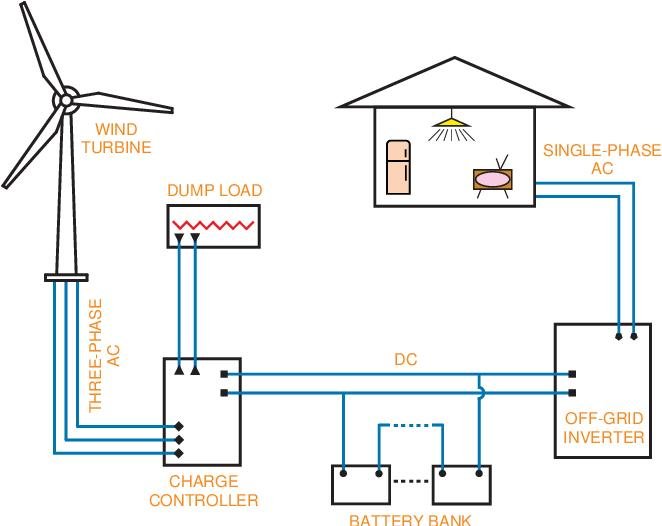
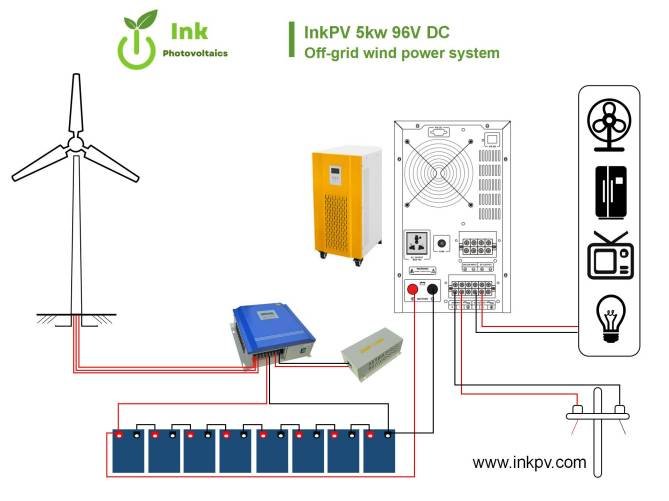
- Off-Grid Systems: For true energy independence, an off-grid system isn’t connected to the utility grid at all. All power generated by the turbine (or solar panels) must be stored in a battery bank. This requires a charge controller to manage battery charging and an inverter to convert battery power to AC for your home. These systems are more complex, more expensive due to battery costs, and require careful sizing to ensure you have enough stored energy during low-wind periods.
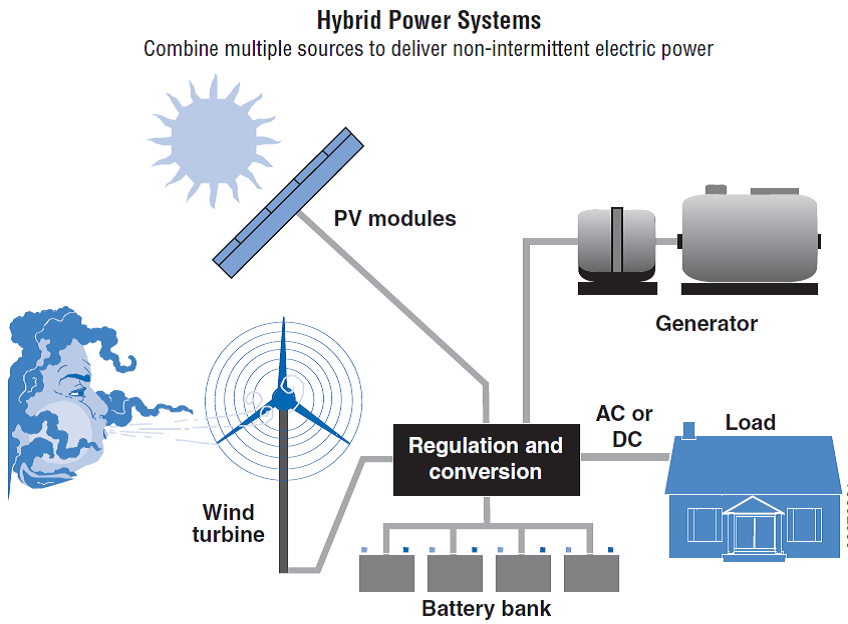
- Hybrid Systems: Combining wind with solar panels and a battery bank offers the best of both worlds. Wind typically produces more power in winter and at night, while solar excels in summer days. This combination can lead to more consistent year-round energy production and greater energy independence.
Key Components of a Home Wind System
Regardless of the type, a residential wind system generally consists of:
- Turbine: The core component, including the rotor (blades) and generator, which converts wind energy into electrical energy (DC).
- Tower: Lifts the turbine to sufficient height to catch clear, unobstructed wind. Common types include monopole (single pole), lattice (truss structure), and guyed (monopole supported by cables).
- Inverter: Converts the DC electricity produced by the turbine into AC electricity suitable for household use or feeding into the grid.
- Charge Controller (for battery systems): Manages the flow of electricity from the turbine to the batteries, preventing overcharging and optimizing battery life.
- Batteries (for off-grid/backup): Stores excess electricity for use when the turbine isn’t producing enough power.
- Wiring and Safety Disconnects: All the necessary cabling, fuses, circuit breakers, and emergency shut-off switches to safely integrate the system.
Phase 3: The Installation Process – From Foundation to Power Generation
With planning complete and equipment chosen, it’s time for the physical installation. While some DIY enthusiasts tackle parts of this, particularly for very small systems, we highly recommend professional installation for safety, efficiency, and compliance with codes and warranties. This is especially true for tower erection and electrical connections.
Step 1: Foundation Preparation – The Unseen Anchor
The foundation is paramount for stability and safety. It must be engineered to withstand the weight of the tower and turbine, as well as significant wind loads. This typically involves:
- Site Clearing: Preparing the specific area for excavation.
- Excavation: Digging a hole of the specified diameter and depth (often several feet deep and wide).
- Rebar Installation: Placing a grid of steel reinforcement bars within the excavation.
- Concrete Pour: Pouring a substantial amount of high-strength concrete to create a solid base. This step often requires specialized equipment and expertise.
Step 2: Tower Assembly & Erection – Reaching for the Sky
The method of tower erection depends on its type:
- Tilt-Up Towers: Some towers are designed to be assembled on the ground and then tilted into place using a winch or small crane. This is common for guyed towers.
- Sectional Towers: Larger monopole or lattice towers are often assembled in sections, lifted by a crane, and bolted together piece by piece. This requires significant coordination and specialized heavy equipment.
Safety is non-negotiable here. Working at heights, especially with heavy equipment and large structures, carries inherent risks. Professional installers have the training, equipment, and insurance to perform this safely.
Step 3: Mounting the Turbine Components – The Heart of the System
Once the tower is erect and secure, the turbine’s components are mounted:
- Nacelle Installation: The nacelle, which houses the generator, gearbox (if applicable), and yaw mechanism (for HAWTs), is lifted and secured to the top of the tower.
- Blade Attachment: The blades are then carefully attached to the rotor hub, and the entire assembly is connected to the nacelle. Proper balancing is crucial for smooth operation.
- Tail Fin (HAWTs): For HAWTs, the tail fin is installed, which helps the turbine orient into the wind.
Step 4: Electrical Connections & Grid Integration – Bringing Power Indoors
This phase involves all the electrical work, which must be performed by a licensed electrician to ensure safety and compliance with electrical codes.
- Wiring: Running the DC wiring from the turbine down the tower to the charge controller (if applicable) and inverter, and then running AC wiring from the inverter to your home’s electrical panel.
- Grounding: Proper grounding of the entire system is essential for lightning protection and electrical safety.
- Safety Disconnects: Installing clearly marked manual disconnect switches to safely shut down the system for maintenance or emergencies.
- Utility Interconnection: For grid-tied systems, the utility company will inspect the installation to ensure it meets their standards before allowing you to connect to the grid. This often involves installing a special meter for net metering.
Step 5: System Testing & Commissioning – The Moment of Truth
After all components are installed and wired, the system undergoes thorough testing:
- Initial Checks: Verifying all connections, voltage, and safety features.
- Safety Cut-Offs: Testing the emergency shut-off mechanisms.
- Performance Monitoring: Activating the system and monitoring its initial power output to ensure it’s functioning as expected. This might involve an initial period of data logging to establish a baseline.
Living with Home Wind Power: Maintenance, Safety, and Optimization
Installing a wind turbine isn’t a “set it and forget it” affair. Like any mechanical system, it requires ongoing attention to ensure safe, efficient, and long-lasting operation.
Regular Maintenance – Keeping the Blades Spinning
- Visual Inspections (Monthly/Quarterly): Periodically check the blades for cracks or damage, the tower for rust or loose guy wires (if applicable), and visible wiring for wear.
- Lubrication (Annually): Certain moving parts, like the yaw mechanism or bearings, may require lubrication as per the manufacturer’s recommendations.
- Brake System Checks (Annually): Ensure the turbine’s brake (or furling mechanism) is functioning correctly for emergency shutdowns or high-wind events.
- Professional Check-ups (Every 2-5 Years): It’s wise to have a qualified technician perform a thorough inspection, including torque checks on bolts, electrical system integrity, and overall performance assessment.
Safety Considerations – Protecting Your Investment & Yourself
- Emergency Shut-Off: Know where your system’s emergency disconnects are and how to use them.
- Lightning Protection: Ensure your system has adequate lightning protection and proper grounding.
- Wildlife Impact: While generally minimal for small residential turbines, be aware of potential impacts on birds and bats. Selecting a proper site and tower height can mitigate this.
- High Winds/Storms: Most turbines have automatic shutdown or furling mechanisms for high winds, but be aware of when manual intervention might be necessary in extreme weather.
Optimizing Performance – Maximizing Your Energy Harvest
- Monitoring: Invest in a good monitoring system that tracks wind speed, power output, and system health. This helps you identify issues early.
- Troubleshooting: Learn basic troubleshooting steps. Many minor issues can be resolved without calling a professional.
- Environmental Changes: Keep an eye on any new tree growth or construction in your area that might start to obstruct wind flow.
Is Wind Power Better Than Solar For Your Home? A Quick Comparison
It’s a common question, and the answer isn’t straightforward; it depends on your specific circumstances.
- Wind Energy Pros: Often produces power day and night, can have higher output in winter when solar is weaker, and can be highly effective in consistently windy areas.
- Wind Energy Cons: Requires significant clear space and taller towers, can be noisier, has more moving parts (higher maintenance), and is generally more expensive per kilowatt-hour installed than solar. Permitting can also be more challenging.
- Solar Energy Pros: Quieter, less visually intrusive (often roof-mounted), lower maintenance, generally easier and cheaper to install, and widely available.
- Solar Energy Cons: Only produces during daylight hours, output decreases significantly in cloudy weather and shorter winter days, and requires ample unshaded roof space.
For many homes, solar is a more straightforward and cost-effective entry into renewable energy. However, for properties with excellent, consistent wind resources and challenging solar conditions (e.g., heavily shaded property), or for those seeking true 24/7 power generation, a wind turbine or a wind-solar hybrid system can be an excellent choice. The best approach often involves exploring both and seeing what fits your property and energy goals.
Conclusion: Your Journey to Residential Wind Energy
Setting up a wind turbine for your home is an ambitious project that can deliver significant returns in energy independence, reduced utility bills, and environmental stewardship. It demands careful planning, a thorough understanding of your property’s potential, and a commitment to maintenance.
From assessing your wind resource and navigating complex regulations to choosing the right turbine and ensuring a safe installation, every step is critical. While the journey may seem daunting, the satisfaction of harnessing the wind to power your home can be immense. Don’t rush the process, consult with professionals, and educate yourself thoroughly. Your greener, more independent energy future awaits!
Frequently Asked Questions
How much does it cost to install a home wind turbine?
The total cost for a residential wind turbine system (1-10 kW) typically ranges from $15,000 to $70,000+. This includes the turbine, tower, inverter, potentially batteries (for off-grid), installation labor, permits, and engineering. The final price depends heavily on turbine size, tower height, site complexity, and whether it’s a grid-tied or off-grid system.
Is my home suitable for a wind turbine?
Suitability depends primarily on your local wind resource. You need an average annual wind speed of at least 10-12 mph (4.5-5.4 m/s) at the proposed turbine height, along with sufficient clear land for the tower and setback requirements. Local zoning laws and homeowners’ association (HOA) rules are also critical factors that can determine feasibility.
How tall does a residential wind turbine tower need to be?
A general rule of thumb is to install the bottom of the rotor blades at least 30 feet (9 meters) above any obstruction (buildings, trees) within a 500-foot radius. Taller towers access stronger, less turbulent wind, which significantly increases power output. The exact height will depend on your specific site and local regulations.
What’s the difference between Horizontal Axis (HAWT) and Vertical Axis (VAWT) wind turbines for home use?
HAWTs are the traditional ‘windmill’ type, generally more efficient, but require a yaw mechanism to face the wind and typically need taller towers. VAWTs are often quieter, omnidirectional (no yaw needed), can start at lower wind speeds, and have easier maintenance access, though they are generally less efficient than HAWTs for the same rotor area.
Do I need batteries with a home wind turbine?
It depends on your system type. If you have a grid-tied system, you connect to the utility grid and don’t typically need batteries; excess power is sent to the grid, and you draw power when needed. For off-grid systems, batteries are essential to store energy for use when the wind isn’t blowing. Hybrid systems often use batteries for backup and to maximize self-consumption.
What kind of maintenance does a home wind turbine require?
Regular maintenance includes monthly/quarterly visual inspections of blades, tower, and wiring; annual lubrication of moving parts; and checking the brake system. Professional check-ups every 2-5 years are recommended for thorough inspections, torque checks, and electrical system integrity. Monitoring system performance also helps identify issues early.
Is home wind power more effective than solar power?
Neither is inherently ‘better’; it depends on your site. Wind power can produce energy day and night, and often more in winter, but requires specific wind resources and typically has higher installation and permitting costs. Solar is often quieter, easier to install, and more widely applicable. Many homeowners find a hybrid wind-solar system offers the most consistent year-round energy production.


