Wind Turbines on the Ocean: Your Definitive Guide to Offshore Wind Power
Imagine a future where clean, endless energy powers our homes, businesses, and lives, all while leaving a minimal footprint on land. This isn’t science fiction; it’s the promise of offshore wind power, where colossal wind turbines stand tall in the ocean, silently harnessing the immense power of coastal winds. As an energy enthusiast or someone simply curious about where our future power comes from, you’ve likely seen them from afar or heard the buzz. But what truly goes into building these ocean giants, how do they work, and what does it mean for our energy future?
Table of Contents
- Wind Turbines on the Ocean: Your Definitive Guide to Offshore Wind Power
- What Exactly Are Offshore Wind Turbines? (And Why the Ocean?)
- The ‘Why’: Unlocking the Ocean’s Energy Potential
- Key Components of an Offshore Wind Turbine
- Fixed vs. Floating: The Two Main Types of Offshore Foundations
- Fixed-Bottom Foundations
- Floating Foundations
- How Do These Ocean Giants Generate Electricity? The Mechanics Explained
- The Immense Benefits of Offshore Wind Energy
- Navigating the Challenges: What’s Holding Us Back?
- Offshore Wind in the USA: A Rising Tide
- Current Landscape: Small but Growing
- Key Projects & States Leading the Charge
- Policy & Support Fueling Growth
- The Future is Floating: Innovations and Next-Gen Turbines
- Technological Advancements
- Floating Offshore Wind: Unlocking Deeper Waters
- Green Hydrogen Production
- Conclusion: Harnessing the Ocean’s Power for a Sustainable Tomorrow
This guide dives deep into the world of offshore wind, exploring everything from the foundational technologies that anchor them to the seabed (or allow them to float), to the complex mechanics that turn wind into electricity, and the significant impact they have on our environment and economy. We’ll also look closely at the rapidly growing landscape of offshore wind in the USA, addressing the challenges and the exciting innovations shaping tomorrow.
What Exactly Are Offshore Wind Turbines? (And Why the Ocean?)
At their core, offshore wind turbines are sophisticated machines designed to capture the kinetic energy of wind and convert it into electricity, much like their land-based cousins. However, their oceanic environment brings unique design considerations and distinct advantages.
The primary difference you’ll notice is their sheer scale. Offshore turbines are typically larger, with taller towers and longer blades, designed to capture more energy from the more powerful and consistent winds found far from land. These colossal structures are engineered to withstand the harsh marine environment—saltwater corrosion, powerful waves, and strong currents are all part of the design challenge.
The ‘Why’: Unlocking the Ocean’s Energy Potential
Why go to the trouble of building in the ocean when we could just build more turbines on land? The answer lies in several compelling factors:
- Stronger, More Consistent Winds: Over open water, wind speeds are generally higher and less turbulent than over land. This means offshore turbines can generate electricity more often and more efficiently, leading to higher capacity factors.
- Proximity to Demand Centers: A significant portion of the global population lives in coastal areas. Placing wind farms offshore allows for relatively direct transmission of power to these densely populated regions, often minimizing the need for extensive new overland transmission lines.
- Vast Untapped Resource: The sheer amount of available offshore wind resource is staggering. The National Renewable Energy Laboratory (NREL) estimates the technical potential of U.S. offshore wind to be more than double the nation’s current electricity use.
- Less Visual and Noise Impact: While not entirely without impact, placing turbines kilometers offshore significantly reduces visual and noise pollution for coastal communities compared to onshore wind farms.
- Scalability: The ocean offers vast expanses for large-scale wind farm development, allowing for the deployment of hundreds of turbines that can collectively produce gigawatts of power.
Key Components of an Offshore Wind Turbine
While looking like simple structures from a distance, each offshore turbine is a marvel of engineering:
- Blades: Typically three, made from lightweight, durable materials like fiberglass or carbon fiber. They are aerodynamic, designed to efficiently capture wind energy.
- Nacelle: This is the ‘brain’ of the turbine, housing the gearbox (though some modern turbines are ‘direct-drive’ and don’t need one), generator, controller, and other critical components.
- Tower: A massive tubular steel structure that supports the nacelle and blades, lifting them to heights where wind is stronger and more consistent.
- Foundation: The critical base that secures the entire structure to the seabed or keeps it floating. This is where offshore technology truly distinguishes itself.
- Subsea Cables: Transmit the electricity generated by each turbine to an offshore substation, and then to the onshore grid.
Fixed vs. Floating: The Two Main Types of Offshore Foundations
The choice of foundation is paramount for an offshore wind turbine, largely dictated by water depth and seabed conditions. Broadly, we categorize them into two types: fixed-bottom and floating.

Fixed-Bottom Foundations
These foundations are anchored directly to the seabed and are the most common type used today. They are suitable for shallower waters, generally up to 60 meters (about 200 feet).
- Monopile: The simplest and most widely used type. A single, large-diameter steel pile is driven or drilled into the seabed. Ideal for depths up to 30-40 meters.
- Jacket Structure: Resembles a lattice framework (like an oil rig platform), with four or more legs pinned to the seabed. Used for deeper waters, typically 30-60 meters, or in areas with challenging soil conditions.
- Gravity-Based: A large concrete structure that sits on the seabed, relying on its massive weight for stability. These require extensive seabed preparation and are often used in shallower waters with specific soil conditions.
Floating Foundations
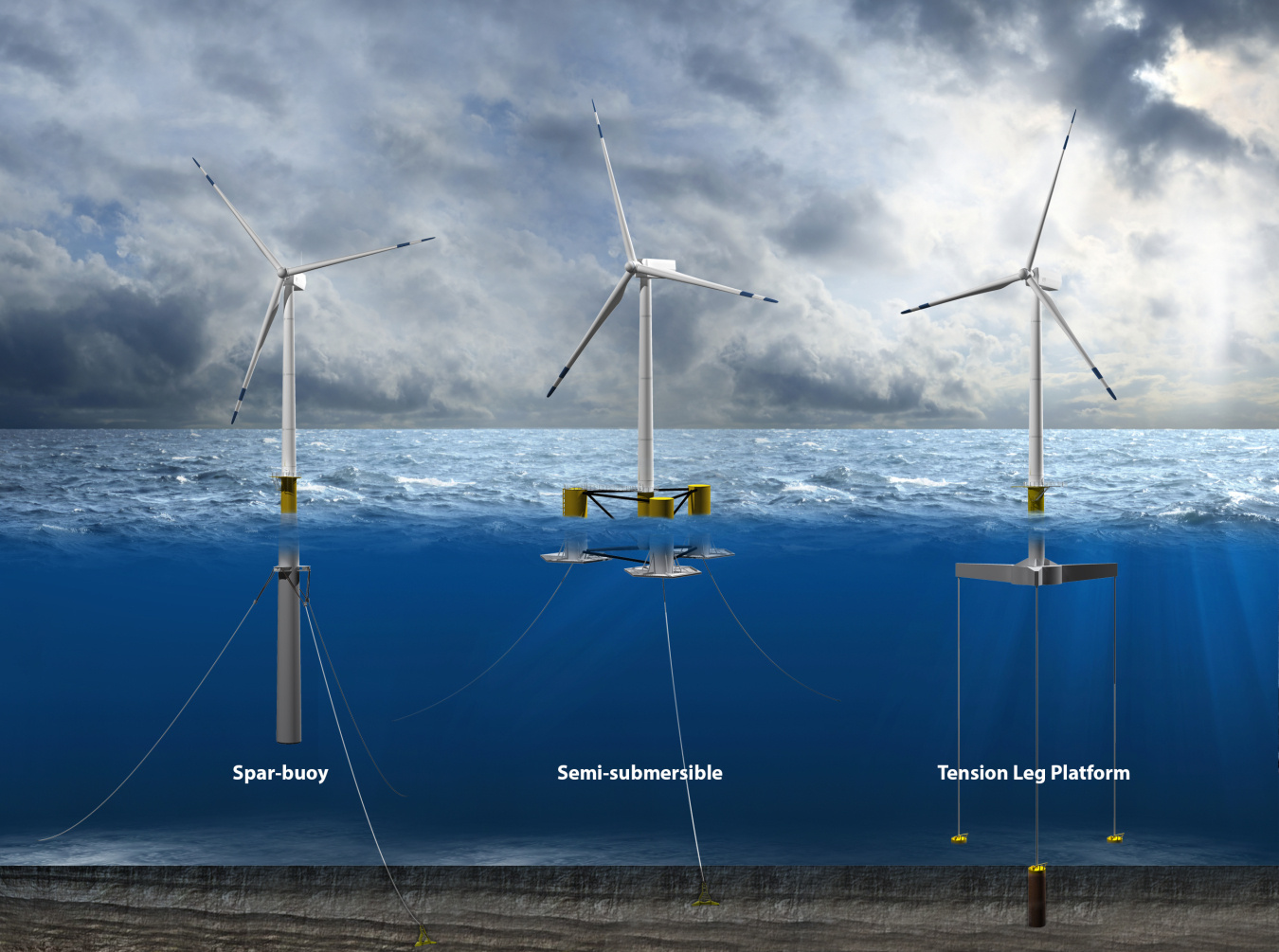
As the industry moves into deeper waters—areas abundant with strong winds but unsuitable for fixed foundations—floating offshore wind technology becomes essential. These platforms are moored to the seabed, allowing the turbine to float freely.
- Spar-Buoy: Features a large, weighted cylinder that extends deep below the water surface, providing stability through ballast.
- Semi-Submersible: Consists of multiple columns connected by submerged pontoons, offering stability through buoyancy and waterplane area. Often ballasted and moored.
- Tension-Leg Platform (TLP): A buoyant platform tethered to the seabed by taut, vertical mooring lines, providing stability by resisting upward forces.
Here’s a comparison to help you understand the core differences and applications:
| Foundation Type | Typical Water Depth Range | Typical Cost Factor | Key Advantage | Key Disadvantage |
|---|---|---|---|---|
| Fixed-Bottom: Monopile | Up to 40 meters (130 ft) | Lower | Simple, proven, relatively easy installation | Limited to shallower waters |
| Fixed-Bottom: Jacket | 30-60 meters (100-200 ft) | Medium | Suitable for deeper waters than monopiles, robust | More complex fabrication and installation |
| Fixed-Bottom: Gravity-Based | Shallow to medium (up to 40 meters) | Medium-High | No piling noise, can be built onshore and towed | Requires very specific seabed conditions, large footprint |
| Floating: Spar-Buoy | Over 100 meters (330 ft) | High | Access to very deep water resources, less seabed disturbance | Complex and costly to manufacture and deploy |
| Floating: Semi-Submersible | Over 50 meters (165 ft) | High | Good stability, can be assembled at port | Higher material usage than TLP or spar, more complex mooring |
| Floating: Tension-Leg Platform (TLP) | Over 50 meters (165 ft) | High | Excellent stability, smaller platform footprint | Very precise installation required for mooring lines |
How Do These Ocean Giants Generate Electricity? The Mechanics Explained
It’s a fascinating journey from a gust of wind to the flick of a light switch in your home. Here’s a simplified breakdown of how an offshore wind turbine generates electricity:
- Wind Turns the Blades: The wind flows over the aerodynamically designed blades, creating lift and causing them to rotate. The angle of the blades (pitch) can be adjusted to optimize energy capture or to ‘feather’ them in very strong winds to prevent damage.
- Rotor Spins the Shaft: The rotating blades are connected to a central hub, which is attached to a low-speed shaft.
- Gearbox (Optional) Increases RPM: For many turbines, the low-speed shaft connects to a gearbox. This gearbox acts like the gears in a bicycle, increasing the rotational speed from perhaps 7-12 revolutions per minute (RPM) to around 1,000-1,800 RPM. This higher speed is necessary for efficient electricity generation. (Note: some modern turbines are ‘direct drive,’ meaning they don’t use a gearbox, which can reduce maintenance.)
- Generator Creates Electricity: The high-speed shaft drives the generator, which uses electromagnetic induction to convert the mechanical energy of rotation into electrical energy.
- Transformer Steps Up Voltage: The electricity generated by an individual turbine is typically at a medium voltage. A transformer within the nacelle or at the base of the tower steps up this voltage to reduce energy loss during transmission.
- Power Flows to Offshore Substation: The stepped-up electricity travels through internal cables down the tower and then along subsea cables laid on or buried in the seabed to a central offshore substation.
- Offshore Substation Aggregates and Boosts Power: This large marine platform collects electricity from many individual turbines in the wind farm. It further steps up the voltage, making it suitable for long-distance transmission.
- Export Cable to Onshore Grid: From the offshore substation, a high-voltage export cable carries the aggregated power under the seabed and ashore to an onshore substation. This onshore substation then connects the clean electricity to the national or regional power grid, ready to be distributed to homes and businesses.
This intricate process ensures that the intermittent nature of wind is harnessed efficiently and reliably, delivering a steady flow of green power to our communities.
The Immense Benefits of Offshore Wind Energy
The global push for offshore wind isn’t just about technological prowess; it’s driven by a powerful suite of benefits that address some of our most pressing challenges.
- Clean, Renewable Power & Climate Action: This is the big one. Offshore wind produces electricity without burning fossil fuels, meaning zero greenhouse gas emissions during operation. This is crucial for combating climate change and reducing air pollution.
- Energy Independence & Security: Harnessing domestic wind resources reduces reliance on imported fossil fuels, bolstering a nation’s energy security and insulating it from volatile global energy markets.
- Massive Job Creation & Economic Growth: The offshore wind industry is a significant job engine. From manufacturing gigantic turbine components to specialized vessel operations, installation, maintenance, and port infrastructure development, it creates tens of thousands of skilled jobs across diverse sectors. It stimulates local economies through investment and supply chain development.
- High Capacity Factors: Thanks to stronger, more consistent winds, offshore wind farms often achieve higher capacity factors (the ratio of actual energy output over a period to the maximum possible output) compared to onshore wind or solar farms. This means they generate power closer to their theoretical maximum more often.
- Less Land Use Conflict: Unlike large-scale onshore projects, offshore wind farms don’t compete with agricultural land, residential areas, or sensitive ecosystems on land, easing land-use planning challenges.
- Scalability for Industrial Demand: The sheer scale achievable with offshore wind makes it a vital tool for decarbonizing heavy industries and powering large urban centers.
Navigating the Challenges: What’s Holding Us Back?
Despite its immense promise, the development of offshore wind energy faces significant hurdles that require innovative solutions and substantial investment.
- High Upfront Costs: Offshore wind projects are notoriously expensive to develop. The specialized vessels, deep-water foundations, extensive cabling, and robust materials needed to withstand the marine environment all contribute to higher capital expenditures compared to most onshore energy projects.
- Logistical Complexity: Installing and maintaining turbines kilometers offshore is a logistical nightmare. Weather windows are tight, specialized installation vessels are scarce, and repairs require highly trained technicians working in challenging conditions.
- Environmental Concerns: While a clean energy source, offshore wind development isn’t without its environmental impacts. These include:
- Marine Life Disturbance: Construction noise (especially pile driving for fixed foundations) can impact marine mammals. Operational turbines generate underwater noise.
- Collision Risk: While often minimal for large migratory birds, it’s a factor to consider and monitor.
- Habitat Alteration: Foundations can create artificial reefs, changing local ecosystems. Cables can disturb benthic habitats.
Rigorous environmental impact assessments and mitigation strategies are essential.
- Grid Connection & Infrastructure: Connecting large-scale offshore wind farms to existing onshore grids requires significant upgrades and new transmission infrastructure, often crossing sensitive coastal areas. Coordinating these large-scale grid developments is complex and time-consuming.
- Permitting and Regulatory Hurdles: Gaining permits for offshore projects involves navigating multiple federal, state, and local agencies, addressing concerns from various stakeholders (fishermen, shipping, military), and conducting extensive environmental reviews. This process can be lengthy and unpredictable.
- Visual & Navigation Impacts: Although turbines are far offshore, visual impacts can still be a concern for coastal communities and tourism. Navigational safety for shipping and fishing vessels also needs careful planning and integration.
Offshore Wind in the USA: A Rising Tide
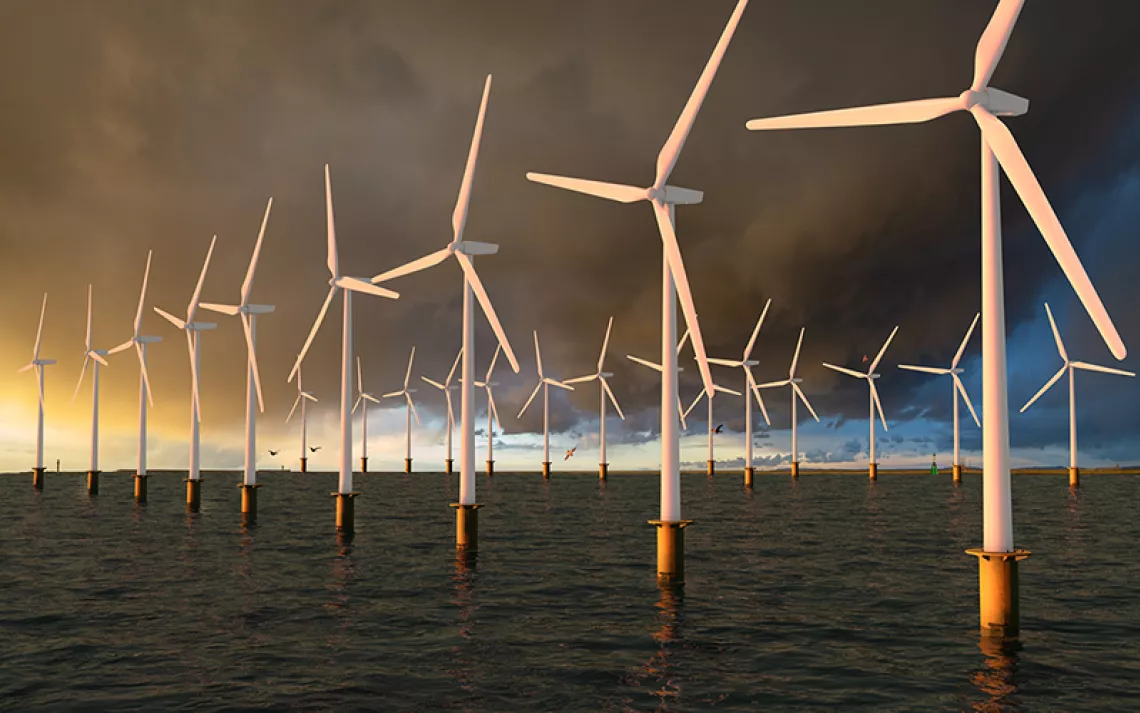
The United States, with its vast coastlines and robust wind resources, is finally embracing offshore wind with serious intent, transforming from a nascent industry to a burgeoning powerhouse.
Current Landscape: Small but Growing
For years, the U.S. lagged behind Europe in offshore wind development. The nation’s first commercial offshore wind farm, the Block Island Wind Farm in Rhode Island, came online in 2016 with just five turbines and 30 megawatts (MW) of capacity. While a landmark, it was a tiny fraction of global capacity.
However, the tide has turned dramatically. The Biden administration has set ambitious targets: 30 gigawatts (GW) of offshore wind by 2030, enough to power more than 10 million homes. This goal is driving significant investment and policy support.
Key Projects & States Leading the Charge
The East Coast, particularly the Northeast and Mid-Atlantic, is at the forefront of this expansion due to its strong winds, shallow continental shelf, and proximity to major population centers.
- Vineyard Wind 1 (Massachusetts): The first utility-scale offshore wind farm in the U.S., currently under construction. It will feature 62 turbines and deliver 800 MW of power, enough for over 400,000 homes.
- South Fork Wind (New York): New York’s first offshore wind farm, also under construction, will deliver 132 MW of power to Long Island.
- Planned Projects: States like New York, New Jersey, Massachusetts, Maryland, and Virginia have aggressive solicitations and numerous projects in various stages of development. Projects like Empire Wind (NY), Ocean Wind (NJ), and Coastal Virginia Offshore Wind are poised to add gigawatts to the grid.
The West Coast and Great Lakes also hold immense potential, though they present different challenges. The deep waters off California, Oregon, and Washington necessitate floating offshore wind technology, which is still in earlier stages of commercialization. California aims for 25 GW of floating offshore wind by 2045.
Policy & Support Fueling Growth
Federal and state policies are critical enablers:
- Lease Area Auctions: The Bureau of Ocean Energy Management (BOEM) regularly conducts lease sales for offshore wind development rights, opening up vast areas for development.
- Investment Tax Credits (ITCs): Federal tax incentives significantly reduce project costs.
- State Renewable Energy Mandates: Many coastal states have ambitious renewable portfolio standards (RPS) that include specific targets for offshore wind.
- Port Infrastructure Development: Billions are being invested in upgrading U.S. ports to handle the immense components and logistics required for offshore wind construction.
This coordinated effort signifies a strategic commitment to establishing a robust domestic offshore wind industry, creating supply chains, and positioning the U.S. as a global leader.
The Future is Floating: Innovations and Next-Gen Turbines
The offshore wind industry is a hotbed of innovation, constantly pushing the boundaries of engineering and technology. The future promises even larger, more efficient turbines and revolutionary deployment methods.
Technological Advancements
- Gigantic Turbines: The next generation of turbines will be truly colossal, with capacities exceeding 15-20 MW per turbine. These giants will have rotor diameters larger than the London Eye and towers taller than the Eiffel Tower, allowing them to capture even more energy with fewer installations.
- Advanced Materials: Research into lighter, stronger, and more durable materials for blades and components will improve efficiency and longevity while reducing maintenance needs in harsh marine environments.
- AI and Digitalization: Artificial intelligence and advanced sensors are being integrated for predictive maintenance, optimizing turbine performance, and managing grid integration more effectively. Digital twin technology allows for virtual simulation and monitoring of entire wind farms.
- Hybrid Projects: Future offshore energy parks might combine wind turbines with other technologies, such as wave energy converters, tidal power, or even offshore solar, to provide a more consistent energy output.
Floating Offshore Wind: Unlocking Deeper Waters
As discussed, floating technology is a game-changer. It allows for the deployment of wind farms in waters too deep for fixed-bottom foundations, opening up vast new resource areas off the West Coast of the U.S., Japan, and parts of Europe. Innovations in mooring systems, platform designs, and installation techniques are rapidly driving down the costs and increasing the viability of floating wind.
Green Hydrogen Production
A particularly exciting prospect is using offshore wind power to produce green hydrogen directly at sea. Electrolyzers on offshore platforms could use renewable electricity to split water into hydrogen and oxygen. This hydrogen could then be stored and transported, acting as a flexible energy carrier for industries, heavy transport, or even power generation when wind is low. This ‘Power-to-X’ concept offers a pathway to decarbonize hard-to-abate sectors.
Conclusion: Harnessing the Ocean’s Power for a Sustainable Tomorrow
Wind turbines on the ocean represent one of humanity’s most ambitious and promising endeavors in the quest for clean energy. From the complex engineering of their foundations to the intricate dance of blades turning wind into electricity, these maritime marvels are pivotal to a sustainable future.
While challenges remain—from the significant upfront costs and complex logistics to environmental considerations—the relentless innovation and growing political will are steadily overcoming these hurdles. The U.S. is now firmly on track to unlock its vast offshore wind potential, creating jobs, bolstering energy security, and making a substantial contribution to combating climate change.
The journey from concept to commercialization has been long, but the horizon for offshore wind is brighter than ever. As these ocean giants continue to rise, they remind us of our capacity for ingenuity and our collective commitment to harnessing nature’s power responsibly for generations to come. The future is powered by the ocean’s breath, and it’s a future we’re building together, one turbine at a time.
Frequently Asked Questions
What is the main difference between onshore and offshore wind turbines?
Offshore wind turbines are typically larger and designed to withstand harsh marine environments. They benefit from stronger, more consistent winds over open water, leading to higher energy production, and are often located further from populated areas, reducing visual and noise impacts compared to their land-based counterparts.
How deep can offshore wind turbines be installed?
Fixed-bottom offshore wind turbines (like monopiles or jacket structures) are typically installed in water depths up to about 60 meters (200 feet). For deeper waters, often beyond 60 meters, floating offshore wind turbines are used, which are moored to the seabed, allowing access to vast, previously untapped wind resources.
What are the biggest challenges for offshore wind energy?
Key challenges include high upfront installation and maintenance costs due to specialized equipment and marine logistics, potential environmental impacts on marine life (e.g., noise during construction, habitat alteration), the need for extensive grid infrastructure upgrades, and complex permitting processes involving multiple stakeholders.
Does offshore wind impact marine life?
Yes, offshore wind farms can have impacts on marine life, particularly during construction (e.g., noise from pile driving affecting marine mammals) and to a lesser extent during operation (e.g., underwater noise, potential collision risk for birds, habitat changes around foundations). However, rigorous environmental assessments, mitigation measures, and ongoing monitoring are employed to minimize these effects.
How is electricity transmitted from offshore wind farms to shore?
Electricity generated by individual turbines is transmitted via subsea cables to an offshore substation. This substation aggregates power from multiple turbines and steps up the voltage. From there, a high-voltage export cable carries the electricity under the seabed to an onshore substation, which then connects to the national or regional power grid.
What is the future outlook for offshore wind in the USA?
The future for offshore wind in the USA is very promising. With ambitious federal and state targets (e.g., 30 GW by 2030), significant investment in infrastructure, and a focus on developing both fixed-bottom and floating technologies, the U.S. is rapidly expanding its offshore wind capacity, particularly along the East and West Coasts. This growth is expected to create numerous jobs and bolster energy independence.