Can a Windmill Power Your House? The Definitive Guide to Home Wind Energy
Imagine harnessing the unseen power of the wind, converting it into clean, sustainable electricity for your home. It’s a compelling vision, offering the promise of energy independence and reduced utility bills. For many homeowners, the idea of a personal windmill is incredibly appealing. But is it a realistic solution for powering an entire house, or even supplementing your energy needs?
Table of Contents
- Can a Windmill Power Your House? The Definitive Guide to Home Wind Energy
- The Honest Truth: Is a Windmill Right for Your Home?
- Key Consideration: Location, Location, Location
- Energy Needs vs. Wind Production
- Understanding Small Wind Turbines: Types and How They Work
- Horizontal-Axis Wind Turbines (HAWTs)
- Vertical-Axis Wind Turbines (VAWTs)
- Key Components of a Home Wind System
- Sizing Your Wind Turbine: How Much Power Do You Really Need?
- Calculate Your Home’s Energy Consumption
- Matching Turbine Output to Demand
- The Investment: How Much Does a Home Windmill Cost?
- Breakdown of Costs
- Estimated Cost Ranges for Residential Wind Systems
- Potential Savings and ROI (Return on Investment)
- Wind vs. Solar: A Head-to-Head Comparison (And Why Hybrids Win)
- Advantages of Wind Power
- Disadvantages of Wind Power
- Advantages of Solar Power
- Disadvantages of Solar Power
- The Power of Hybrid Wind-Solar Systems
- The Practicalities: Permits, Zoning, and Installation Challenges
- Navigating Local Regulations
- Site Preparation and Installation
- Maintenance Requirements
- Aesthetic and Noise Considerations
- Is Going Off-Grid with Wind a Realistic Dream?
- Your Next Steps: Making an Informed Decision
- Conclusion: Harnessing the Wind for a Greener Future
I’m here to cut through the marketing hype and give you the honest truth. While residential wind energy offers immense potential, it’s not a one-size-fits-all solution. This guide will walk you through everything you need to know, from assessing your property’s wind potential to understanding costs, types of turbines, and whether a hybrid system might be your best bet.
The Honest Truth: Is a Windmill Right for Your Home?
Let’s get straight to it: the answer to whether a windmill can power your house is often “it depends.” While theoretically possible, practically speaking, achieving 100% energy independence solely from a small residential wind turbine is challenging for most homes. More often, they serve as a powerful supplement to grid power, or as a crucial component of an off-grid system combined with other renewables.
Key Consideration: Location, Location, Location
Wind energy is incredibly site-specific. This isn’t like solar, where if you have sun, you have potential. For wind, you need a consistent, strong, and unobstructed wind resource.
- Wind Resource Assessment: This is the absolute first step. You need to understand the average annual wind speed at your proposed turbine height. Obstacles like trees, buildings, and hills create turbulence, which significantly reduces a turbine’s efficiency and can even damage it. Think open spaces, hilltops, or coastal areas.
- Rural vs. Urban Suitability: Residential wind turbines are generally much better suited for rural or semi-rural properties. Urban and suburban environments often lack sufficient, clean wind resources due to dense construction and numerous obstructions. Furthermore, zoning and permitting are typically more lenient in less populated areas.
Energy Needs vs. Wind Production
Your home’s energy consumption is another critical factor. The average U.S. household uses around 893 kWh of electricity per month (EIA, 2022 data). Can a small turbine reliably generate that much?
- Average Household Consumption: Before considering any renewable energy, know your baseline. Look at your past utility bills to determine your average monthly and annual kWh usage.
- Intermittency and Energy Storage: Unlike a solar panel that produces predictably during daylight, wind is inherently intermittent. It blows when it blows. This means you’ll need a robust battery storage system if you’re aiming for off-grid living, or a grid-tied system that allows you to draw from the utility when the wind isn’t blowing and sell excess back when it is (net metering).
Understanding Small Wind Turbines: Types and How They Work
When we talk about “windmills” for homes, we’re really talking about small wind turbines. They operate on the same principle as large utility-scale turbines but are designed for lower power output and smaller footprints.
Essentially, wind spins the blades, which turns a shaft connected to a generator, producing electricity. It sounds simple, but the engineering behind efficient energy capture is quite sophisticated.
Horizontal-Axis Wind Turbines (HAWTs)
These are what most people visualize when they think of a wind turbine – the classic propeller-style design. They are the most common and efficient type for residential use.
- Description: Features blades (typically 2 or 3) that rotate around a horizontal axis, facing into the wind.
- Pros: Generally more efficient at converting wind energy into electricity, well-established technology, available in various sizes.
- Cons: Require a mechanism to yaw (turn) into the wind, can be visually imposing, typically require taller towers for optimal performance and to clear turbulence.
Vertical-Axis Wind Turbines (VAWTs)
VAWTs have blades that rotate around a vertical axis. They come in various designs, such as Darrieus (egg-beater style) or Savonius (S-shaped scoops).
- Description: Blades oriented vertically, rotating regardless of wind direction.
- Pros: Don’t need to yaw into the wind, can operate in turbulent winds (though less efficiently), potentially quieter at lower speeds, sometimes considered more aesthetically pleasing or less imposing, easier to maintain ground-level components.
- Cons: Generally less efficient than HAWTs, lower starting torque (may require a stronger gust to begin spinning), tend to have a larger footprint for similar power output.
Key Components of a Home Wind System
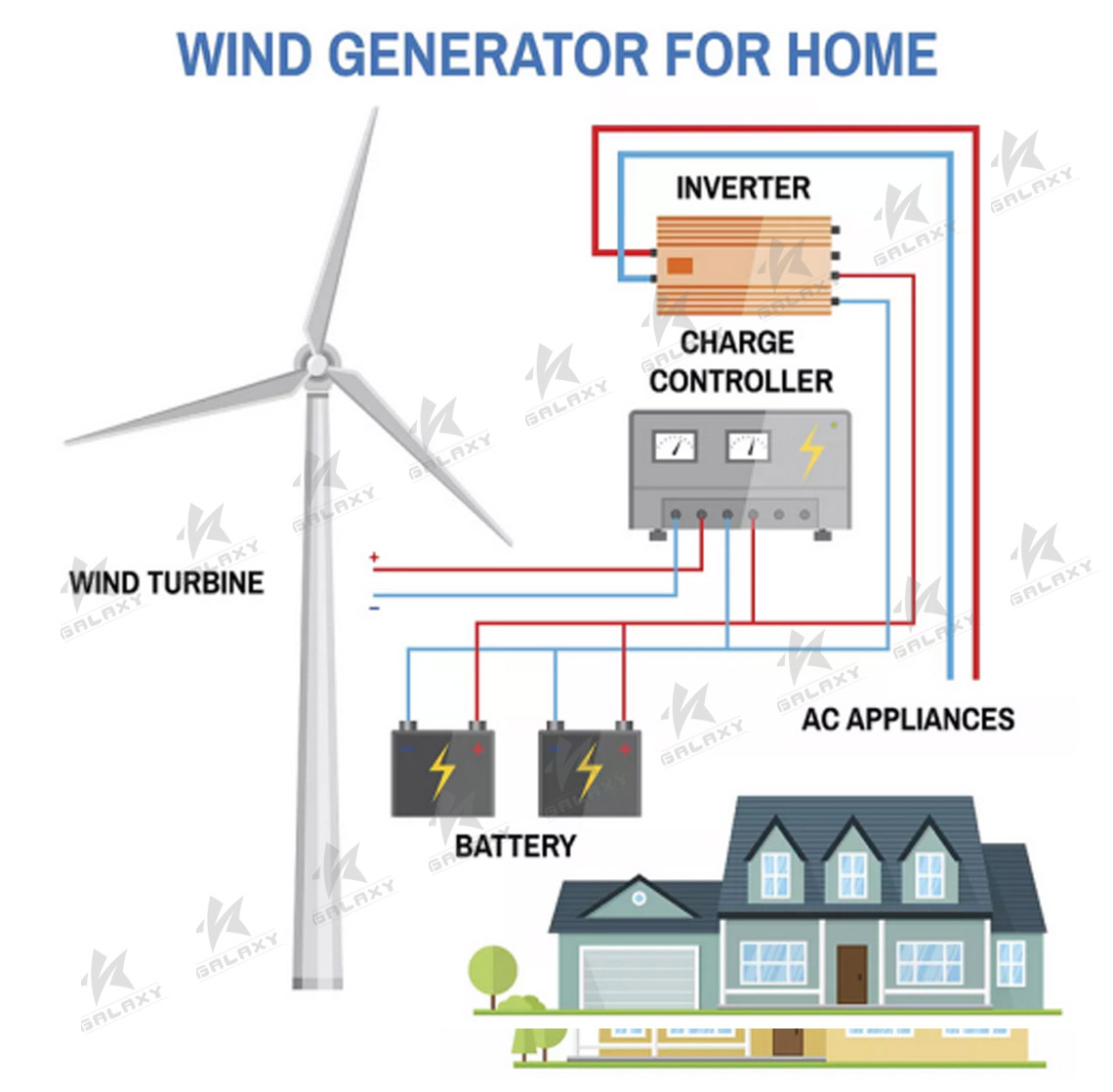
A residential wind power system is more than just the turbine itself. Here’s what’s typically involved:
:max_bytes(150000):strip_icc()/wind-turbine-generator-on-house-roof-90967703-b9619befbf954726ae92dfb6154711f2.jpg)
- Rotor: The blades and hub assembly that captures the wind’s energy.
- Nacelle: The housing at the top of the tower that contains the generator, gearbox (if present), and control mechanisms.
- Tower: Supports the rotor and nacelle, elevating the turbine above ground-level obstructions for better wind capture. Towers can be guyed (supported by cables) or freestanding.
- Charge Controller: Manages the electricity flow from the turbine, preventing overcharging of batteries in off-grid systems or regulating voltage for grid-tied systems.
- Inverter: Converts the DC (direct current) electricity produced by the turbine into AC (alternating current) electricity, which is what your home appliances use and what the grid accepts.
- Batteries (optional but recommended for off-grid/hybrid): Store excess electricity for use when the wind isn’t blowing.
- Safety Features: Overspeed protection, braking systems.
Sizing Your Wind Turbine: How Much Power Do You Really Need?
This is where many homeowners get tripped up. It’s not about buying the biggest turbine; it’s about matching its output to your actual needs and your specific wind resource.
Calculate Your Home’s Energy Consumption
Before you can size a turbine, you need to know how much electricity your home consumes. Most utility bills show your monthly kilowatt-hour (kWh) usage. Aim to get an annual average.
Here’s a rough idea of average consumption:
| Household Size | Average Monthly Usage (kWh) | Turbine Output Needed (Approx. kW at avg. wind) |
|---|---|---|
| Small (1-2 people) | 500 – 700 kWh | 1 – 3 kW |
| Medium (3-4 people) | 700 – 1200 kWh | 3 – 10 kW |
| Large (5+ people) | 1200+ kWh | 10 – 20 kW |
Note: These are approximations. Actual turbine output depends heavily on consistent wind speed.
Matching Turbine Output to Demand
Turbines are rated by their peak power output in kilowatts (kW), for example, a 5 kW turbine. However, they only produce that peak power at their optimal wind speed (e.g., 25-30 mph). Crucially, the power output of a wind turbine is proportional to the cube of the wind speed. This means a small increase in wind speed results in a disproportionately large increase in power output.
To meet typical household needs, a residential turbine typically ranges from 1 kW to 10 kW, sometimes up to 20 kW for very large homes or small businesses with excellent wind resources.
- A 1.5 kW turbine in a location with a 14 MPH annual average wind speed could meet the needs of a home requiring 300 kWh per month.
- A 5 kW turbine, in a good wind resource, might generate 500-1000 kWh per month.
This highlights the importance of accurate wind resource assessment. A larger turbine in a poor wind location will underperform, while a smaller turbine in an excellent location can exceed expectations.
The Investment: How Much Does a Home Windmill Cost?
Home wind systems are a significant investment, comparable to a large solar PV system. The cost varies widely based on turbine size, tower height, installation complexity, and whether you’re going grid-tied or off-grid with batteries.
Breakdown of Costs
When budgeting, consider these components:
- Turbine Unit: This is the primary cost, ranging from a few thousand for a small (<1 kW) unit to tens of thousands for a larger (5-10 kW) one.
- Tower: Critical for performance. Taller towers cost more. Guyed towers are cheaper but require more land; freestanding towers are more expensive but compact.
- Foundation: A robust concrete foundation is essential for stability.
- Inverter and Balance of System (BOS): The electronics, wiring, and electrical components needed to convert and manage the power.
- Batteries (for off-grid or backup): A major additional cost for energy storage, potentially adding thousands to tens of thousands depending on capacity.
- Installation Labor: Erecting a tower and turbine requires specialized equipment and expertise.
- Permitting and Site Assessment: Don’t forget these administrative costs.
Estimated Cost Ranges for Residential Wind Systems
Here’s a general idea of what you might expect to pay for a fully installed residential wind system:
| Turbine Size (kW) | Estimated All-in Cost (Grid-Tied, Installed) | Potential Monthly kWh Output (Avg. Wind) |
|---|---|---|
| 1 – 3 kW | $10,000 – $30,000 | 100 – 500 kWh |
| 5 – 10 kW | $30,000 – $80,000 | 500 – 1500 kWh |
| 10 – 20 kW | $80,000 – $150,000+ | 1500 – 3000+ kWh |
Costs can vary significantly based on location, specific turbine model, tower type, and local labor rates. These figures do not include battery storage, which can add substantially to the total.
Potential Savings and ROI (Return on Investment)
The financial viability of a home wind system hinges on several factors:
- Wind Resource: The stronger and more consistent your wind, the more electricity you generate, and the faster your payback.
- Electricity Rates: If you pay high electricity rates, the savings will be greater.
- Incentives: Federal tax credits (like the Investment Tax Credit, often 30% for renewables), state rebates, and local programs can significantly reduce the upfront cost and improve ROI.
- Net Metering: If your utility offers net metering, you can sell excess electricity back to the grid, essentially using the grid as a large battery.
ROI for residential wind can range from 5 to 20 years or more. It’s a long-term investment that provides energy security and environmental benefits in addition to financial returns.
Wind vs. Solar: A Head-to-Head Comparison (And Why Hybrids Win)
When considering home renewable energy, solar panels are often the first thing people think of. Here’s how wind stacks up, and why combining them is often the smartest move.
Advantages of Wind Power
- Nighttime Production: Wind turbines can produce electricity 24/7 as long as the wind blows, unlike solar which only produces during daylight hours.
- Winter Performance: Wind resources are often stronger and more consistent in winter months when solar production is lower due to shorter days and lower sun angles.
- Smaller Footprint (relative to output): A single turbine can potentially generate a significant amount of power compared to the land area it directly occupies, especially for taller towers.
Disadvantages of Wind Power
- Site Specificity: Requires a strong, consistent, and unobstructed wind resource, which is not available everywhere.
- Visual and Noise Impact: Turbines can be visually prominent and generate some noise, which can be a concern for neighbors or local zoning.
- Higher Upfront Cost per Watt: Often more expensive than solar for residential applications.
- Permitting Challenges: Can face stricter zoning regulations and permitting hurdles.
- Maintenance: Involves moving parts that require periodic maintenance.
Advantages of Solar Power
- Widespread Applicability: Most homes with unshaded roof space can benefit from solar.
- Lower Cost: Generally has a lower upfront cost per watt compared to residential wind.
- Easier Permitting: Often faces fewer regulatory hurdles than wind turbines.
- Minimal Maintenance: Largely passive systems, requiring little more than occasional cleaning.
- Quiet and Discreet: No moving parts, silent operation, and often less visually impactful.
Disadvantages of Solar Power
- Daylight Dependent: Only produces power when the sun is shining.
- Lower Winter Production: Output decreases significantly in winter due to shorter days and lower sun angles.
- Larger Footprint: Requires significant roof or ground space to generate substantial power.
The Power of Hybrid Wind-Solar Systems
This is where things get really interesting for energy independence. Wind and solar often complement each other beautifully:
- Solar excels in summer (long, sunny days).
- Wind often excels in winter (stronger, more consistent winds).
- Solar produces during the day; wind can produce day and night.
A hybrid system combines the strengths of both, providing a more reliable and consistent power supply throughout the year and reducing reliance on battery storage or grid backup. For off-grid scenarios, a hybrid system with a robust battery bank is typically the most practical and dependable solution.
| Feature | Residential Wind | Residential Solar | Hybrid Wind-Solar |
|---|---|---|---|
| Primary Resource | Wind Speed/Consistency | Sunlight/Irradiance | Wind + Sunlight |
| Daily Production Profile | Day & Night (Intermittent) | Daytime Only | More Consistent Day & Night |
| Seasonal Production | Often Stronger in Winter | Stronger in Summer | Balanced Year-Round |
| Site Requirements | Open, Windy Location, Tall Tower | Unshaded Roof/Ground Space | Both Specific Wind & Solar Needs |
| Typical Cost/kW | Higher | Lower | Combined Cost, Optimized Value |
The Practicalities: Permits, Zoning, and Installation Challenges
Beyond the technical aspects, there are significant administrative and practical hurdles to clear when installing a home wind turbine.
Navigating Local Regulations
This is often the most challenging part. Wind turbines are subject to local zoning ordinances and building codes, which vary dramatically by municipality and even by neighborhood.
- Permit Requirements: You will almost certainly need building permits, and potentially electrical permits, utility interconnection permits, and environmental impact assessments.
- Setback Rules: Many areas have strict rules about how far a turbine must be from property lines, other buildings, and public roads. These can be prohibitive for smaller lots.
- Height Restrictions: There are often limits on how tall structures can be, which can conflict with the need for a tall tower to access clean wind.
- Noise Ordinances: While modern turbines are relatively quiet, they do produce some sound. Local ordinances might limit decibel levels.
- Aesthetic Concerns: Some communities resist turbines due to visual impact.
Always start by contacting your local planning department and utility company early in the process. They can provide specific regulations and interconnection requirements.
Site Preparation and Installation
Installing a home wind turbine is not a DIY project for most homeowners. It involves heavy machinery, electrical work, and specialized safety protocols.
- Foundation Work: A substantial concrete foundation must be poured.
- Tower Erection: This requires cranes or specialized tilt-up systems, along with trained professionals.
- Electrical Wiring: Connecting the turbine to your home’s electrical panel or battery bank is complex and must be done by a licensed electrician to code.
Maintenance Requirements
Unlike passive solar panels, wind turbines have moving parts that require periodic inspection and maintenance to ensure optimal performance and longevity.
- Routine Checks: Annual inspections of blades, bearings, bolts, and electrical connections.
- Lubrication: Moving parts may need lubrication.
- Storm Readiness: Depending on the turbine, you might need to lower or feather the blades in anticipation of extreme weather.
- Typical Lifespan: A well-maintained residential wind turbine can last 20-25 years or more.
Aesthetic and Noise Considerations
These are genuine concerns for many homeowners and their neighbors.
 "Home Wind Turbines: When Do They Make Sense? | EnergySage")
- Visual Impact: A tower, even a relatively small one, is a prominent structure. It’s a personal preference, but it can be an obstacle for permits and neighbor relations.
- Noise: While vastly improved, turbines do generate some noise – a whooshing sound from the blades and a humming from the generator. This is typically only noticeable directly beneath or near the turbine and can be muffled by distance. VAWTs are generally quieter than HAWTs.
Is Going Off-Grid with Wind a Realistic Dream?
The dream of cutting ties completely with the utility company and powering your life solely from the wind is romantic, but often unrealistic for typical residential usage without significant compromises.
The primary challenge is wind intermittency. You might have days with no wind, or very low wind, and then days with abundant wind. To maintain a consistent power supply off-grid with wind alone, you would need:
- Massive Battery Storage: Enough to power your home through multiple days or even weeks of low wind. This is incredibly expensive and requires a large physical space.
- Backup Generator: Almost always a necessity for purely off-grid wind systems to cover extended calm periods or unexpected high demand.
- Significant Lifestyle Changes: Learning to conserve energy and adapt usage to when power is available.
For most, a grid-tied system with battery backup is the sweet spot. You get the benefits of renewable energy and some energy independence, while still having the reliability of the grid to fall back on. A hybrid wind-solar system further enhances this reliability, reducing the reliance on any single energy source.
Your Next Steps: Making an Informed Decision
So, you’re still interested? Excellent! Here’s how to move forward thoughtfully:
- Prioritize Energy Efficiency: Before investing in any renewable energy system, make your home as energy-efficient as possible. Seal drafts, upgrade insulation, replace old appliances. The less energy you use, the smaller and cheaper your renewable system needs to be.
- Conduct a Professional Wind Resource Assessment: This is non-negotiable. A qualified installer can analyze local wind maps, consider your specific site characteristics, and even deploy anemometers (wind meters) for a period to get accurate data.
- Research Local Zoning and Permitting: Contact your local planning department and homeowners’ association (if applicable) early to understand all regulations, setbacks, height restrictions, and required permits.
- Get Multiple Quotes: Talk to several reputable wind energy installers. They can help you determine the appropriate turbine size, tower height, and system configuration for your needs and budget. Ensure they provide a detailed breakdown of costs and an estimate of energy production.
- Compare Wind and Solar: Even if you’re set on wind, get a solar quote too. You might find solar is more cost-effective or that a hybrid system offers the best value.
- Understand Incentives: Ask installers about federal, state, and local incentives that can offset the cost of your system.
Conclusion: Harnessing the Wind for a Greener Future
Can a windmill power your house? Yes, it absolutely can, especially as part of a well-planned system. However, it’s not a simple plug-and-play solution. Residential wind energy demands a specific set of circumstances – most notably, a strong and consistent wind resource, ample space, and a willingness to navigate regulatory complexities.
For the right property owner, a home wind turbine can be a incredibly rewarding investment, providing clean energy, significant long-term savings, and a tangible step towards energy independence. Whether as a primary source for an off-grid cabin, or a powerful supplement to a grid-tied home, understanding the nuances of wind power is your first step to making that greener future a reality.
Frequently Asked Questions
How much does a home wind turbine cost to install?
A fully installed residential wind turbine system can range from $10,000 for a small 1-3 kW unit to over $80,000 for a larger 10-20 kW system, excluding battery storage. Costs vary significantly based on turbine size, tower height, installation complexity, and local labor rates. Federal and state incentives can help offset these upfront costs.
Can a small wind turbine power an entire house?
While theoretically possible with an excellent wind resource and substantial battery storage, powering an entire house solely with a small wind turbine is challenging for most. Wind is intermittent, so it often functions best as a supplemental power source for grid-tied homes or as part of a hybrid wind-solar system for more reliable off-grid solutions.
What’s the best wind speed for a home turbine?
Most residential wind turbines start producing power at around 7-10 mph (3-4.5 m/s) and reach their rated power at speeds of 25-30 mph (11-13.5 m/s). An average annual wind speed of at least 10-14 mph (4.5-6 m/s) is generally recommended for a residential wind system to be economically viable and provide sufficient energy output.
Are home wind turbines noisy?
Modern home wind turbines are much quieter than older models, but they do produce some sound – typically a whooshing from the blades and a hum from the generator. The noise level depends on the turbine design, size, wind speed, and distance from your home. Vertical-axis turbines are often quieter than horizontal-axis designs. Local zoning laws may have noise ordinances to consider.
How long do residential wind turbines last?
With proper installation and regular maintenance, a quality residential wind turbine can last 20 to 25 years or even longer. Key components like blades, bearings, and electronics may need periodic inspection and occasional replacement to maximize lifespan and efficiency.
Can I combine wind and solar for my home?
Yes, combining wind and solar (a hybrid system) is often an ideal solution for home energy. Wind and solar naturally complement each other: solar excels during sunny days, while wind can produce power day and night, often stronger in winter when solar output is lower. This combination provides a more consistent and reliable energy supply, especially for off-grid homes, reducing reliance on single energy sources or extensive battery storage.
Do I need permits for a home wind turbine?
Absolutely. You will almost certainly need building permits, electrical permits, and possibly utility interconnection permits. Local zoning ordinances can be very strict, imposing rules on turbine height, setbacks from property lines, and noise limits. It’s crucial to contact your local planning department and utility company early in your planning process to understand all requirements.