Windmills To Power Your Home: Is Backyard Wind Energy Right For You?
Picture this: a sleek turbine spinning gracefully in your backyard, silently generating clean electricity, freeing you from the grid’s ever-fluctuating prices. It’s a powerful vision, isn’t it? The idea of using windmills to power your home is undeniably appealing, conjuring images of self-sufficiency and environmental stewardship. But before you start sketching out turbine placement, let’s talk turkey.
Table of Contents
- Windmills To Power Your Home: Is Backyard Wind Energy Right For You?
- First Things First: Is Your Home a Candidate for Wind Power?
- The Unbreakable Rule: Wind Speed is King
- Space, Zoning, and Neighborly Relations
- Energy Efficiency: The Foundation of Any Renewable System
- Understanding Small Wind Turbines: How They Work and What They Look Like
- Horizontal Axis Wind Turbines (HAWTs)
- Vertical Axis Wind Turbines (VAWTs)
- Grid-Tied vs. Off-Grid Systems: Which is Right for You?
- Sizing Your Home Wind Turbine: How Much Power Do You Really Need?
- Calculating Your Home’s Energy Consumption
- Matching Turbine Output to Your Needs
- The Role of Batteries in Home Wind Systems
- The Real Cost of Going Wind: Installation, Maintenance, and Payback
- Initial Investment: Turbines, Towers, and Installation
- Beyond the Initial Price Tag: Maintenance and Longevity
- Incentives and Rebates: Lowering Your Out-of-Pocket Expense
- The Payback Period: When Does Wind Power Start Saving You Money?
- Wind vs. Solar: A Head-to-Head Comparison (and Why Hybrid Might Be Best)
- Solar Power: Pros and Cons
- Wind Power: Pros and Cons
- The Hybrid Advantage: Combining Strengths
- Navigating the Hurdles: Permitting, Installation, and Finding a Pro
- Local Regulations: Your First Call
- Professional Installation: Don’t DIY This
- Finding a Reputable Installer: What to Look For
- Conclusion: Making an Informed Decision for Your Energy Future
While home wind power is absolutely a reality for some, it’s not a plug-and-play solution for everyone. Unlike solar, which benefits from ubiquitous sunlight, wind energy is far more site-specific. This guide isn’t here to sell you a dream; it’s here to give you the honest truth, equipping you with the knowledge to decide if backyard wind generation truly makes sense for your unique situation. We’re going to dive deep into the real costs, the essential conditions, and the practicalities of harnessing the wind to power your life.
First Things First: Is Your Home a Candidate for Wind Power?
This is where the rubber meets the road. Many folks get excited about wind power only to find their location isn’t quite right. Let’s break down the critical factors that determine if your home is even in the running.
The Unbreakable Rule: Wind Speed is King
I cannot stress this enough: wind speed is the single most important factor. A wind turbine is a machine designed to convert kinetic energy from the wind into electricity. If there isn’t enough wind, it simply won’t produce much, or any, power. This isn’t just about an occasional gust; we’re talking about consistent, average wind speeds.
What’s a “Good” Average Wind Speed?
Most experts agree that for a small residential wind turbine to be economically viable, you need an annual average wind speed of at least 10-11 miles per hour (mph), or 4.5-5 meters per second (m/s), measured at the height of the turbine’s hub. Anything less, and your turbine will likely spend more time idle than productive, making it a poor investment.
How do you figure this out? You can start with online wind maps (often provided by government energy departments), but these are usually broad averages. For a true assessment, especially if you’re serious, consider a site-specific wind resource assessment. This often involves temporarily erecting a meteorological tower (met tower) with an anemometer to measure actual wind speeds at various heights on your property over several months to a year. It’s an investment, yes, but far cheaper than installing a turbine that doesn’t perform.
Beyond Averages: How Obstructions Matter
Even if regional data suggests good wind, local obstructions can kill your turbine’s performance. Trees, hills, and especially buildings (your own or neighbors’) create turbulence and wind shadows. This isn’t just about reducing wind speed; turbulent wind is less efficient and can even cause premature wear and tear on your turbine.
For optimal performance, a wind turbine needs to be placed at a height where it can access smooth, uninterrupted wind flow. This usually means positioning the turbine tower at least 30 feet above any obstruction within a 500-foot radius. That’s often a much taller tower than people initially imagine, pushing costs up and potentially increasing zoning challenges.
Space, Zoning, and Neighborly Relations
Beyond wind, you need physical space. Turbines need clearance from power lines, roads, property lines, and obviously, your home. A typical small residential turbine system might require a footprint that’s surprisingly large, primarily due to the tower’s guy wires or the setback requirements for a freestanding pole.
Then there’s the zoning and permitting nightmare – sorry, *process. Local governments often have strict ordinances regarding tower height, noise levels, and visual impact. What might be perfectly acceptable in a rural agricultural zone could be a non-starter in a suburban residential area. Expect to spend significant time researching your local municipality’s rules, attending public hearings, and potentially dealing with neighbor objections.
Speaking of neighbors: while modern small wind turbines are much quieter than their industrial cousins, they aren’t silent. There’s a subtle hum and mechanical noise, especially noticeable on very windy days. Good neighbor relations often mean considering their view and potential noise impact upfront.
Energy Efficiency: The Foundation of Any Renewable System
Here’s a crucial tip that applies to any home renewable energy project, be it wind or solar: the cheapest kilowatt-hour is the one you don’t use. Before you even think about generating your own power, optimize your home’s energy efficiency.
- Insulate: Upgrade your attic, wall, and floor insulation.
- Seal Leaks: Tackle drafts around windows, doors, and utility penetrations.
- Efficient Appliances: Replace old, power-hungry appliances with ENERGY STAR® rated models.
- LED Lighting: Switch out incandescent bulbs.
- Smart Thermostats: Optimize your heating and cooling schedules.
By reducing your overall energy demand, you can then size a smaller, less expensive wind (or solar) system to meet your remaining needs. This dramatically improves the economic viability of your investment.
:max_bytes(150000):strip_icc()/wind-turbine-generator-on-house-roof-90967703-b9619befbf954726ae92dfb6154711f2.jpg)
Understanding Small Wind Turbines: How They Work and What They Look Like
Let’s demystify the hardware a bit. Small wind turbines for homes share the same fundamental principles as their colossal utility-scale brethren but are, well, smaller. They capture wind’s kinetic energy with blades, spin a rotor, which then drives a generator to produce electricity.
Horizontal Axis Wind Turbines (HAWTs)
These are what most people picture when they think of a windmill: blades (usually two or three) rotating around a horizontal axis, mounted on a tower. HAWTs are generally more efficient at capturing wind energy in areas with consistent, directional wind, as their blades are designed to face directly into the wind.
- Pros: High efficiency, well-established technology, often more power output per given rotor swept area.
- Cons: Requires a yaw mechanism to turn into the wind, often needs taller towers to avoid turbulence, can be more visually impactful.
Vertical Axis Wind Turbines (VAWTs)
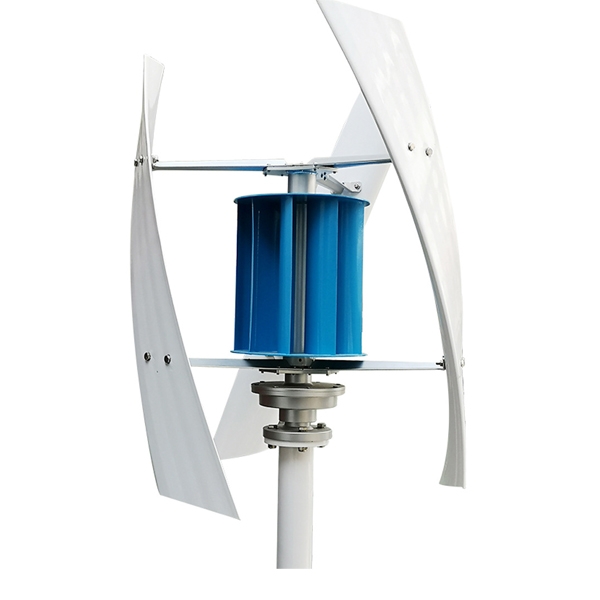
VAWTs have blades that rotate around a vertical axis. Think of an eggbeater or a Darrieus rotor. They don’t need to be oriented into the wind, making them effective in turbulent or constantly shifting wind conditions.
- Pros: Omnidirectional (no yaw mechanism needed), can potentially be installed closer to the ground (though still needing clear wind access), often perceived as less visually intrusive.
- Cons: Generally less efficient than HAWTs at the same swept area, often have lower power output, can have vibrational issues.
For most residential applications in open, windy areas, HAWTs tend to be the more common and efficient choice, but VAWTs can have niche applications, particularly in urban or constrained environments where wind is more erratic.
Grid-Tied vs. Off-Grid Systems: Which is Right for You?
How you connect your wind turbine to your home’s electrical system is a critical decision, influencing costs, complexity, and your level of energy independence.
Grid-Tied: The Most Common Setup
A grid-tied (or grid-connected) system means your wind turbine is connected to the public utility grid. When your turbine generates more electricity than your home is using, the excess power flows back into the grid, and you typically receive a credit through a policy called net metering. When your turbine isn’t producing enough (or any) power, you draw electricity from the grid as usual.
- Pros: No need for expensive battery banks, effectively uses the grid as a “battery,” simpler installation (no complex battery management), can significantly reduce or eliminate electricity bills.
- Cons: Still reliant on the grid (power outages mean your home also loses power, even if the wind is blowing, for safety reasons), subject to utility company policies (net metering rates can change).
Off-Grid: True Energy Independence (and its Challenges)
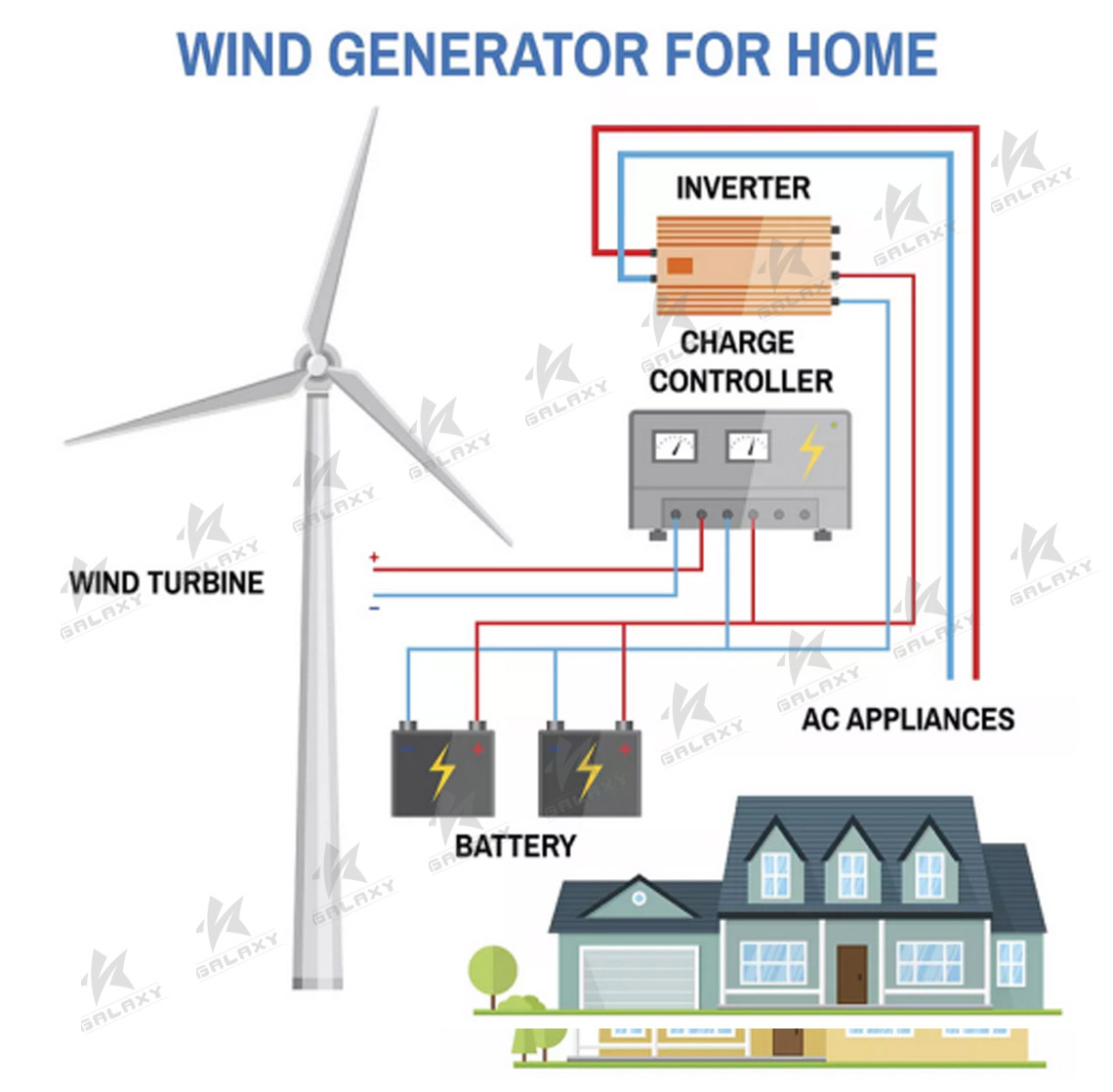
An off-grid system means your home is completely disconnected from the utility grid. All your electricity must be generated by your wind turbine (and often, solar panels) and stored in a battery bank. When the wind blows, power charges the batteries and runs your home. When it’s calm, your home draws from the stored energy.
- Pros: Complete energy independence, no electricity bills ever, resilience during grid outages.
- Cons: Significantly more expensive due to large battery banks and charge controllers, requires careful energy management to avoid draining batteries, often requires a backup generator for extended calm periods, higher maintenance.
Most residential installations aim to be grid-tied due to cost and simplicity. Off-grid systems are typically chosen for remote locations where grid extension is prohibitively expensive.
Sizing Your Home Wind Turbine: How Much Power Do You Really Need?
Figuring out the right size for your turbine is crucial. Too small, and you won’t meet your needs. Too large, and you’ve overspent on capacity you won’t use. It’s a delicate balance, and it starts with understanding your home’s energy appetite.
Calculating Your Home’s Energy Consumption
Grab your electricity bills! Look for your average monthly kilowatt-hour (kWh) usage. This number is your baseline. Most homes in the US use between 800-1,200 kWh per month, but this varies wildly by region, season, and lifestyle. If you can get a year’s worth of data, you’ll see seasonal variations (e.g., higher usage in summer for AC, winter for heating).
Let’s say your home uses an average of 900 kWh per month. That’s 900 kWh / 30 days = 30 kWh per day. This is the amount of energy your wind turbine system needs to produce on average.
Matching Turbine Output to Your Needs
Wind turbine power output is rated in kilowatts (kW) of capacity*. A 5 kW turbine, for example, can produce 5 kW of power at its rated wind speed. However, it rarely operates at full capacity continuously. The actual energy produced (kWh) depends heavily on your average wind speed and the turbine’s efficiency curve.
A common rule of thumb is that a wind turbine’s capacity factor (the ratio of actual energy produced over a period to the maximum possible energy it could have produced) for a good residential site might be around 25-40%. So, a 5 kW turbine operating at a 30% capacity factor would produce 5 kW * 24 hours/day * 30 days/month * 0.30 = ~1,080 kWh per month. This means our hypothetical 900 kWh/month home might need something like a 4-5 kW rated turbine.
It’s important to work with an experienced installer who can perform detailed calculations based on your specific wind resource data and the chosen turbine’s power curve.
)
| Home Energy Need (Avg. kWh/month) | Approx. Turbine Size (kW) | Tower Height (ft) | Estimated Cost Range (USD) |
|---|---|---|---|
| 300 – 600 kWh | 1 – 3 kW | 30 – 60 ft | $10,000 – $25,000 |
| 600 – 1,000 kWh | 3 – 5 kW | 60 – 80 ft | $25,000 – $50,000 |
| 1,000 – 2,000+ kWh | 5 – 15 kW | 80 – 120+ ft | $50,000 – $100,000+ |
Note: These are rough estimates. Actual costs and performance depend heavily on specific turbine models, installation complexity, tower height, and local wind conditions.
The Role of Batteries in Home Wind Systems
For most grid-tied systems, batteries aren’t strictly necessary. The grid acts as your storage. However, if you want backup power during outages (often called a grid-interactive or grid-hybrid system), or if you’re going completely off-grid, batteries are essential. A battery bank can easily add many thousands of dollars to the total system cost, but it provides true resilience. It’s an important consideration for many homeowners seeking more than just bill reduction.
The Real Cost of Going Wind: Installation, Maintenance, and Payback
Let’s talk dollars and sense. The upfront cost of a residential wind turbine system can be a significant hurdle for many. It’s not just the turbine itself; it’s the entire balance of system components and the installation labor.
Initial Investment: Turbines, Towers, and Installation
A small residential wind turbine system (1 kW to 10 kW) can range anywhere from $10,000 to $70,000 or more, before incentives. What drives this wide range?
- Turbine Size & Quality: Larger turbines cost more, as do those from reputable manufacturers with better warranties and performance.
- Tower Type & Height: The tower can be a significant portion of the cost. Guyed towers are generally less expensive than freestanding monopole towers, but require more land. Taller towers cost more.
- Balance of System (BOS) Components: This includes inverters (to convert DC power to AC for your home), charge controllers (for battery systems), wiring, grounding, and safety disconnects.
- Installation Labor: This is not a DIY project. Crane rental, foundation work, electrical wiring, and the skilled labor of experienced installers all contribute to the cost. Remote or difficult-to-access sites will incur higher labor costs.
- Permitting & Site Assessment: As discussed, detailed wind assessments and navigating local bureaucracy can add costs.
Here’s a breakdown of typical costs for common residential sizes:
| Turbine Capacity (kW) | Average All-in Cost (USD) | Cost per Watt ($/W) |
|---|---|---|
| 1 kW | $10,000 – $25,000 | $10 – $25 |
| 5 kW | $30,000 – $60,000 | $6 – $12 |
| 10 kW | $50,000 – $100,000+ | $5 – $10+ |
Disclaimer: These figures are general estimates and can fluctuate based on location, specific equipment, and installation complexity. Always get multiple quotes from certified installers.
Beyond the Initial Price Tag: Maintenance and Longevity
Just like your car, a wind turbine requires periodic maintenance. This includes:
- Annual Inspections: Checking blades for damage, tower integrity, wiring, and lubrication.
- Component Replacement: Parts like bearings, brushes, and yaw motors (for HAWTs) will eventually need replacement.
- Battery Replacement: If you have an off-grid or battery backup system, batteries have a finite lifespan (typically 5-15 years) and are a significant recurring cost.
A well-maintained small wind turbine can last 20-25 years or more for the major components (tower, generator). However, planning for ongoing maintenance costs is critical for an accurate long-term financial picture.
Incentives and Rebates: Lowering Your Out-of-Pocket Expense
Don’t despair over the high upfront costs just yet! Federal, state, and local incentives can significantly reduce your net investment. The most prominent is the Federal Investment Tax Credit (ITC), which currently offers a substantial tax credit for residential renewable energy installations. Many states also offer their own tax credits, grants, or rebate programs. Your local utility might even have incentives for connecting renewable energy.
It’s vital to research what’s available in your area. These incentives can dramatically improve your system’s financial viability, sometimes cutting the net cost by 20-30% or more.
The Payback Period: When Does Wind Power Start Saving You Money?
The payback period is the time it takes for your energy savings (and incentives) to recoup your initial investment. For residential wind, this can vary widely, typically ranging from 8 to 20 years. Factors influencing this include:
- Initial System Cost (Net): After incentives, what did you actually pay?
- Average Wind Speed: Higher, more consistent wind means more energy production and faster savings.
- Electricity Rates: If you live in an area with high electricity prices, your savings per kWh are greater, leading to a quicker payback.
- Net Metering Policies: Favorable net metering allows you to get full retail value for excess energy, accelerating payback.
Compared to solar (which often has a shorter payback in many areas), wind’s payback can be longer due to higher upfront costs per kWh generated, especially at residential scales. This isn’t a deal-breaker, but it’s important to have realistic expectations.
Wind vs. Solar: A Head-to-Head Comparison (and Why Hybrid Might Be Best)
For many homeowners considering renewable energy, the choice often comes down to wind, solar, or a combination. Let’s compare the two primary options.
Solar Power: Pros and Cons
Solar photovoltaic (PV) systems are incredibly popular for a reason.
- Pros:
- Widespread Applicability: Most homes have a suitable roof or ground space for panels.
- Predictable Output: Sun patterns are generally more consistent than wind.
- Lower Visual Impact: Panels are often less intrusive than a tall wind turbine.
- Lower Cost: Generally less expensive per watt installed than residential wind.
- Easier Permitting: Often a more streamlined process than for wind turbines.
- Cons:
- No Nighttime Production: Doesn’t generate power after dark without battery storage.
- Weather Dependent: Reduced output on cloudy days, in winter, or when covered by snow.
- Space Requirements: Can take up significant roof or yard space for larger systems.
Wind Power: Pros and Cons
We’ve covered many of these, but let’s summarize.
- Pros:
- 24/7 Potential: Can generate power day or night, as long as the wind blows.
- Often Stronger in Winter: Wind resources tend to be stronger and more consistent in colder months, when solar output is lower.
- Excellent for Remote/Off-Grid: Can be a primary power source where solar alone isn’t sufficient.
- Cons:
- Site-Specific: Requires very specific, consistent wind resources to be viable.
- Higher Upfront Cost: Generally more expensive per watt than solar.
- Permitting & Visual Impact: More challenging to permit and can be a significant visual element.
- Maintenance: Can require more active maintenance than solar panels.
The Hybrid Advantage: Combining Strengths
Often, the best solution isn’t wind *or* solar, but wind AND solar. This is called a hybrid system. Why?
Wind and solar resources are often complementary:
- Solar excels during sunny days.
- Wind often picks up at night or during stormy weather when solar output is low.
- In many regions, wind is stronger in winter (when solar is weaker due to shorter days and lower sun angle).
- In summer, solar is at its peak (when wind can sometimes be calmer).
By combining both, you create a more consistent and reliable power supply, reducing the need for massive battery storage or heavy reliance on the grid (for grid-tied systems). This synergy can be particularly powerful for off-grid homes, providing a robust, year-round energy solution.
| Feature | Solar Power (PV) | Wind Power | Hybrid (Solar + Wind) |
|---|---|---|---|
| Primary Resource | Sunlight | Wind Speed | Sunlight & Wind Speed |
| Production Time | Daytime only | Day & Night (when windy) | More consistent, 24/7 potential |
| Site Requirements | Unshaded roof/ground space | Consistent high wind, clear area for tall tower | Good sun exposure & wind resource |
| Upfront Cost | Moderate | High | Very High (but more resilient) |
| Maintenance | Low (cleaning, occasional checks) | Moderate (annual checks, component replacement) | Moderate to High (managing both systems) |
| Typical Payback | 5-10 years | 8-20 years | 10-25 years (enhanced reliability) |
Navigating the Hurdles: Permitting, Installation, and Finding a Pro
So, you’ve assessed your wind resource, understood the technology, and crunched some numbers. If you’re still keen, the next steps involve the practicalities of getting a system installed. This is often where enthusiasm can wane without proper guidance.
Local Regulations: Your First Call
Before buying anything, make a call to your local planning or zoning department. Ask about specific ordinances regarding small wind energy systems. You’ll want to know about:
- Height Restrictions: How tall can your tower be?
- Setback Requirements: How far must it be from property lines, buildings, and roads?
- Noise Ordinances: Are there decibel limits?
- Permitting Process: What permits are required? What documents (site plans, engineering drawings, wind studies) do you need to submit?
- Aesthetics: Are there design guidelines or requirements for visual screening?
- Utility Interconnection: What are your local utility’s specific rules for connecting a renewable energy system to their grid? This is crucial for net metering.
Be prepared for this to be a lengthy and sometimes frustrating process. Small wind is less common than solar, so some local officials may not be familiar with the regulations, or the regulations might be outdated or non-existent, requiring variances.
Professional Installation: Don’t DIY This
Unlike some smaller solar DIY projects, a home wind turbine system is not a do-it-yourself endeavor for the average homeowner. It involves heavy machinery (cranes), complex electrical work, significant structural engineering (for the tower foundation), and safety considerations that demand professional expertise. Attempting to install one yourself is dangerous and could void warranties, lead to performance issues, or even cause structural failure.
Finding a Reputable Installer: What to Look For
Choosing the right installer is paramount. Look for:
- Experience: How many small wind systems have they installed? Can they provide references?
- Certifications: Are they NABCEP (North American Board of Certified Energy Practitioners) certified for wind? Do their electricians hold relevant licenses?
- Local Knowledge: Are they familiar with your local zoning laws and utility interconnection requirements?
- Comprehensive Services: Do they handle site assessment, permitting, installation, and warranty support?
- Transparent Quotes: Do they provide a detailed breakdown of costs, including turbine, tower, BOS, labor, and expected energy production?
- Insurance: Ensure they are fully insured to cover any accidents or damage during installation.
Don’t be afraid to interview several companies and compare bids. A good installer will be your partner throughout this complex process.
Conclusion: Making an Informed Decision for Your Energy Future
Harnessing the wind to power your home is a compelling vision, and for the right homeowner in the right location, it can be a highly rewarding investment in energy independence and sustainability. However, it’s undeniably more complex and site-specific than solar power.
If you have a property with consistent, unobstructed winds (averaging 10+ mph), sufficient space for a tall tower, a willingness to navigate permitting, and a budget for a significant upfront investment, then a small wind turbine might indeed be a powerful solution for you. For many, a hybrid wind and solar system offers the best of both worlds, providing robust, year-round energy production.
The key takeaway? Do your homework. Start with a realistic wind resource assessment, understand the full scope of costs and challenges, and work with experienced professionals. With a clear-eyed approach, you can determine if the dream of windmills powering your home can truly become your energy reality.
Frequently Asked Questions
How much wind do I need for a home wind turbine to be effective?
For a home wind turbine to be economically viable and produce sufficient power, your property should have an annual average wind speed of at least 10-11 miles per hour (4.5-5 meters per second) at the turbine’s hub height. Local obstructions like trees and buildings can significantly reduce effective wind speed and increase turbulence, so a professional site assessment is crucial.
How much does it cost to install a residential wind turbine?
The cost of a small residential wind turbine system (1 kW to 10 kW) can range from $10,000 to over $70,000 before incentives. This includes the turbine, tower, balance of system components (inverter, wiring), and professional installation labor. Larger systems and taller towers increase the cost.
Can a single windmill power an entire house?
It depends on your energy consumption and the turbine’s size and site-specific wind resource. A typical 5 kW residential turbine might generate enough power for an average home in a good wind location, especially when grid-tied. However, achieving 100% energy independence, especially off-grid, often requires a larger system or a hybrid setup with solar and battery storage to ensure consistent power supply.
Is wind power better than solar power for homes?
Neither is inherently ‘better’; they are complementary. Wind can generate power day and night, and often performs better in winter when solar output is lower. Solar is generally less expensive, easier to permit, and applicable to more homes due to less stringent site requirements. A hybrid wind and solar system often provides the most consistent and reliable power supply, leveraging the strengths of both.
What kind of maintenance do home wind turbines require?
Residential wind turbines require periodic maintenance, including annual inspections of blades, tower, and electrical components. Bearings, brushes, and yaw motors may need replacement over time. If a battery bank is part of your system, batteries will need replacement every 5-15 years. Professional maintenance is recommended to ensure longevity and optimal performance.
What are the common challenges with residential wind turbines?
Key challenges include finding a property with consistently high wind speeds, significant upfront costs, complex local zoning and permitting processes (especially regarding tower height and setbacks), potential visual impact, and noise concerns. It’s crucial to address these factors early in your planning.